{"title":"Microbial regulatory mechanisms underlying methane emission in rivers with different land covers","authors":"Yuan Xin , Qun Gao , Sibo Zhang , Zhuangzhuang Zhang , Junfeng Wang , Xinghui Xia","doi":"10.1016/j.watres.2025.123680","DOIUrl":null,"url":null,"abstract":"<div><div>Inland rivers play a crucial role in regulating the methane (CH<sub>4</sub>) budget via microbial carbon cycling. CH<sub>4</sub> emissions vary significantly among rivers with different land covers, yet the regulatory mechanisms of CH<sub>4</sub>-cycling microorganisms across different land covers remain less understood. This study intergrates in-situ CH<sub>4</sub> measurements with amplicon and metagenomic sequencing to investigate CH<sub>4</sub>-cycling microbial community composition and metabolic functions in regulating CH<sub>4</sub> emissions across rivers with different land covers. Our results show that agricultural and urban rivers significantly increase riverine CH<sub>4</sub> emission fluxes by 14 and 34 times than forest rivers, respectively. Urban and agricultural river sediments exhibited higher methanogenic abundance, but lower methanotrophic abundance than forest river sediments. Acetoclastic methanogens dominate the methanogenic communities of agricultural rivers, enhanced by high NO<sub>3</sub><sup>−</sup> and DOC concentrations. Furthermore, methanogenic metagenome-assembled genomes (MAGs) recovered from agricultural rivers, which affiliated to <em>Methanosarcina</em>, carried the complete set of genes encoding for the enzymes in acetoclastic methanogenesis. In contrast, hydrogenotrophic methanogens drive CH<sub>4</sub> production in urban rivers, favored by low DOC: NH<sub>4</sub><sup>+</sup> ratios that enable methanogenesis independent of organic carbon. Lower CH<sub>4</sub> emissions in agricultural rivers compared to urban rivers might be partly due to the greater sulfate-dependent anaerobic methane-oxidation. In forest rivers, type I methanotrophs outcompetes methanogens, aided by suitable sediment pH and larger sediment particle sizes, fostering oxic conditions that suppress CH<sub>4</sub> emissions. This study reveals versatile microbial mechanisms underlying riverine CH<sub>4</sub> emissions across land covers, enhancing understanding of microbial-mediated riverine CH<sub>4</sub> cycling.</div></div>","PeriodicalId":443,"journal":{"name":"Water Research","volume":"281 ","pages":"Article 123680"},"PeriodicalIF":12.4000,"publicationDate":"2025-08-01","publicationTypes":"Journal Article","fieldsOfStudy":null,"isOpenAccess":false,"openAccessPdf":"","citationCount":"0","resultStr":null,"platform":"Semanticscholar","paperid":null,"PeriodicalName":"Water Research","FirstCategoryId":"93","ListUrlMain":"https://www.sciencedirect.com/science/article/pii/S0043135425005895","RegionNum":1,"RegionCategory":"环境科学与生态学","ArticlePicture":[],"TitleCN":null,"AbstractTextCN":null,"PMCID":null,"EPubDate":"2025/4/19 0:00:00","PubModel":"Epub","JCR":"Q1","JCRName":"ENGINEERING, ENVIRONMENTAL","Score":null,"Total":0}
引用次数: 0
Abstract
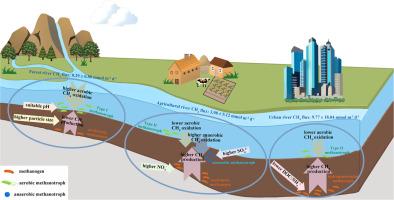
Inland rivers play a crucial role in regulating the methane (CH4) budget via microbial carbon cycling. CH4 emissions vary significantly among rivers with different land covers, yet the regulatory mechanisms of CH4-cycling microorganisms across different land covers remain less understood. This study intergrates in-situ CH4 measurements with amplicon and metagenomic sequencing to investigate CH4-cycling microbial community composition and metabolic functions in regulating CH4 emissions across rivers with different land covers. Our results show that agricultural and urban rivers significantly increase riverine CH4 emission fluxes by 14 and 34 times than forest rivers, respectively. Urban and agricultural river sediments exhibited higher methanogenic abundance, but lower methanotrophic abundance than forest river sediments. Acetoclastic methanogens dominate the methanogenic communities of agricultural rivers, enhanced by high NO3− and DOC concentrations. Furthermore, methanogenic metagenome-assembled genomes (MAGs) recovered from agricultural rivers, which affiliated to Methanosarcina, carried the complete set of genes encoding for the enzymes in acetoclastic methanogenesis. In contrast, hydrogenotrophic methanogens drive CH4 production in urban rivers, favored by low DOC: NH4+ ratios that enable methanogenesis independent of organic carbon. Lower CH4 emissions in agricultural rivers compared to urban rivers might be partly due to the greater sulfate-dependent anaerobic methane-oxidation. In forest rivers, type I methanotrophs outcompetes methanogens, aided by suitable sediment pH and larger sediment particle sizes, fostering oxic conditions that suppress CH4 emissions. This study reveals versatile microbial mechanisms underlying riverine CH4 emissions across land covers, enhancing understanding of microbial-mediated riverine CH4 cycling.
期刊介绍:
Water Research, along with its open access companion journal Water Research X, serves as a platform for publishing original research papers covering various aspects of the science and technology related to the anthropogenic water cycle, water quality, and its management worldwide. The audience targeted by the journal comprises biologists, chemical engineers, chemists, civil engineers, environmental engineers, limnologists, and microbiologists. The scope of the journal include:
•Treatment processes for water and wastewaters (municipal, agricultural, industrial, and on-site treatment), including resource recovery and residuals management;
•Urban hydrology including sewer systems, stormwater management, and green infrastructure;
•Drinking water treatment and distribution;
•Potable and non-potable water reuse;
•Sanitation, public health, and risk assessment;
•Anaerobic digestion, solid and hazardous waste management, including source characterization and the effects and control of leachates and gaseous emissions;
•Contaminants (chemical, microbial, anthropogenic particles such as nanoparticles or microplastics) and related water quality sensing, monitoring, fate, and assessment;
•Anthropogenic impacts on inland, tidal, coastal and urban waters, focusing on surface and ground waters, and point and non-point sources of pollution;
•Environmental restoration, linked to surface water, groundwater and groundwater remediation;
•Analysis of the interfaces between sediments and water, and between water and atmosphere, focusing specifically on anthropogenic impacts;
•Mathematical modelling, systems analysis, machine learning, and beneficial use of big data related to the anthropogenic water cycle;
•Socio-economic, policy, and regulations studies.




 京公网安备 11010802042870号
京ICP备2023020795号-1
京公网安备 11010802042870号
京ICP备2023020795号-1

 分享
分享
 求助内容:
求助内容: 应助结果提醒方式:
 扫码关注我们
