{"title":"Engineering 5-Enolpyruvylshikimate-3-phosphate Synthases from Halomonas sp. for Augmenting Glyphosate-Resistance without Activity Penalty","authors":"Yunhao He, Yu Hua, Xinyi Chen, Xin Zhang, Lei Lei, Yongjun Lin, Gaobing Wu","doi":"10.1021/acs.jafc.5c00610","DOIUrl":null,"url":null,"abstract":"Glyphosate nonselectively inhibits most herbaceous plants by targeting 5-enolpyruvylshikimate-3-phosphate synthase (EPSPS). Introducing glyphosate-resistant EPSPS genes into crops imparts herbicide resistance, essential for molecular breeding. In this study, we enhanced the EPSPS from <i>Halomonas</i> sp. through directed evolution. After two screening rounds, the best variant (<i>Ho</i>EPSPS-4M) with four mutations (G112A, M155 V, I285F, D326E) exhibited a 22-fold increase in glyphosate resistance (<i>k</i><sub>cat</sub>/<i>K</i><sub>m</sub> × <i>K</i><sub><i>i</i></sub>) and a 2.3-fold improvement in catalytic efficiency (<i>k</i><sub>cat</sub>/<i>K</i><sub>m</sub>). Isothermal titration calorimetry (ITC) showed a 1.7-fold reduction in glyphosate binding affinity. Molecular docking and dynamics simulations revealed that the G112A mutation at the active site decreased glyphosate binding, while distal mutations modulated enzymatic activity by altering protein dynamics and functional networks. Overexpression of <i>Ho</i>EPSPS-4 M in <i>Nicotiana benthamiana</i> conferred high glyphosate resistance, demonstrating its potential for developing herbicide-resistant crops. This work expands genetic resources for glyphosate resistance and provides insights into optimizing resistance and enzymatic efficiency by protein engineering.","PeriodicalId":41,"journal":{"name":"Journal of Agricultural and Food Chemistry","volume":"32 1","pages":""},"PeriodicalIF":6.2000,"publicationDate":"2025-04-19","publicationTypes":"Journal Article","fieldsOfStudy":null,"isOpenAccess":false,"openAccessPdf":"","citationCount":"0","resultStr":null,"platform":"Semanticscholar","paperid":null,"PeriodicalName":"Journal of Agricultural and Food Chemistry","FirstCategoryId":"97","ListUrlMain":"https://doi.org/10.1021/acs.jafc.5c00610","RegionNum":1,"RegionCategory":"农林科学","ArticlePicture":[],"TitleCN":null,"AbstractTextCN":null,"PMCID":null,"EPubDate":"","PubModel":"","JCR":"Q1","JCRName":"AGRICULTURE, MULTIDISCIPLINARY","Score":null,"Total":0}
引用次数: 0
Abstract
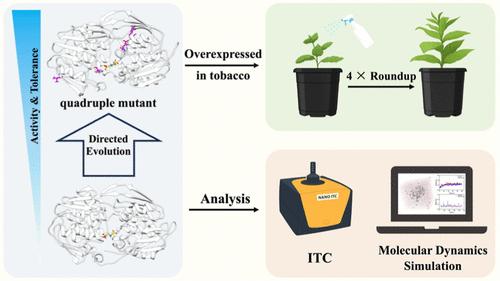
Glyphosate nonselectively inhibits most herbaceous plants by targeting 5-enolpyruvylshikimate-3-phosphate synthase (EPSPS). Introducing glyphosate-resistant EPSPS genes into crops imparts herbicide resistance, essential for molecular breeding. In this study, we enhanced the EPSPS from Halomonas sp. through directed evolution. After two screening rounds, the best variant (HoEPSPS-4M) with four mutations (G112A, M155 V, I285F, D326E) exhibited a 22-fold increase in glyphosate resistance (kcat/Km × Ki) and a 2.3-fold improvement in catalytic efficiency (kcat/Km). Isothermal titration calorimetry (ITC) showed a 1.7-fold reduction in glyphosate binding affinity. Molecular docking and dynamics simulations revealed that the G112A mutation at the active site decreased glyphosate binding, while distal mutations modulated enzymatic activity by altering protein dynamics and functional networks. Overexpression of HoEPSPS-4 M in Nicotiana benthamiana conferred high glyphosate resistance, demonstrating its potential for developing herbicide-resistant crops. This work expands genetic resources for glyphosate resistance and provides insights into optimizing resistance and enzymatic efficiency by protein engineering.
期刊介绍:
The Journal of Agricultural and Food Chemistry publishes high-quality, cutting edge original research representing complete studies and research advances dealing with the chemistry and biochemistry of agriculture and food. The Journal also encourages papers with chemistry and/or biochemistry as a major component combined with biological/sensory/nutritional/toxicological evaluation related to agriculture and/or food.



 京公网安备 11010802042870号
京ICP备2023020795号-1
京公网安备 11010802042870号
京ICP备2023020795号-1

 分享
分享
 求助内容:
求助内容: 应助结果提醒方式:
 扫码关注我们
