Ting-Ting Wen, Yu-Meng Yang, Yi-Xin Zhang, Meng-Qian Liu, Zhuo-Yu Qian, Zi-Ying Zhang, Cai-Hong Dong, Lei Sun, Lin Xu, Wen-Jing Sun, Feng-Jie Cui
{"title":"CRISPR-Cas9/Safe Harbor-Targeted Overexpression of Glucan Synthase Gene CmGls in Edible Mushroom Cordyceps militaris","authors":"Ting-Ting Wen, Yu-Meng Yang, Yi-Xin Zhang, Meng-Qian Liu, Zhuo-Yu Qian, Zi-Ying Zhang, Cai-Hong Dong, Lei Sun, Lin Xu, Wen-Jing Sun, Feng-Jie Cui","doi":"10.1021/acs.jafc.5c01310","DOIUrl":null,"url":null,"abstract":"The membrane-integrated β-1,3-glucan synthase is the key enzyme involved in the biosynthesis of the core component β-1,3-glucan of the fungal cell wall. To date, the precise and targeted insertion of the β-1,3-glucan synthase gene into the genomes of edible fungi for safe and predictable overexpression has been extremely difficult due to the large DNA sequences (>5.0 kb) encoding the multitransmembrane domains and large molecular weights. In the present study, a large 5.9 kb DNA sequence of the membrane-bound β-1,3-glucan synthase gene <i>CmGls</i> was successfully and precisely inserted at a genomic safe harbor site <i>CmSh1</i> of the <i>C. militaris</i> genome for the first time. By comparing mycelial and fermentation performance, overexpression of the β-1,3-glucan synthase gene <i>CmGls</i> resulted in rapid radial growth with a more pronounced yellowish color and increased resistance to cell wall stresses. Overexpression of <i>CmGls</i> significantly improved exopolysaccharide production with higher molecular weights, accompanied by an increase in the transcription levels of genes associated with polysaccharide/glucan synthesis, such as <i>CmPgm, CmPgi</i>, and <i>CmUgp.</i> Our findings provide convincing proof for the elucidation of glucan biosynthetic pathways and a basis for developing safe strains with highly efficient production of polysaccharides/glucans by edible fungi.","PeriodicalId":41,"journal":{"name":"Journal of Agricultural and Food Chemistry","volume":"108 1","pages":""},"PeriodicalIF":6.2000,"publicationDate":"2025-04-19","publicationTypes":"Journal Article","fieldsOfStudy":null,"isOpenAccess":false,"openAccessPdf":"","citationCount":"0","resultStr":null,"platform":"Semanticscholar","paperid":null,"PeriodicalName":"Journal of Agricultural and Food Chemistry","FirstCategoryId":"97","ListUrlMain":"https://doi.org/10.1021/acs.jafc.5c01310","RegionNum":1,"RegionCategory":"农林科学","ArticlePicture":[],"TitleCN":null,"AbstractTextCN":null,"PMCID":null,"EPubDate":"","PubModel":"","JCR":"Q1","JCRName":"AGRICULTURE, MULTIDISCIPLINARY","Score":null,"Total":0}
引用次数: 0
Abstract
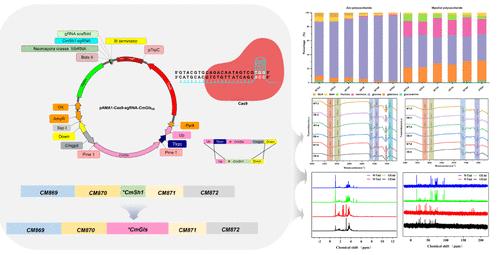
The membrane-integrated β-1,3-glucan synthase is the key enzyme involved in the biosynthesis of the core component β-1,3-glucan of the fungal cell wall. To date, the precise and targeted insertion of the β-1,3-glucan synthase gene into the genomes of edible fungi for safe and predictable overexpression has been extremely difficult due to the large DNA sequences (>5.0 kb) encoding the multitransmembrane domains and large molecular weights. In the present study, a large 5.9 kb DNA sequence of the membrane-bound β-1,3-glucan synthase gene CmGls was successfully and precisely inserted at a genomic safe harbor site CmSh1 of the C. militaris genome for the first time. By comparing mycelial and fermentation performance, overexpression of the β-1,3-glucan synthase gene CmGls resulted in rapid radial growth with a more pronounced yellowish color and increased resistance to cell wall stresses. Overexpression of CmGls significantly improved exopolysaccharide production with higher molecular weights, accompanied by an increase in the transcription levels of genes associated with polysaccharide/glucan synthesis, such as CmPgm, CmPgi, and CmUgp. Our findings provide convincing proof for the elucidation of glucan biosynthetic pathways and a basis for developing safe strains with highly efficient production of polysaccharides/glucans by edible fungi.
期刊介绍:
The Journal of Agricultural and Food Chemistry publishes high-quality, cutting edge original research representing complete studies and research advances dealing with the chemistry and biochemistry of agriculture and food. The Journal also encourages papers with chemistry and/or biochemistry as a major component combined with biological/sensory/nutritional/toxicological evaluation related to agriculture and/or food.



 京公网安备 11010802042870号
京ICP备2023020795号-1
京公网安备 11010802042870号
京ICP备2023020795号-1

 分享
分享
 求助内容:
求助内容: 应助结果提醒方式:
 扫码关注我们
