Functional Characterization of the Subtilase Gene Cg043 Downregulated by 4-Ethyl-1,2-dimethoxybenzene in the Growth and Pathogenicity of Colletotrichum gloeosporioides
{"title":"Functional Characterization of the Subtilase Gene Cg043 Downregulated by 4-Ethyl-1,2-dimethoxybenzene in the Growth and Pathogenicity of Colletotrichum gloeosporioides","authors":"Jiahao Lai, Bing Liu, Guihong Xiong, Shuilin Song, Youxin Yang, Hongyi Wei, Shuilong Xie, Junxi Jiang","doi":"10.1021/acs.jafc.5c00433","DOIUrl":null,"url":null,"abstract":"<i>Colletotrichum gloeosporioides</i>, the causative agent of anthracnose, poses a significant threat to agricultural production. Previous studies identified 4-ethyl-1,2-dimethoxybenzene as a potent antifungal compound that downregulates the expression of the subtilase gene <i>Cg043</i>, although the underlying molecular mechanism remains unclear. Here, we generated <i>Cg043</i> knockout mutants (Δ<i>Cg043</i>) and found that their sensitivity to 4-ethyl-1,2-dimethoxybenzene was significantly reduced, identifying <i>Cg043</i> as a key molecular target. Phenotypic assays and transcriptomic analyses revealed that <i>Cg043</i> downregulation inhibits hyphal growth, spore production, and germination while impairing cell wall and membrane integrity and reducing pathogenicity. Furthermore, functional verification of the signal peptide and subcellular localization analysis confirmed that Cg043 is a secreted protein specifically localized to the plant cell nucleus, suggesting its role in virulence. These findings elucidate a novel antifungal mechanism by which 4-ethyl-1,2-dimethoxybenzene suppresses the growth, development, and pathogenicity of <i>C. gloeosporioides</i> via <i>Cg043</i> downregulation, highlighting a promising molecular target for sustainable anthracnose management.","PeriodicalId":41,"journal":{"name":"Journal of Agricultural and Food Chemistry","volume":"28 1","pages":""},"PeriodicalIF":6.2000,"publicationDate":"2025-04-18","publicationTypes":"Journal Article","fieldsOfStudy":null,"isOpenAccess":false,"openAccessPdf":"","citationCount":"0","resultStr":null,"platform":"Semanticscholar","paperid":null,"PeriodicalName":"Journal of Agricultural and Food Chemistry","FirstCategoryId":"97","ListUrlMain":"https://doi.org/10.1021/acs.jafc.5c00433","RegionNum":1,"RegionCategory":"农林科学","ArticlePicture":[],"TitleCN":null,"AbstractTextCN":null,"PMCID":null,"EPubDate":"","PubModel":"","JCR":"Q1","JCRName":"AGRICULTURE, MULTIDISCIPLINARY","Score":null,"Total":0}
引用次数: 0
Abstract
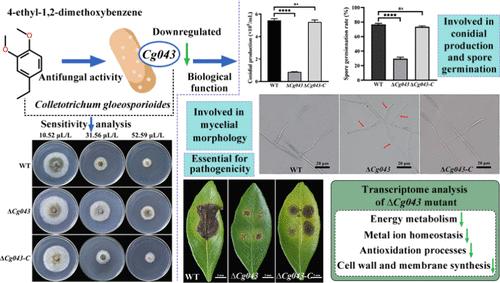
Colletotrichum gloeosporioides, the causative agent of anthracnose, poses a significant threat to agricultural production. Previous studies identified 4-ethyl-1,2-dimethoxybenzene as a potent antifungal compound that downregulates the expression of the subtilase gene Cg043, although the underlying molecular mechanism remains unclear. Here, we generated Cg043 knockout mutants (ΔCg043) and found that their sensitivity to 4-ethyl-1,2-dimethoxybenzene was significantly reduced, identifying Cg043 as a key molecular target. Phenotypic assays and transcriptomic analyses revealed that Cg043 downregulation inhibits hyphal growth, spore production, and germination while impairing cell wall and membrane integrity and reducing pathogenicity. Furthermore, functional verification of the signal peptide and subcellular localization analysis confirmed that Cg043 is a secreted protein specifically localized to the plant cell nucleus, suggesting its role in virulence. These findings elucidate a novel antifungal mechanism by which 4-ethyl-1,2-dimethoxybenzene suppresses the growth, development, and pathogenicity of C. gloeosporioides via Cg043 downregulation, highlighting a promising molecular target for sustainable anthracnose management.
期刊介绍:
The Journal of Agricultural and Food Chemistry publishes high-quality, cutting edge original research representing complete studies and research advances dealing with the chemistry and biochemistry of agriculture and food. The Journal also encourages papers with chemistry and/or biochemistry as a major component combined with biological/sensory/nutritional/toxicological evaluation related to agriculture and/or food.



 京公网安备 11010802042870号
京ICP备2023020795号-1
京公网安备 11010802042870号
京ICP备2023020795号-1

 分享
分享
 求助内容:
求助内容: 应助结果提醒方式:
 扫码关注我们
