Martin Lippmann, Moritz Hitzemann, Timo Sawatzki, Jonas Winkelholz, Alexander Nitschke, Tim Kobelt, Stefan Zimmermann
{"title":"Ion mobility spectrometer with heated sample inlet - Solution to the issue of temperature effect on resolving power","authors":"Martin Lippmann, Moritz Hitzemann, Timo Sawatzki, Jonas Winkelholz, Alexander Nitschke, Tim Kobelt, Stefan Zimmermann","doi":"10.1016/j.aca.2025.344097","DOIUrl":null,"url":null,"abstract":"<div><h3>Background</h3><div>One major challenge in detecting less volatile compounds with an ion mobility spectrometer (IMS) is preventing condensation of target molecules in the sampling line and ionization region to allow for fast response and recovery. Heating the entire device including the sampling line can of course mitigate condensation of such compounds, but this comes at the cost of reduced resolving power and compromised detection limits. Furthermore, a considerable amount of additional power and an IMS design with temperature-resistant components are needed.</div></div><div><h3>Results</h3><div>In this work, a different approach has been investigated, with a heated sample inlet in combination with a directed sample gas flow through the ionization region, but with the drift region at lower temperature. While this approach effectively addresses the issue of condensation, it results in an inhomogeneous temperature distribution within the drift region. Simulations and experimental data reveal that this uneven temperature distribution can significantly distort the peaks in the ion mobility spectrum, depending on the IMS orientation. However, positioning the IMS vertically, with the detector facing down, significantly minimizes temperature-induced peak distortion, thereby maintaining high resolving power. In this orientation, the IMS used in this work shows a resolving power of 80, while the IMS sample inlet and outlet are heated to 423 K. In addition, a directed sample gas flow in the ionization region is used to further reduce condensation in the ionization region.</div></div><div><h3>Significance and novelty</h3><div>The approach and findings revealed in this work allow the construction of IMS with a heated sample inlet to prevent condensation of less volatile compounds while also maintaining the high resolving power of a drift tube at room temperature. The results on the influence of the orientation of the IMS can also be applied to even higher temperatures.</div></div>","PeriodicalId":240,"journal":{"name":"Analytica Chimica Acta","volume":"1358 ","pages":"Article 344097"},"PeriodicalIF":6.0000,"publicationDate":"2025-07-08","publicationTypes":"Journal Article","fieldsOfStudy":null,"isOpenAccess":false,"openAccessPdf":"","citationCount":"0","resultStr":null,"platform":"Semanticscholar","paperid":null,"PeriodicalName":"Analytica Chimica Acta","FirstCategoryId":"92","ListUrlMain":"https://www.sciencedirect.com/science/article/pii/S000326702500491X","RegionNum":2,"RegionCategory":"化学","ArticlePicture":[],"TitleCN":null,"AbstractTextCN":null,"PMCID":null,"EPubDate":"2025/4/19 0:00:00","PubModel":"Epub","JCR":"Q1","JCRName":"CHEMISTRY, ANALYTICAL","Score":null,"Total":0}
引用次数: 0
Abstract
Background
One major challenge in detecting less volatile compounds with an ion mobility spectrometer (IMS) is preventing condensation of target molecules in the sampling line and ionization region to allow for fast response and recovery. Heating the entire device including the sampling line can of course mitigate condensation of such compounds, but this comes at the cost of reduced resolving power and compromised detection limits. Furthermore, a considerable amount of additional power and an IMS design with temperature-resistant components are needed.
Results
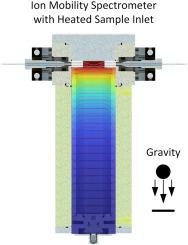
In this work, a different approach has been investigated, with a heated sample inlet in combination with a directed sample gas flow through the ionization region, but with the drift region at lower temperature. While this approach effectively addresses the issue of condensation, it results in an inhomogeneous temperature distribution within the drift region. Simulations and experimental data reveal that this uneven temperature distribution can significantly distort the peaks in the ion mobility spectrum, depending on the IMS orientation. However, positioning the IMS vertically, with the detector facing down, significantly minimizes temperature-induced peak distortion, thereby maintaining high resolving power. In this orientation, the IMS used in this work shows a resolving power of 80, while the IMS sample inlet and outlet are heated to 423 K. In addition, a directed sample gas flow in the ionization region is used to further reduce condensation in the ionization region.
Significance and novelty
The approach and findings revealed in this work allow the construction of IMS with a heated sample inlet to prevent condensation of less volatile compounds while also maintaining the high resolving power of a drift tube at room temperature. The results on the influence of the orientation of the IMS can also be applied to even higher temperatures.
期刊介绍:
Analytica Chimica Acta has an open access mirror journal Analytica Chimica Acta: X, sharing the same aims and scope, editorial team, submission system and rigorous peer review.
Analytica Chimica Acta provides a forum for the rapid publication of original research, and critical, comprehensive reviews dealing with all aspects of fundamental and applied modern analytical chemistry. The journal welcomes the submission of research papers which report studies concerning the development of new and significant analytical methodologies. In determining the suitability of submitted articles for publication, particular scrutiny will be placed on the degree of novelty and impact of the research and the extent to which it adds to the existing body of knowledge in analytical chemistry.





 京公网安备 11010802042870号
京ICP备2023020795号-1
京公网安备 11010802042870号
京ICP备2023020795号-1

 分享
分享
 求助内容:
求助内容: 应助结果提醒方式:
 扫码关注我们
