Exponential rolling circle amplification-hybridization chain reaction (EXRCA-HCR) for AgNPs@gel-enhanced fluorescence ultrasensitive detection of miRNA-21
Wenjiao Zhang , Yuchen Song , Dongmei Deng , Meiyin Liu , Huinan Chen , Wanyi Zhang , Hong Lei , Zhiguo Li , Liqiang Luo
{"title":"Exponential rolling circle amplification-hybridization chain reaction (EXRCA-HCR) for AgNPs@gel-enhanced fluorescence ultrasensitive detection of miRNA-21","authors":"Wenjiao Zhang , Yuchen Song , Dongmei Deng , Meiyin Liu , Huinan Chen , Wanyi Zhang , Hong Lei , Zhiguo Li , Liqiang Luo","doi":"10.1016/j.aca.2025.344095","DOIUrl":null,"url":null,"abstract":"<div><div>MicroRNA (miRNA) is a common tumor marker, whose abnormal expression is often closely related to the occurrence of various diseases. However, the conventional method for detecting miRNA is qRT-PCR, requiring additional reverse transcription steps, well-trained professionals, and expensive thermal cycling equipment. In this work, we propose a novel isothermal amplification technique (exponential rolling circle amplification-hybridization chain reaction, EXRCA-HCR) for AgNPs@gel-enhanced fluorescence specific and ultrasensitive detection of miRNA-21. This novel technique consists of rolling circle amplification (RCA), exponential isothermal amplification reaction (EXPAR) and hybridization chain reaction (HCR). Combining these three amplification methods, EXRCA-HCR provides a unique cascade amplification strategy, inheriting the advantages of linear amplification and exponential amplification. Under optimal conditions, this novel EXRCA-HCR exhibits a wide fluorescent detection range from 200 fM to 200 nM for miRNA-21, with low detection limit of 21.47 fM. By introducing AgNPs@gel, the fabricated paper-based fluorosensor based on EXRCA-HCR provides a simple and rapid visual detection of miRNA-21. This research puts forward a promising approach for detecting miRNA-21, which can be applied for early diagnosis.</div></div>","PeriodicalId":240,"journal":{"name":"Analytica Chimica Acta","volume":"1358 ","pages":"Article 344095"},"PeriodicalIF":6.0000,"publicationDate":"2025-07-08","publicationTypes":"Journal Article","fieldsOfStudy":null,"isOpenAccess":false,"openAccessPdf":"","citationCount":"0","resultStr":null,"platform":"Semanticscholar","paperid":null,"PeriodicalName":"Analytica Chimica Acta","FirstCategoryId":"92","ListUrlMain":"https://www.sciencedirect.com/science/article/pii/S0003267025004891","RegionNum":2,"RegionCategory":"化学","ArticlePicture":[],"TitleCN":null,"AbstractTextCN":null,"PMCID":null,"EPubDate":"2025/4/19 0:00:00","PubModel":"Epub","JCR":"Q1","JCRName":"CHEMISTRY, ANALYTICAL","Score":null,"Total":0}
引用次数: 0
Abstract
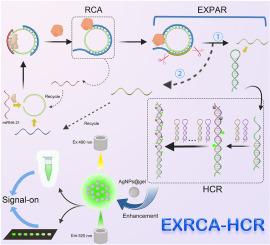
MicroRNA (miRNA) is a common tumor marker, whose abnormal expression is often closely related to the occurrence of various diseases. However, the conventional method for detecting miRNA is qRT-PCR, requiring additional reverse transcription steps, well-trained professionals, and expensive thermal cycling equipment. In this work, we propose a novel isothermal amplification technique (exponential rolling circle amplification-hybridization chain reaction, EXRCA-HCR) for AgNPs@gel-enhanced fluorescence specific and ultrasensitive detection of miRNA-21. This novel technique consists of rolling circle amplification (RCA), exponential isothermal amplification reaction (EXPAR) and hybridization chain reaction (HCR). Combining these three amplification methods, EXRCA-HCR provides a unique cascade amplification strategy, inheriting the advantages of linear amplification and exponential amplification. Under optimal conditions, this novel EXRCA-HCR exhibits a wide fluorescent detection range from 200 fM to 200 nM for miRNA-21, with low detection limit of 21.47 fM. By introducing AgNPs@gel, the fabricated paper-based fluorosensor based on EXRCA-HCR provides a simple and rapid visual detection of miRNA-21. This research puts forward a promising approach for detecting miRNA-21, which can be applied for early diagnosis.
期刊介绍:
Analytica Chimica Acta has an open access mirror journal Analytica Chimica Acta: X, sharing the same aims and scope, editorial team, submission system and rigorous peer review.
Analytica Chimica Acta provides a forum for the rapid publication of original research, and critical, comprehensive reviews dealing with all aspects of fundamental and applied modern analytical chemistry. The journal welcomes the submission of research papers which report studies concerning the development of new and significant analytical methodologies. In determining the suitability of submitted articles for publication, particular scrutiny will be placed on the degree of novelty and impact of the research and the extent to which it adds to the existing body of knowledge in analytical chemistry.





 京公网安备 11010802042870号
京ICP备2023020795号-1
京公网安备 11010802042870号
京ICP备2023020795号-1

 分享
分享
 求助内容:
求助内容: 应助结果提醒方式:
 扫码关注我们
