γ-cyclodextrin metal-organic framework-activated gold nanoclusters with water solubility as multi-enzyme mimics for simultaneous detection of pesticide and cholinesterase activity
Bing Tan , Qian Wang , Qiaoli Liu , Yimei Wu , Luyao Ban , Yingli Yan , Xiang Li , Guifen Zhu , Jing Fan , Huimin Zhao
{"title":"γ-cyclodextrin metal-organic framework-activated gold nanoclusters with water solubility as multi-enzyme mimics for simultaneous detection of pesticide and cholinesterase activity","authors":"Bing Tan , Qian Wang , Qiaoli Liu , Yimei Wu , Luyao Ban , Yingli Yan , Xiang Li , Guifen Zhu , Jing Fan , Huimin Zhao","doi":"10.1016/j.aca.2025.344093","DOIUrl":null,"url":null,"abstract":"<div><div>Cyclodextrin metal-organic framework (CD-MOF) with environmentally friendly components has attracted enormous attention in the past few decades. However, the fragile aqueous stability has limited its application in aqueous catalysis. In this work, we have devised a novel strategy to cope with the problems by introducing the well-defined gold nanoclusters (AuNCs) onto the cyclodextrin ligand through host-guest chemistry. The combination with AuNCs endowed the fragile CD-MOF with excellent multi-enzyme mimicking catalytic abilities, including peroxidase (POD), oxidase (OXD), catalase (CAT) and glucose oxidase (GOx)-mimetic activities. Furthermore, based on its intrinsic POD-like activities, by constructing the typical enzyme cascade reaction, a colorimetric sensor based on Au<sub>38</sub>/γ-CD-MOF was developed for the rapid and sensitive of carbaryl and butyrylcholinesterase (BChE) activity, respectively. In addition, combined with the smartphone, a portable paper-based sensor was developed, which could realize the on-site and semiquantitative detection of pesticide residues by identifying the RGB value. This low-cost and easy-operation portable assay shows great potential for online detection of pesticides exposure and monitoring other disease biomarkers.</div></div>","PeriodicalId":240,"journal":{"name":"Analytica Chimica Acta","volume":"1358 ","pages":"Article 344093"},"PeriodicalIF":6.0000,"publicationDate":"2025-07-08","publicationTypes":"Journal Article","fieldsOfStudy":null,"isOpenAccess":false,"openAccessPdf":"","citationCount":"0","resultStr":null,"platform":"Semanticscholar","paperid":null,"PeriodicalName":"Analytica Chimica Acta","FirstCategoryId":"92","ListUrlMain":"https://www.sciencedirect.com/science/article/pii/S0003267025004878","RegionNum":2,"RegionCategory":"化学","ArticlePicture":[],"TitleCN":null,"AbstractTextCN":null,"PMCID":null,"EPubDate":"2025/4/18 0:00:00","PubModel":"Epub","JCR":"Q1","JCRName":"CHEMISTRY, ANALYTICAL","Score":null,"Total":0}
引用次数: 0
Abstract
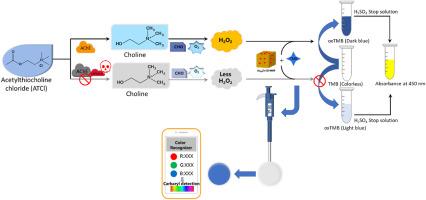
Cyclodextrin metal-organic framework (CD-MOF) with environmentally friendly components has attracted enormous attention in the past few decades. However, the fragile aqueous stability has limited its application in aqueous catalysis. In this work, we have devised a novel strategy to cope with the problems by introducing the well-defined gold nanoclusters (AuNCs) onto the cyclodextrin ligand through host-guest chemistry. The combination with AuNCs endowed the fragile CD-MOF with excellent multi-enzyme mimicking catalytic abilities, including peroxidase (POD), oxidase (OXD), catalase (CAT) and glucose oxidase (GOx)-mimetic activities. Furthermore, based on its intrinsic POD-like activities, by constructing the typical enzyme cascade reaction, a colorimetric sensor based on Au38/γ-CD-MOF was developed for the rapid and sensitive of carbaryl and butyrylcholinesterase (BChE) activity, respectively. In addition, combined with the smartphone, a portable paper-based sensor was developed, which could realize the on-site and semiquantitative detection of pesticide residues by identifying the RGB value. This low-cost and easy-operation portable assay shows great potential for online detection of pesticides exposure and monitoring other disease biomarkers.
期刊介绍:
Analytica Chimica Acta has an open access mirror journal Analytica Chimica Acta: X, sharing the same aims and scope, editorial team, submission system and rigorous peer review.
Analytica Chimica Acta provides a forum for the rapid publication of original research, and critical, comprehensive reviews dealing with all aspects of fundamental and applied modern analytical chemistry. The journal welcomes the submission of research papers which report studies concerning the development of new and significant analytical methodologies. In determining the suitability of submitted articles for publication, particular scrutiny will be placed on the degree of novelty and impact of the research and the extent to which it adds to the existing body of knowledge in analytical chemistry.





 京公网安备 11010802042870号
京ICP备2023020795号-1
京公网安备 11010802042870号
京ICP备2023020795号-1

 分享
分享
 求助内容:
求助内容: 应助结果提醒方式:
 扫码关注我们
