Spatial distribution analysis of secondary metabolites in bolted and unbolted Saposhnikovia divaricata by atmospheric pressure laser ablation carbon fiber ionization mass spectrometry imaging
Na Li , Xialian Cui , Yingjie Lu , Fang Zhang , Su Guo , Yue Su , Yinlong Guo
{"title":"Spatial distribution analysis of secondary metabolites in bolted and unbolted Saposhnikovia divaricata by atmospheric pressure laser ablation carbon fiber ionization mass spectrometry imaging","authors":"Na Li , Xialian Cui , Yingjie Lu , Fang Zhang , Su Guo , Yue Su , Yinlong Guo","doi":"10.1016/j.aca.2025.344096","DOIUrl":null,"url":null,"abstract":"<div><h3>Background</h3><div>Bolting severely affects the medicinal value and yield of <em>Saposhnikovia divaricata</em>. Currently, spatial distribution of secondary metabolites in bolted and unbolted <em>Saposhnikovia divaricata</em> remains unknown. The commercial Mass spectrometry imaging (MSI) platforms has high sensitivity to high-polar compounds, but suppresses signals of less polar compounds, generating a gap of understanding how spatial distributed of such metabolites that is less prone to ionize.</div></div><div><h3>Results</h3><div>This study developed a highly sensitive Laser Ablation Carbon Fiber Ionization (LACFI) MSI method under atmospheric pressure to achieve the spatial distribution analysis of secondary metabolites in <em>Saposhnikovia divaricata</em>, including low-polar compounds which is difficult to be analyzed in other MSI methods. The laser efficiently desorbs compounds from <em>Saposhnikovia divaricata</em> tissue, and the desorbed compounds are rapidly ionized by a carbon fiber ion source under high pressure. The desorption and ionization are performed in two separate steps, reducing the matrix effect and enhancing the ionization efficiency of compounds, which increase sensitivity. The carbon fiber has good compatibility with polar and low-polar compounds, which increases the number of detectable metabolites. The spatial distribution of secondary metabolites undergoes a shift from the unbolted to the bolted <em>Saposhnikovia divaricata</em>. The result of imaging is consistent with the conclusion of pharmacopoeia that the bolted <em>Saposhnikovia divaricata</em> is not used medicinally.</div></div><div><h3>Significance</h3><div>Compared to commercial imaging methods, the LACFI-MSI method developed is ultra-sensitive, has a greater sensitivity in the analysis of less polar compounds. Spatial distribution analysis of secondary metabolites that previously difficult/unable to detect in bolted and unbolted <em>Saposhnikovia divaricata</em> is realized.</div></div>","PeriodicalId":240,"journal":{"name":"Analytica Chimica Acta","volume":"1358 ","pages":"Article 344096"},"PeriodicalIF":6.0000,"publicationDate":"2025-07-08","publicationTypes":"Journal Article","fieldsOfStudy":null,"isOpenAccess":false,"openAccessPdf":"","citationCount":"0","resultStr":null,"platform":"Semanticscholar","paperid":null,"PeriodicalName":"Analytica Chimica Acta","FirstCategoryId":"92","ListUrlMain":"https://www.sciencedirect.com/science/article/pii/S0003267025004908","RegionNum":2,"RegionCategory":"化学","ArticlePicture":[],"TitleCN":null,"AbstractTextCN":null,"PMCID":null,"EPubDate":"2025/4/19 0:00:00","PubModel":"Epub","JCR":"Q1","JCRName":"CHEMISTRY, ANALYTICAL","Score":null,"Total":0}
引用次数: 0
Abstract
Background
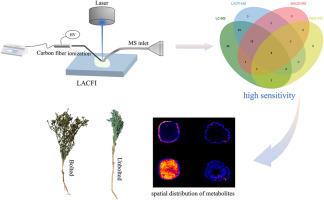
Bolting severely affects the medicinal value and yield of Saposhnikovia divaricata. Currently, spatial distribution of secondary metabolites in bolted and unbolted Saposhnikovia divaricata remains unknown. The commercial Mass spectrometry imaging (MSI) platforms has high sensitivity to high-polar compounds, but suppresses signals of less polar compounds, generating a gap of understanding how spatial distributed of such metabolites that is less prone to ionize.
Results
This study developed a highly sensitive Laser Ablation Carbon Fiber Ionization (LACFI) MSI method under atmospheric pressure to achieve the spatial distribution analysis of secondary metabolites in Saposhnikovia divaricata, including low-polar compounds which is difficult to be analyzed in other MSI methods. The laser efficiently desorbs compounds from Saposhnikovia divaricata tissue, and the desorbed compounds are rapidly ionized by a carbon fiber ion source under high pressure. The desorption and ionization are performed in two separate steps, reducing the matrix effect and enhancing the ionization efficiency of compounds, which increase sensitivity. The carbon fiber has good compatibility with polar and low-polar compounds, which increases the number of detectable metabolites. The spatial distribution of secondary metabolites undergoes a shift from the unbolted to the bolted Saposhnikovia divaricata. The result of imaging is consistent with the conclusion of pharmacopoeia that the bolted Saposhnikovia divaricata is not used medicinally.
Significance
Compared to commercial imaging methods, the LACFI-MSI method developed is ultra-sensitive, has a greater sensitivity in the analysis of less polar compounds. Spatial distribution analysis of secondary metabolites that previously difficult/unable to detect in bolted and unbolted Saposhnikovia divaricata is realized.
期刊介绍:
Analytica Chimica Acta has an open access mirror journal Analytica Chimica Acta: X, sharing the same aims and scope, editorial team, submission system and rigorous peer review.
Analytica Chimica Acta provides a forum for the rapid publication of original research, and critical, comprehensive reviews dealing with all aspects of fundamental and applied modern analytical chemistry. The journal welcomes the submission of research papers which report studies concerning the development of new and significant analytical methodologies. In determining the suitability of submitted articles for publication, particular scrutiny will be placed on the degree of novelty and impact of the research and the extent to which it adds to the existing body of knowledge in analytical chemistry.




 京公网安备 11010802042870号
京ICP备2023020795号-1
京公网安备 11010802042870号
京ICP备2023020795号-1

 分享
分享
 求助内容:
求助内容: 应助结果提醒方式:
 扫码关注我们
