A minimally instrumented method for the detection of rifampicin resistance-causing mutations in Mycobacterium tuberculosis utilizing lateral flow readout
{"title":"A minimally instrumented method for the detection of rifampicin resistance-causing mutations in Mycobacterium tuberculosis utilizing lateral flow readout","authors":"Ayushi Chauhan , S. SivaKumar , Bhushan J. Toley","doi":"10.1016/j.aca.2025.344090","DOIUrl":null,"url":null,"abstract":"<div><h3>Background</h3><div>Genotypic methods for detecting antimicrobial resistance in <em>Mycobacterium tuberculosis (M.tb)</em> typically require expensive instrumentation, limiting their accessibility in peripheral and resource-limited settings. Rifampicin resistance is a key marker of multidrug-resistant tuberculosis (MDR-TB) and is primarily caused by mutations in the <em>rpoB</em> gene. Rapid, cost-effective, and minimally instrumented methods for detecting these mutations are essential for improving tuberculosis diagnostics, particularly in low-resource environments. This study addresses the need for a simple, sensitive, and specific assay to detect the four most common rifampicin resistance-associated mutations without relying on complex laboratory infrastructure.</div></div><div><h3>Results</h3><div>We developed a minimally instrumented method to detect the four most prevalent mutations causing rifampicin resistance in <em>M.tb</em>—S531L, H526Y, H526D, and D516V. The method is based on the oligonucleotide ligation assay (OLA), coupled with lateral flow readout. The method successfully detected wild-type and mutant DNA at limits of 10 and 100 gene copies per reaction, respectively. It exhibited high sensitivity in heterozygous samples, detecting as low as 3 % mutant DNA for all four mutations. Validation with genomic DNA extracted from 29 <em>M.tb</em> isolates from the ICMR-National Institute for Research in Tuberculosis (NIRT), Chennai, India, demonstrated a sensitivity and specificity of 100 % for <em>M.tb</em> detection and 90.90 % and 100 %, respectively, for rifampicin resistance detection.</div></div><div><h3>Significance</h3><div>This method provides a cost-effective and minimally instrumented alternative to conventional genotypic resistance detection methods. Its high sensitivity and specificity, combined with its ease of adaptation to other resistance-causing mutations, make it a promising tool for tuberculosis diagnostics in resource-limited settings. By reducing reliance on expensive laboratory infrastructure, this approach could facilitate more accessible and rapid detection of drug-resistant <em>M.tb,</em> improving global TB control efforts.</div></div>","PeriodicalId":240,"journal":{"name":"Analytica Chimica Acta","volume":"1358 ","pages":"Article 344090"},"PeriodicalIF":6.0000,"publicationDate":"2025-07-08","publicationTypes":"Journal Article","fieldsOfStudy":null,"isOpenAccess":false,"openAccessPdf":"","citationCount":"0","resultStr":null,"platform":"Semanticscholar","paperid":null,"PeriodicalName":"Analytica Chimica Acta","FirstCategoryId":"92","ListUrlMain":"https://www.sciencedirect.com/science/article/pii/S0003267025004842","RegionNum":2,"RegionCategory":"化学","ArticlePicture":[],"TitleCN":null,"AbstractTextCN":null,"PMCID":null,"EPubDate":"2025/4/19 0:00:00","PubModel":"Epub","JCR":"Q1","JCRName":"CHEMISTRY, ANALYTICAL","Score":null,"Total":0}
引用次数: 0
Abstract
Background
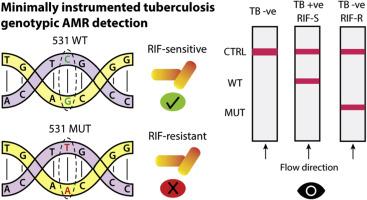
Genotypic methods for detecting antimicrobial resistance in Mycobacterium tuberculosis (M.tb) typically require expensive instrumentation, limiting their accessibility in peripheral and resource-limited settings. Rifampicin resistance is a key marker of multidrug-resistant tuberculosis (MDR-TB) and is primarily caused by mutations in the rpoB gene. Rapid, cost-effective, and minimally instrumented methods for detecting these mutations are essential for improving tuberculosis diagnostics, particularly in low-resource environments. This study addresses the need for a simple, sensitive, and specific assay to detect the four most common rifampicin resistance-associated mutations without relying on complex laboratory infrastructure.
Results
We developed a minimally instrumented method to detect the four most prevalent mutations causing rifampicin resistance in M.tb—S531L, H526Y, H526D, and D516V. The method is based on the oligonucleotide ligation assay (OLA), coupled with lateral flow readout. The method successfully detected wild-type and mutant DNA at limits of 10 and 100 gene copies per reaction, respectively. It exhibited high sensitivity in heterozygous samples, detecting as low as 3 % mutant DNA for all four mutations. Validation with genomic DNA extracted from 29 M.tb isolates from the ICMR-National Institute for Research in Tuberculosis (NIRT), Chennai, India, demonstrated a sensitivity and specificity of 100 % for M.tb detection and 90.90 % and 100 %, respectively, for rifampicin resistance detection.
Significance
This method provides a cost-effective and minimally instrumented alternative to conventional genotypic resistance detection methods. Its high sensitivity and specificity, combined with its ease of adaptation to other resistance-causing mutations, make it a promising tool for tuberculosis diagnostics in resource-limited settings. By reducing reliance on expensive laboratory infrastructure, this approach could facilitate more accessible and rapid detection of drug-resistant M.tb, improving global TB control efforts.
期刊介绍:
Analytica Chimica Acta has an open access mirror journal Analytica Chimica Acta: X, sharing the same aims and scope, editorial team, submission system and rigorous peer review.
Analytica Chimica Acta provides a forum for the rapid publication of original research, and critical, comprehensive reviews dealing with all aspects of fundamental and applied modern analytical chemistry. The journal welcomes the submission of research papers which report studies concerning the development of new and significant analytical methodologies. In determining the suitability of submitted articles for publication, particular scrutiny will be placed on the degree of novelty and impact of the research and the extent to which it adds to the existing body of knowledge in analytical chemistry.




 京公网安备 11010802042870号
京ICP备2023020795号-1
京公网安备 11010802042870号
京ICP备2023020795号-1

 分享
分享
 求助内容:
求助内容: 应助结果提醒方式:
 扫码关注我们
