{"title":"Deuterium stress Reprograms Chlorella sorokiniana Metabolism: Coupling photosynthetic suppression with carbon Reserve Surge","authors":"Tianfei Li, Yixian He, Shanni Ke, Zexia Cai, Zhuo Jiang","doi":"10.1016/j.biortech.2025.132548","DOIUrl":null,"url":null,"abstract":"<div><div>Microalgae convert inorganic substrates into stable isotope-labeled compounds, ideal for deuterated compound production. However, the mechanism by which deuterium affects the growth and metabolism of microalgae remains unclear. This study aims to reveal the effects of deuterium on the growth and metabolic processes of <em>Chlorella sorokiniana</em> and to clarify the interaction between them. After deuterium treatment, cell growth and the accumulation of photosynthetic pigments were significantly inhibited, leading to reduced photosynthetic efficiency and blocked energy transfer. Under 100% D<sub>2</sub>O conditions, the accumulation of starch and lipids was enhanced, with starch content reaching up to 52% of dry cell weight and lipid content reaching 22%. Transcriptomics revealed deuterium stress inhibited photosynthesis-related genes while upregulating pathways for starch, fatty acid, and nucleic acid synthesis. These findings reveal the adaptation mechanism of microalgae to deuterium treatment and provide valuable insights for the utilization of microalgae in the production of deuterated organic compounds.</div></div>","PeriodicalId":258,"journal":{"name":"Bioresource Technology","volume":"430 ","pages":"Article 132548"},"PeriodicalIF":9.0000,"publicationDate":"2025-08-01","publicationTypes":"Journal Article","fieldsOfStudy":null,"isOpenAccess":false,"openAccessPdf":"","citationCount":"0","resultStr":null,"platform":"Semanticscholar","paperid":null,"PeriodicalName":"Bioresource Technology","FirstCategoryId":"5","ListUrlMain":"https://www.sciencedirect.com/science/article/pii/S0960852425005140","RegionNum":1,"RegionCategory":"环境科学与生态学","ArticlePicture":[],"TitleCN":null,"AbstractTextCN":null,"PMCID":null,"EPubDate":"2025/4/14 0:00:00","PubModel":"Epub","JCR":"Q1","JCRName":"AGRICULTURAL ENGINEERING","Score":null,"Total":0}
引用次数: 0
Abstract
Microalgae convert inorganic substrates into stable isotope-labeled compounds, ideal for deuterated compound production. However, the mechanism by which deuterium affects the growth and metabolism of microalgae remains unclear. This study aims to reveal the effects of deuterium on the growth and metabolic processes of Chlorella sorokiniana and to clarify the interaction between them. After deuterium treatment, cell growth and the accumulation of photosynthetic pigments were significantly inhibited, leading to reduced photosynthetic efficiency and blocked energy transfer. Under 100% D2O conditions, the accumulation of starch and lipids was enhanced, with starch content reaching up to 52% of dry cell weight and lipid content reaching 22%. Transcriptomics revealed deuterium stress inhibited photosynthesis-related genes while upregulating pathways for starch, fatty acid, and nucleic acid synthesis. These findings reveal the adaptation mechanism of microalgae to deuterium treatment and provide valuable insights for the utilization of microalgae in the production of deuterated organic compounds.
期刊介绍:
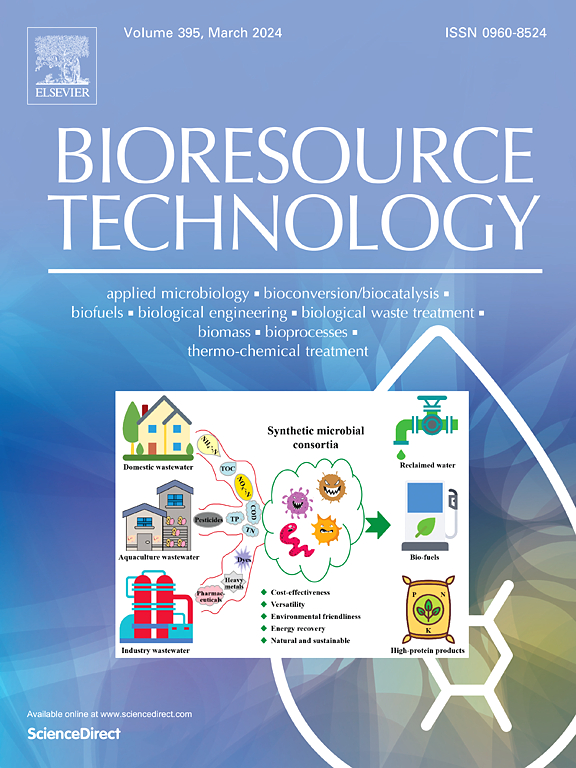
Bioresource Technology publishes original articles, review articles, case studies, and short communications covering the fundamentals, applications, and management of bioresource technology. The journal seeks to advance and disseminate knowledge across various areas related to biomass, biological waste treatment, bioenergy, biotransformations, bioresource systems analysis, and associated conversion or production technologies.
Topics include:
• Biofuels: liquid and gaseous biofuels production, modeling and economics
• Bioprocesses and bioproducts: biocatalysis and fermentations
• Biomass and feedstocks utilization: bioconversion of agro-industrial residues
• Environmental protection: biological waste treatment
• Thermochemical conversion of biomass: combustion, pyrolysis, gasification, catalysis.




 京公网安备 11010802042870号
京ICP备2023020795号-1
京公网安备 11010802042870号
京ICP备2023020795号-1

 分享
分享
 求助内容:
求助内容: 应助结果提醒方式:
 扫码关注我们
