Jun Gao , Qi Mang , Quanjie Li , Yi Sun , Gangchun Xu
{"title":"Microbial-algal symbiotic system drives reconstruction of nitrogen, phosphorus, and methane cycles for purification of pollutants in aquaculture water","authors":"Jun Gao , Qi Mang , Quanjie Li , Yi Sun , Gangchun Xu","doi":"10.1016/j.biortech.2025.132531","DOIUrl":null,"url":null,"abstract":"<div><div>Intensive aquaculture’s excessive nitrogen, phosphorus, and methane emissions caused environmental degradation. This study explored how algae-bacteria symbiotic systems (ABSS) enhanced water purification by regulating element cycles. We established a <em>Chlorella pyrenoidosa</em>-<em>Bacillus subtilis</em> symbiotic system. At a 1:1 bacteria-to-algae ratio, chlorophyll <em>a</em> and cell dry weight were highest. <em>C. pyrenoidosa</em> supplied organic acids, carbohydrates, and amino acids to <em>B. subtilis</em>, which reciprocated with amino acids, purines, and vitamins. ABSS significantly reduced total nitrogen, ammonia nitrogen (NH<sub>4</sub><sup>+</sup>-N), nitrite (NO<sub>2</sub><sup>−</sup>-N), nitrate (NO<sub>3</sub><sup>−</sup>-N), phosphate (PO<sub>4</sub><sup>3−</sup>-P), total phosphorous, dissolved organic carbon, and chemical oxygen demand in aquaculture water. It reshaped microbial communities and enriched key genus (<em>Limnohabitans</em>, <em>Planktophila</em>, <em>Polaromonas</em>, <em>Methylocystis</em>) and upregulating genes linked to organic phosphate mineralization, methane oxidation, and nitrate reduction. These changes strengthened nitrogen-phosphorus-methane cycle coupling, boosting water purification. ABSS offers an eco-engineering solution for aquaculture pollution by optimizing microbial interactions and nutrient cycling.</div></div>","PeriodicalId":258,"journal":{"name":"Bioresource Technology","volume":"430 ","pages":"Article 132531"},"PeriodicalIF":9.0000,"publicationDate":"2025-08-01","publicationTypes":"Journal Article","fieldsOfStudy":null,"isOpenAccess":false,"openAccessPdf":"","citationCount":"0","resultStr":null,"platform":"Semanticscholar","paperid":null,"PeriodicalName":"Bioresource Technology","FirstCategoryId":"5","ListUrlMain":"https://www.sciencedirect.com/science/article/pii/S0960852425004973","RegionNum":1,"RegionCategory":"环境科学与生态学","ArticlePicture":[],"TitleCN":null,"AbstractTextCN":null,"PMCID":null,"EPubDate":"2025/4/14 0:00:00","PubModel":"Epub","JCR":"Q1","JCRName":"AGRICULTURAL ENGINEERING","Score":null,"Total":0}
引用次数: 0
Abstract
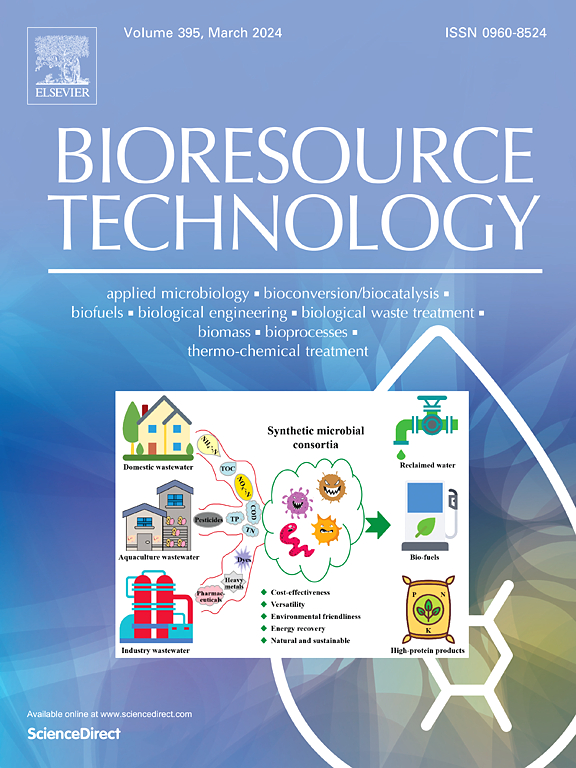
Intensive aquaculture’s excessive nitrogen, phosphorus, and methane emissions caused environmental degradation. This study explored how algae-bacteria symbiotic systems (ABSS) enhanced water purification by regulating element cycles. We established a Chlorella pyrenoidosa-Bacillus subtilis symbiotic system. At a 1:1 bacteria-to-algae ratio, chlorophyll a and cell dry weight were highest. C. pyrenoidosa supplied organic acids, carbohydrates, and amino acids to B. subtilis, which reciprocated with amino acids, purines, and vitamins. ABSS significantly reduced total nitrogen, ammonia nitrogen (NH4+-N), nitrite (NO2−-N), nitrate (NO3−-N), phosphate (PO43−-P), total phosphorous, dissolved organic carbon, and chemical oxygen demand in aquaculture water. It reshaped microbial communities and enriched key genus (Limnohabitans, Planktophila, Polaromonas, Methylocystis) and upregulating genes linked to organic phosphate mineralization, methane oxidation, and nitrate reduction. These changes strengthened nitrogen-phosphorus-methane cycle coupling, boosting water purification. ABSS offers an eco-engineering solution for aquaculture pollution by optimizing microbial interactions and nutrient cycling.
期刊介绍:
Bioresource Technology publishes original articles, review articles, case studies, and short communications covering the fundamentals, applications, and management of bioresource technology. The journal seeks to advance and disseminate knowledge across various areas related to biomass, biological waste treatment, bioenergy, biotransformations, bioresource systems analysis, and associated conversion or production technologies.
Topics include:
• Biofuels: liquid and gaseous biofuels production, modeling and economics
• Bioprocesses and bioproducts: biocatalysis and fermentations
• Biomass and feedstocks utilization: bioconversion of agro-industrial residues
• Environmental protection: biological waste treatment
• Thermochemical conversion of biomass: combustion, pyrolysis, gasification, catalysis.



 京公网安备 11010802042870号
京ICP备2023020795号-1
京公网安备 11010802042870号
京ICP备2023020795号-1

 分享
分享
 求助内容:
求助内容: 应助结果提醒方式:
 扫码关注我们
