Xinru Wang , Wenwen Fan , Chengmin Zha , Zihan Wang , Jiawei Yu , Luchao Wu , Xinzhong Zhang , Fengjian Luo , Zongmao Chen , Li Zhou
{"title":"Occurrence, fate and dietary risk assessment of pesticides in chrysanthemum from garden to cup","authors":"Xinru Wang , Wenwen Fan , Chengmin Zha , Zihan Wang , Jiawei Yu , Luchao Wu , Xinzhong Zhang , Fengjian Luo , Zongmao Chen , Li Zhou","doi":"10.1016/j.jhazmat.2025.138363","DOIUrl":null,"url":null,"abstract":"<div><div>As a popular beverage with an integration property of medicine, chrysanthemum industry has exhibited a significant increase in production and consumption in recent years. However, pesticide residues have emerged as a critical concern threatening the sustainable development of the chrysanthemum industry. In this study, based on an analysis of pesticide occurrence of 111 market chrysanthemum products from China, 17 pesticides with high detection frequencies and residue levels were selected to investigate their fate and exposure risks across the chrysanthemum production chain. Field dissipation experiments revealed first-order kinetics for all target pesticides, with half-lives ranging from 0.8 to 8.8 days after foliar application. During chrysanthemum manufacturing, pesticides showed a significant concentration, significantly correlated with the hydrophobicity (logKow) and water solubility (Ws) of the pesticides. Drying was identified as the pivotal step determining the pesticide residue retention in final products. Brewing step resulted 0.5–112.3 % residue transfer of the pesticides from dry chrysanthemum to infusion, positively related with Ws. Combined risk assessment indicated an acceptable health risk by chrysanthemum consumption. Data from this study provide insights into the fate of pesticides during chrysanthemum production chain, promoting a rational and scientific use of pesticides to ensure product safety and industry sustainability.</div></div>","PeriodicalId":361,"journal":{"name":"Journal of Hazardous Materials","volume":"493 ","pages":"Article 138363"},"PeriodicalIF":11.3000,"publicationDate":"2025-08-05","publicationTypes":"Journal Article","fieldsOfStudy":null,"isOpenAccess":false,"openAccessPdf":"","citationCount":"0","resultStr":null,"platform":"Semanticscholar","paperid":null,"PeriodicalName":"Journal of Hazardous Materials","FirstCategoryId":"93","ListUrlMain":"https://www.sciencedirect.com/science/article/pii/S0304389425012786","RegionNum":1,"RegionCategory":"环境科学与生态学","ArticlePicture":[],"TitleCN":null,"AbstractTextCN":null,"PMCID":null,"EPubDate":"2025/4/21 0:00:00","PubModel":"Epub","JCR":"Q1","JCRName":"ENGINEERING, ENVIRONMENTAL","Score":null,"Total":0}
引用次数: 0
Abstract
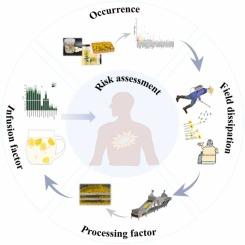
As a popular beverage with an integration property of medicine, chrysanthemum industry has exhibited a significant increase in production and consumption in recent years. However, pesticide residues have emerged as a critical concern threatening the sustainable development of the chrysanthemum industry. In this study, based on an analysis of pesticide occurrence of 111 market chrysanthemum products from China, 17 pesticides with high detection frequencies and residue levels were selected to investigate their fate and exposure risks across the chrysanthemum production chain. Field dissipation experiments revealed first-order kinetics for all target pesticides, with half-lives ranging from 0.8 to 8.8 days after foliar application. During chrysanthemum manufacturing, pesticides showed a significant concentration, significantly correlated with the hydrophobicity (logKow) and water solubility (Ws) of the pesticides. Drying was identified as the pivotal step determining the pesticide residue retention in final products. Brewing step resulted 0.5–112.3 % residue transfer of the pesticides from dry chrysanthemum to infusion, positively related with Ws. Combined risk assessment indicated an acceptable health risk by chrysanthemum consumption. Data from this study provide insights into the fate of pesticides during chrysanthemum production chain, promoting a rational and scientific use of pesticides to ensure product safety and industry sustainability.
期刊介绍:
The Journal of Hazardous Materials serves as a global platform for promoting cutting-edge research in the field of Environmental Science and Engineering. Our publication features a wide range of articles, including full-length research papers, review articles, and perspectives, with the aim of enhancing our understanding of the dangers and risks associated with various materials concerning public health and the environment. It is important to note that the term "environmental contaminants" refers specifically to substances that pose hazardous effects through contamination, while excluding those that do not have such impacts on the environment or human health. Moreover, we emphasize the distinction between wastes and hazardous materials in order to provide further clarity on the scope of the journal. We have a keen interest in exploring specific compounds and microbial agents that have adverse effects on the environment.



 京公网安备 11010802042870号
京ICP备2023020795号-1
京公网安备 11010802042870号
京ICP备2023020795号-1

 分享
分享
 求助内容:
求助内容: 应助结果提醒方式:
 扫码关注我们
