Zheqiong Fan , Cong Chen , Fenghong Li , Chaozong Liu , Bo Liu , Zhihui Zhang
{"title":"Catalyst-free synthesis and deposition mechanism of vertically oriented graphene on aluminum foil using PECVD","authors":"Zheqiong Fan , Cong Chen , Fenghong Li , Chaozong Liu , Bo Liu , Zhihui Zhang","doi":"10.1016/j.apsusc.2025.163314","DOIUrl":null,"url":null,"abstract":"<div><div>The catalyst-free growth of vertically oriented graphene (VG) networks with growth rate of about 5 nm/min on commercial aluminum (Al) foil via radio frequency plasma-enhanced chemical vapor deposition (RF-PECVD) is reported. The effects of process parameters, including precursor type and deposition temperature, on VG synthesis were systematically investigated. The deposition temperature plays a decisive role in the formation of VGs, while the precursor primarily influences growth rate and crystallinity. VGs were synthesized using either ethylene (C<sub>2</sub>H<sub>4</sub>) or propylene (C<sub>3</sub>H<sub>6</sub>) as precursors, but formation does not occur at lower temperatures (e.g., 500 °C). Precursors that effectively generate carbon dimers and exhibit a higher H:C ratio are more favorable for achieving VGs with high growth rates and superior crystallinity. Furthermore, we proposed a deposition mechanism that encompasses both the growth of VGs on the Al foil surface and the diffusion of carbon atoms into the Al foil. The growth process of VGs follows three distinct stages: the formation of buffer carbon nanoislands, nucleation, and subsequent growth. X-ray photoelectron spectroscopy (XPS) revealed the chemical interactions between carbon, Al<sub>x</sub>O<sub>y</sub>, and metallic Al at the interface, resulting in a diffusion layer and an interface layer between the VG layer and the underlying Al substrate.</div></div>","PeriodicalId":247,"journal":{"name":"Applied Surface Science","volume":"701 ","pages":"Article 163314"},"PeriodicalIF":6.9000,"publicationDate":"2025-08-30","publicationTypes":"Journal Article","fieldsOfStudy":null,"isOpenAccess":false,"openAccessPdf":"","citationCount":"0","resultStr":null,"platform":"Semanticscholar","paperid":null,"PeriodicalName":"Applied Surface Science","FirstCategoryId":"88","ListUrlMain":"https://www.sciencedirect.com/science/article/pii/S0169433225010281","RegionNum":2,"RegionCategory":"材料科学","ArticlePicture":[],"TitleCN":null,"AbstractTextCN":null,"PMCID":null,"EPubDate":"2025/4/20 0:00:00","PubModel":"Epub","JCR":"Q2","JCRName":"CHEMISTRY, PHYSICAL","Score":null,"Total":0}
引用次数: 0
Abstract
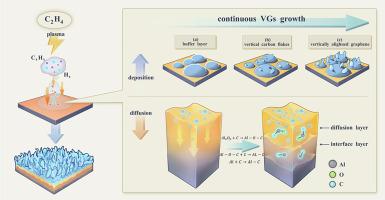
The catalyst-free growth of vertically oriented graphene (VG) networks with growth rate of about 5 nm/min on commercial aluminum (Al) foil via radio frequency plasma-enhanced chemical vapor deposition (RF-PECVD) is reported. The effects of process parameters, including precursor type and deposition temperature, on VG synthesis were systematically investigated. The deposition temperature plays a decisive role in the formation of VGs, while the precursor primarily influences growth rate and crystallinity. VGs were synthesized using either ethylene (C2H4) or propylene (C3H6) as precursors, but formation does not occur at lower temperatures (e.g., 500 °C). Precursors that effectively generate carbon dimers and exhibit a higher H:C ratio are more favorable for achieving VGs with high growth rates and superior crystallinity. Furthermore, we proposed a deposition mechanism that encompasses both the growth of VGs on the Al foil surface and the diffusion of carbon atoms into the Al foil. The growth process of VGs follows three distinct stages: the formation of buffer carbon nanoislands, nucleation, and subsequent growth. X-ray photoelectron spectroscopy (XPS) revealed the chemical interactions between carbon, AlxOy, and metallic Al at the interface, resulting in a diffusion layer and an interface layer between the VG layer and the underlying Al substrate.
期刊介绍:
Applied Surface Science covers topics contributing to a better understanding of surfaces, interfaces, nanostructures and their applications. The journal is concerned with scientific research on the atomic and molecular level of material properties determined with specific surface analytical techniques and/or computational methods, as well as the processing of such structures.




 京公网安备 11010802042870号
京ICP备2023020795号-1
京公网安备 11010802042870号
京ICP备2023020795号-1

 分享
分享
 求助内容:
求助内容: 应助结果提醒方式:
 扫码关注我们
