Wenting Li , Wei Kang , Chengan Ye , Nina Wu , Feihong Wang , Huan Pang
{"title":"Zirconium-based MOF/MXene aerogel composite for highly stable and selective capture of uranium from aqueous solution","authors":"Wenting Li , Wei Kang , Chengan Ye , Nina Wu , Feihong Wang , Huan Pang","doi":"10.1016/j.apsusc.2025.163323","DOIUrl":null,"url":null,"abstract":"<div><div>Excessive discharge of uranyl ion (U(VI)-containing) wastewater poses significant environmental and human health risks due to radiological contamination. In this study, a metal–organic framework (MOF) exhibiting aerogel-like properties was synthesized by combining UiO-66-NH<sub>2</sub> with MXene through a freeze-drying process. The research focused on the removal of U(VI) from aqueous solutions with this aerogel material. The adsorption isotherm was consistent with the Langmuir model, and the maximum adsorption capacity was determined to be 229.1 mg∙g<sup>−1</sup>. The aerogel-like MOF possesses a mesoporous structure, enhancing its U(VI) adsorption efficiency while enabling easy separation and maintaining structural integrity afterward. In cyclic adsorption–desorption experiments conducted over five cycles, the UiO-66-NH<sub>2</sub>/MXene adsorbent demonstrated a U(VI) removal efficiency exceeding 96 %. Overall, the aerogel-like MOF demonstrates outstanding U(VI) adsorption capacity and shows promise as an effective capacitive deionization (CDI) electrode for mitigating radiological contamination.</div></div>","PeriodicalId":247,"journal":{"name":"Applied Surface Science","volume":"702 ","pages":"Article 163323"},"PeriodicalIF":6.9000,"publicationDate":"2025-09-01","publicationTypes":"Journal Article","fieldsOfStudy":null,"isOpenAccess":false,"openAccessPdf":"","citationCount":"0","resultStr":null,"platform":"Semanticscholar","paperid":null,"PeriodicalName":"Applied Surface Science","FirstCategoryId":"88","ListUrlMain":"https://www.sciencedirect.com/science/article/pii/S0169433225010372","RegionNum":2,"RegionCategory":"材料科学","ArticlePicture":[],"TitleCN":null,"AbstractTextCN":null,"PMCID":null,"EPubDate":"2025/4/20 0:00:00","PubModel":"Epub","JCR":"Q2","JCRName":"CHEMISTRY, PHYSICAL","Score":null,"Total":0}
引用次数: 0
Abstract
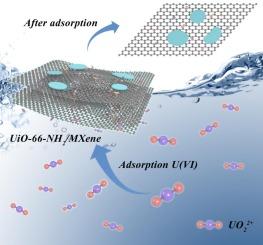
Excessive discharge of uranyl ion (U(VI)-containing) wastewater poses significant environmental and human health risks due to radiological contamination. In this study, a metal–organic framework (MOF) exhibiting aerogel-like properties was synthesized by combining UiO-66-NH2 with MXene through a freeze-drying process. The research focused on the removal of U(VI) from aqueous solutions with this aerogel material. The adsorption isotherm was consistent with the Langmuir model, and the maximum adsorption capacity was determined to be 229.1 mg∙g−1. The aerogel-like MOF possesses a mesoporous structure, enhancing its U(VI) adsorption efficiency while enabling easy separation and maintaining structural integrity afterward. In cyclic adsorption–desorption experiments conducted over five cycles, the UiO-66-NH2/MXene adsorbent demonstrated a U(VI) removal efficiency exceeding 96 %. Overall, the aerogel-like MOF demonstrates outstanding U(VI) adsorption capacity and shows promise as an effective capacitive deionization (CDI) electrode for mitigating radiological contamination.
期刊介绍:
Applied Surface Science covers topics contributing to a better understanding of surfaces, interfaces, nanostructures and their applications. The journal is concerned with scientific research on the atomic and molecular level of material properties determined with specific surface analytical techniques and/or computational methods, as well as the processing of such structures.




 京公网安备 11010802042870号
京ICP备2023020795号-1
京公网安备 11010802042870号
京ICP备2023020795号-1

 分享
分享
 求助内容:
求助内容: 应助结果提醒方式:
 扫码关注我们
