{"title":"Forest productivity response to elevated CO2 in free-air CO2 enrichment experiments: the 23 percent solution, revisited","authors":"Richard J. Norby","doi":"10.1111/nph.70162","DOIUrl":null,"url":null,"abstract":"<p>A synthesis of free-air CO<sub>2</sub> enrichment (FACE) experiments describing the response of forest net primary productivity (NPP) to elevated atmospheric CO<sub>2</sub> published in 2005 has provided a valuable benchmark for ecosystem models used to address the impact of future atmospheric CO<sub>2</sub> levels on forest productivity and the feedback to the atmosphere and climate change. However, that analysis was limited to young, temperate zone tree plantations, and its applicability to other biomes can be questioned. Now, after 20 years, this new analysis includes two sites in much older, mature forests and expanded and updated analyses from the original sites. The original conclusion from 2005 remains valid with only a minor modification. After normalizing to a common CO<sub>2</sub> enrichment of 41%, NPP increased 21.8% in elevated CO<sub>2</sub> across a wide range of forest productivity. The response declined with increasing mean annual temperature, but did not decline with forest age as expected. The response of wood production (18.2%) was somewhat less than that of NPP, but there was no evidence of a CO<sub>2</sub> effect on carbon allocation between long- and short-term carbon pools. This analysis should inform and generate testable hypotheses for new FACE experiments such as the AmazonFACE experiment in a tropical forest.</p>","PeriodicalId":214,"journal":{"name":"New Phytologist","volume":"246 5","pages":"1952-1959"},"PeriodicalIF":8.1000,"publicationDate":"2025-04-20","publicationTypes":"Journal Article","fieldsOfStudy":null,"isOpenAccess":false,"openAccessPdf":"https://onlinelibrary.wiley.com/doi/epdf/10.1111/nph.70162","citationCount":"0","resultStr":null,"platform":"Semanticscholar","paperid":null,"PeriodicalName":"New Phytologist","FirstCategoryId":"99","ListUrlMain":"https://nph.onlinelibrary.wiley.com/doi/10.1111/nph.70162","RegionNum":1,"RegionCategory":"生物学","ArticlePicture":[],"TitleCN":null,"AbstractTextCN":null,"PMCID":null,"EPubDate":"","PubModel":"","JCR":"Q1","JCRName":"PLANT SCIENCES","Score":null,"Total":0}
引用次数: 0
Abstract
A synthesis of free-air CO2 enrichment (FACE) experiments describing the response of forest net primary productivity (NPP) to elevated atmospheric CO2 published in 2005 has provided a valuable benchmark for ecosystem models used to address the impact of future atmospheric CO2 levels on forest productivity and the feedback to the atmosphere and climate change. However, that analysis was limited to young, temperate zone tree plantations, and its applicability to other biomes can be questioned. Now, after 20 years, this new analysis includes two sites in much older, mature forests and expanded and updated analyses from the original sites. The original conclusion from 2005 remains valid with only a minor modification. After normalizing to a common CO2 enrichment of 41%, NPP increased 21.8% in elevated CO2 across a wide range of forest productivity. The response declined with increasing mean annual temperature, but did not decline with forest age as expected. The response of wood production (18.2%) was somewhat less than that of NPP, but there was no evidence of a CO2 effect on carbon allocation between long- and short-term carbon pools. This analysis should inform and generate testable hypotheses for new FACE experiments such as the AmazonFACE experiment in a tropical forest.
期刊介绍:
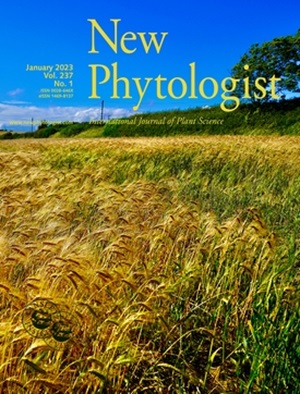
New Phytologist is an international electronic journal published 24 times a year. It is owned by the New Phytologist Foundation, a non-profit-making charitable organization dedicated to promoting plant science. The journal publishes excellent, novel, rigorous, and timely research and scholarship in plant science and its applications. The articles cover topics in five sections: Physiology & Development, Environment, Interaction, Evolution, and Transformative Plant Biotechnology. These sections encompass intracellular processes, global environmental change, and encourage cross-disciplinary approaches. The journal recognizes the use of techniques from molecular and cell biology, functional genomics, modeling, and system-based approaches in plant science. Abstracting and Indexing Information for New Phytologist includes Academic Search, AgBiotech News & Information, Agroforestry Abstracts, Biochemistry & Biophysics Citation Index, Botanical Pesticides, CAB Abstracts®, Environment Index, Global Health, and Plant Breeding Abstracts, and others.





 京公网安备 11010802042870号
京ICP备2023020795号-1
京公网安备 11010802042870号
京ICP备2023020795号-1

 分享
分享
 求助内容:
求助内容: 应助结果提醒方式:
 扫码关注我们
