Tsunetoshi Nakatani, Tamas Schauer, Mrinmoy Pal, Andreas Ettinger, Luis Altamirano-Pacheco, Julia Zorn, David M. Gilbert, Maria-Elena Torres-Padilla
{"title":"RIF1 controls replication timing in early mouse embryos independently of lamina-associated nuclear organization","authors":"Tsunetoshi Nakatani, Tamas Schauer, Mrinmoy Pal, Andreas Ettinger, Luis Altamirano-Pacheco, Julia Zorn, David M. Gilbert, Maria-Elena Torres-Padilla","doi":"10.1016/j.devcel.2025.03.016","DOIUrl":null,"url":null,"abstract":"Cells must duplicate their genome before they divide to ensure equal transmission of genetic information. The genome is replicated with a defined temporal order, replication timing (RT), which is cell-type specific and linked to 3D-genome organization. During mammalian development, RT is initially not well defined and becomes progressively consolidated from the 4-cell stage. However, the molecular regulators are unknown. Here, by combining loss-of-function analysis with genome-wide investigation of RT in mouse embryos, we identify Rap1 interacting factor 1 (RIF1) as a regulator of the progressive consolidation of RT. Embryos without RIF1 show DNA replication features of an early, more totipotent state. RIF1 regulates the progressive stratification of RT values and its depletion leads to global RT changes and a more heterogeneous RT program. Developmental RT changes are disentangled from changes in transcription and nuclear organization, specifically nuclear lamina association. Our work provides molecular understanding of replication and genome organization at the beginning of mammalian development.","PeriodicalId":11157,"journal":{"name":"Developmental cell","volume":"108 1","pages":""},"PeriodicalIF":8.7000,"publicationDate":"2025-04-21","publicationTypes":"Journal Article","fieldsOfStudy":null,"isOpenAccess":false,"openAccessPdf":"","citationCount":"0","resultStr":null,"platform":"Semanticscholar","paperid":null,"PeriodicalName":"Developmental cell","FirstCategoryId":"99","ListUrlMain":"https://doi.org/10.1016/j.devcel.2025.03.016","RegionNum":1,"RegionCategory":"生物学","ArticlePicture":[],"TitleCN":null,"AbstractTextCN":null,"PMCID":null,"EPubDate":"","PubModel":"","JCR":"Q1","JCRName":"CELL BIOLOGY","Score":null,"Total":0}
引用次数: 0
Abstract
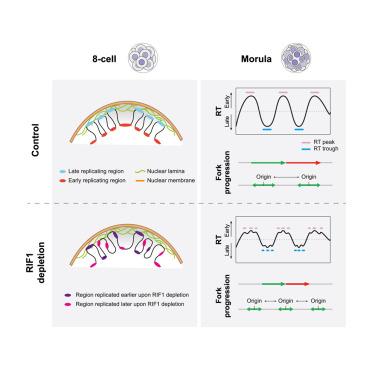
Cells must duplicate their genome before they divide to ensure equal transmission of genetic information. The genome is replicated with a defined temporal order, replication timing (RT), which is cell-type specific and linked to 3D-genome organization. During mammalian development, RT is initially not well defined and becomes progressively consolidated from the 4-cell stage. However, the molecular regulators are unknown. Here, by combining loss-of-function analysis with genome-wide investigation of RT in mouse embryos, we identify Rap1 interacting factor 1 (RIF1) as a regulator of the progressive consolidation of RT. Embryos without RIF1 show DNA replication features of an early, more totipotent state. RIF1 regulates the progressive stratification of RT values and its depletion leads to global RT changes and a more heterogeneous RT program. Developmental RT changes are disentangled from changes in transcription and nuclear organization, specifically nuclear lamina association. Our work provides molecular understanding of replication and genome organization at the beginning of mammalian development.
期刊介绍:
Developmental Cell, established in 2001, is a comprehensive journal that explores a wide range of topics in cell and developmental biology. Our publication encompasses work across various disciplines within biology, with a particular emphasis on investigating the intersections between cell biology, developmental biology, and other related fields. Our primary objective is to present research conducted through a cell biological perspective, addressing the essential mechanisms governing cell function, cellular interactions, and responses to the environment. Moreover, we focus on understanding the collective behavior of cells, culminating in the formation of tissues, organs, and whole organisms, while also investigating the consequences of any malfunctions in these intricate processes.



 京公网安备 11010802042870号
京ICP备2023020795号-1
京公网安备 11010802042870号
京ICP备2023020795号-1

 分享
分享
 求助内容:
求助内容: 应助结果提醒方式:
 扫码关注我们
