Shijie Zhang , Haotian Yang , Yuanxin Wan , Yujie Shi , Xiaochan Wang , Gang Liu , Xiande Zhao , Guo Zhao
{"title":"Paper-based sap enrichment device combined with laser-induced breakdown spectroscopy for the minimally invasive detection of Cd(Ⅱ) and Pb(Ⅱ) in plants","authors":"Shijie Zhang , Haotian Yang , Yuanxin Wan , Yujie Shi , Xiaochan Wang , Gang Liu , Xiande Zhao , Guo Zhao","doi":"10.1016/j.jhazmat.2025.138351","DOIUrl":null,"url":null,"abstract":"<div><div>Detecting heavy metals in plants is highly important for diagnosing plant health and understanding the stress mechanisms induced by heavy metals. However, the minimally invasive detection of heavy metals in plants remains a challenge. A novel paper-based sap enrichment device (PBSED), combined with laser-induced breakdown spectroscopy (LIBS) was proposed for the minimally invasive detection of Cd(Ⅱ) and Pb(Ⅱ) in plants. The PBSED included a stainless-steel capillary and heavy metal ion enrichment filter paper (HMIE-FP). The stainless-steel capillary was inserted into the plant stem, where plant sap was transported onto the paper substrate through capillary action. The heavy metal ions (HMIs) in the plants were enriched on the HMIE-FP, and LIBS was used to detect Cd(Ⅱ) and Pb(Ⅱ) on the HMIE-FP to determine the Cd(Ⅱ) and Pb(Ⅱ) concentration within the plant. COMSOL simulations were employed to analyse the flow dynamics of plant sap within the PBSED. To increase the heavy metal enrichment amount, the HMIE-FP was modified with AuAg bimetallic nanoparticles (AuAgBNPs). The PBSED–LIBS method was applied to detect Cd(Ⅱ) and Pb(Ⅱ) in cucumber plants, and the results were strongly correlated with the inductively coupled plasma mass spectrometry (ICP–MS) results (R² = 0.99 for Cd(Ⅱ) and 0.96 for Pb(Ⅱ)). The proposed PBSED–LIBS method demonstrated high sensitivity and minimal invasiveness; thus, it is suitable for rapid, in vivo detection of HMIs in plants. These findings provide valuable insights for the development of efficient, nondestructive tools for environmental applications.</div></div>","PeriodicalId":361,"journal":{"name":"Journal of Hazardous Materials","volume":"493 ","pages":"Article 138351"},"PeriodicalIF":11.3000,"publicationDate":"2025-08-05","publicationTypes":"Journal Article","fieldsOfStudy":null,"isOpenAccess":false,"openAccessPdf":"","citationCount":"0","resultStr":null,"platform":"Semanticscholar","paperid":null,"PeriodicalName":"Journal of Hazardous Materials","FirstCategoryId":"93","ListUrlMain":"https://www.sciencedirect.com/science/article/pii/S030438942501266X","RegionNum":1,"RegionCategory":"环境科学与生态学","ArticlePicture":[],"TitleCN":null,"AbstractTextCN":null,"PMCID":null,"EPubDate":"2025/4/21 0:00:00","PubModel":"Epub","JCR":"Q1","JCRName":"ENGINEERING, ENVIRONMENTAL","Score":null,"Total":0}
引用次数: 0
Abstract
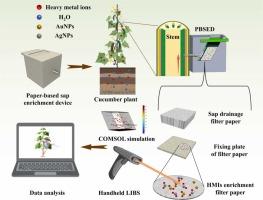
Detecting heavy metals in plants is highly important for diagnosing plant health and understanding the stress mechanisms induced by heavy metals. However, the minimally invasive detection of heavy metals in plants remains a challenge. A novel paper-based sap enrichment device (PBSED), combined with laser-induced breakdown spectroscopy (LIBS) was proposed for the minimally invasive detection of Cd(Ⅱ) and Pb(Ⅱ) in plants. The PBSED included a stainless-steel capillary and heavy metal ion enrichment filter paper (HMIE-FP). The stainless-steel capillary was inserted into the plant stem, where plant sap was transported onto the paper substrate through capillary action. The heavy metal ions (HMIs) in the plants were enriched on the HMIE-FP, and LIBS was used to detect Cd(Ⅱ) and Pb(Ⅱ) on the HMIE-FP to determine the Cd(Ⅱ) and Pb(Ⅱ) concentration within the plant. COMSOL simulations were employed to analyse the flow dynamics of plant sap within the PBSED. To increase the heavy metal enrichment amount, the HMIE-FP was modified with AuAg bimetallic nanoparticles (AuAgBNPs). The PBSED–LIBS method was applied to detect Cd(Ⅱ) and Pb(Ⅱ) in cucumber plants, and the results were strongly correlated with the inductively coupled plasma mass spectrometry (ICP–MS) results (R² = 0.99 for Cd(Ⅱ) and 0.96 for Pb(Ⅱ)). The proposed PBSED–LIBS method demonstrated high sensitivity and minimal invasiveness; thus, it is suitable for rapid, in vivo detection of HMIs in plants. These findings provide valuable insights for the development of efficient, nondestructive tools for environmental applications.
期刊介绍:
The Journal of Hazardous Materials serves as a global platform for promoting cutting-edge research in the field of Environmental Science and Engineering. Our publication features a wide range of articles, including full-length research papers, review articles, and perspectives, with the aim of enhancing our understanding of the dangers and risks associated with various materials concerning public health and the environment. It is important to note that the term "environmental contaminants" refers specifically to substances that pose hazardous effects through contamination, while excluding those that do not have such impacts on the environment or human health. Moreover, we emphasize the distinction between wastes and hazardous materials in order to provide further clarity on the scope of the journal. We have a keen interest in exploring specific compounds and microbial agents that have adverse effects on the environment.



 京公网安备 11010802042870号
京ICP备2023020795号-1
京公网安备 11010802042870号
京ICP备2023020795号-1

 分享
分享
 求助内容:
求助内容: 应助结果提醒方式:
 扫码关注我们
