Yuan Zheng , Hao Zhou , Yingqi Peng , Xue Wang , Yuxiang Yang , Yifan Deng , Yang Liu , Haixia Pan , Xu Zhao , Xiaojing Yang , Jianli Guo , Jiajia Shan
{"title":"Deep learning-enhanced hyperspectral imaging for rapid screening of Co-metabolic microplastic-degrading bacteria in environmental samples","authors":"Yuan Zheng , Hao Zhou , Yingqi Peng , Xue Wang , Yuxiang Yang , Yifan Deng , Yang Liu , Haixia Pan , Xu Zhao , Xiaojing Yang , Jianli Guo , Jiajia Shan","doi":"10.1016/j.jhazmat.2025.138370","DOIUrl":null,"url":null,"abstract":"<div><div>Microbial biodegradation of microplastic (MP) emerges as an environmentally benign and highly promising strategy for alleviating MP pollution in the ecosystem. Conventional approaches for screening MP-degrading bacteria use pollutants as the sole carbon source. Co-metabolism plays an essential role in microbial screening, as it enables the discovery of additional degrading microorganisms. However, identifying co-metabolic degrading bacteria is challenging and time-intensive, as not all microorganisms on a co-metabolic medium exhibit degradation capability, increasing the need for refined screening methods. In this study, we propose a novel hyperspectral imaging (HSI) approach to rapidly screen polybutylene adipate terephthalate (PBAT) degrading bacteria directly from co-metabolic media. Hyperspectral images of solid media cultures were acquired, capturing both spatial (image) and spectral (chemical) information. Chemical components in the solid medium exhibit distinct changes under the influence of degrading and non-degrading bacteria. By analyzing the spectral information using machine and deep learning algorithms, it was possible to monitor the PBAT concentration changes in the solid medium, indirectly identifying degrading and non-degrading bacteria. This HSI-based model successfully screened out one kind of PBAT-degrading bacteria validated by traditional method, demonstrating potential for rapid screening of MP-degrading bacteria. With artificial intelligence (AI) technology attracting extensive attention across diverse fields, this study pioneers a new approach for the efficient screening of degrading microorganisms by combining AI algorithms with HSI. This innovative methodology is expected to display significant application potential, thus facilitating the research and development in related fields.</div></div><div><h3>Synopsis</h3><div>This study introduces a highly efficient method to screen co-metabolic MP-degrading bacteria. By combining HSI with deep learning, MP-degrading bacteria can be directly identified on co-metabolism solid media, greatly enhancing the efficiency of screening for MP-degrading microorganisms.</div></div>","PeriodicalId":361,"journal":{"name":"Journal of Hazardous Materials","volume":"493 ","pages":"Article 138370"},"PeriodicalIF":11.3000,"publicationDate":"2025-08-05","publicationTypes":"Journal Article","fieldsOfStudy":null,"isOpenAccess":false,"openAccessPdf":"","citationCount":"0","resultStr":null,"platform":"Semanticscholar","paperid":null,"PeriodicalName":"Journal of Hazardous Materials","FirstCategoryId":"93","ListUrlMain":"https://www.sciencedirect.com/science/article/pii/S0304389425012853","RegionNum":1,"RegionCategory":"环境科学与生态学","ArticlePicture":[],"TitleCN":null,"AbstractTextCN":null,"PMCID":null,"EPubDate":"2025/4/21 0:00:00","PubModel":"Epub","JCR":"Q1","JCRName":"ENGINEERING, ENVIRONMENTAL","Score":null,"Total":0}
引用次数: 0
Abstract
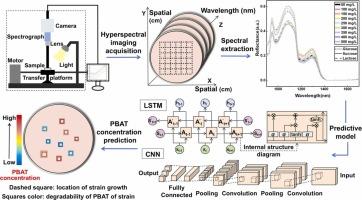
Microbial biodegradation of microplastic (MP) emerges as an environmentally benign and highly promising strategy for alleviating MP pollution in the ecosystem. Conventional approaches for screening MP-degrading bacteria use pollutants as the sole carbon source. Co-metabolism plays an essential role in microbial screening, as it enables the discovery of additional degrading microorganisms. However, identifying co-metabolic degrading bacteria is challenging and time-intensive, as not all microorganisms on a co-metabolic medium exhibit degradation capability, increasing the need for refined screening methods. In this study, we propose a novel hyperspectral imaging (HSI) approach to rapidly screen polybutylene adipate terephthalate (PBAT) degrading bacteria directly from co-metabolic media. Hyperspectral images of solid media cultures were acquired, capturing both spatial (image) and spectral (chemical) information. Chemical components in the solid medium exhibit distinct changes under the influence of degrading and non-degrading bacteria. By analyzing the spectral information using machine and deep learning algorithms, it was possible to monitor the PBAT concentration changes in the solid medium, indirectly identifying degrading and non-degrading bacteria. This HSI-based model successfully screened out one kind of PBAT-degrading bacteria validated by traditional method, demonstrating potential for rapid screening of MP-degrading bacteria. With artificial intelligence (AI) technology attracting extensive attention across diverse fields, this study pioneers a new approach for the efficient screening of degrading microorganisms by combining AI algorithms with HSI. This innovative methodology is expected to display significant application potential, thus facilitating the research and development in related fields.
Synopsis
This study introduces a highly efficient method to screen co-metabolic MP-degrading bacteria. By combining HSI with deep learning, MP-degrading bacteria can be directly identified on co-metabolism solid media, greatly enhancing the efficiency of screening for MP-degrading microorganisms.
期刊介绍:
The Journal of Hazardous Materials serves as a global platform for promoting cutting-edge research in the field of Environmental Science and Engineering. Our publication features a wide range of articles, including full-length research papers, review articles, and perspectives, with the aim of enhancing our understanding of the dangers and risks associated with various materials concerning public health and the environment. It is important to note that the term "environmental contaminants" refers specifically to substances that pose hazardous effects through contamination, while excluding those that do not have such impacts on the environment or human health. Moreover, we emphasize the distinction between wastes and hazardous materials in order to provide further clarity on the scope of the journal. We have a keen interest in exploring specific compounds and microbial agents that have adverse effects on the environment.



 京公网安备 11010802042870号
京ICP备2023020795号-1
京公网安备 11010802042870号
京ICP备2023020795号-1

 分享
分享
 求助内容:
求助内容: 应助结果提醒方式:
 扫码关注我们
