Synergistic iron single/diatomic nanozyme-based colorimetric filtration valve for real-time detection and degradation of kitchen wastewater contaminants
Hongsu Wang , Nan Liang , Li Wang , Yue Yu , Jingqi Guan , Xiaodi Niu
{"title":"Synergistic iron single/diatomic nanozyme-based colorimetric filtration valve for real-time detection and degradation of kitchen wastewater contaminants","authors":"Hongsu Wang , Nan Liang , Li Wang , Yue Yu , Jingqi Guan , Xiaodi Niu","doi":"10.1016/j.jhazmat.2025.138361","DOIUrl":null,"url":null,"abstract":"<div><div>Conventional single-atom nanozyme materials often exhibit limited enzyme-like activities and substrate specificity, making it challenging to meet the integrated demands for simultaneous detection and purification in environmental applications. In this study, we developed a novel nanozyme system featuring single/diatomic synergistic iron active sites (sdsFeN@G). sdsFeN@G exhibits superior multi-enzyme activities (POD, OXD, Laccase), outperforming natural enzymes in catalytic efficiency. Density functional theory (DFT) calculations revealed that the Fe-N four-coordination bonding shifted the <em>d</em>-band center of Fe closer to the Fermi level, enhancing the catalytic activity of the single/diatomic synergistic active sites. The colorimetric sensor platform integrating sdsFeN@G as the active component exhibited a detection limit as low as 0.992 μM and, leveraging its Laccase-like activity, achieved effective degradation of these antioxidants with a maximum degradation rate of 80 % for kitchen wastewater. To meet the real-time detection and purification needs in practical kitchen wastewater discharge processes, a convenient detection/purification integrated kitchen wastewater filtration valve was designed based on the sdsFeN@G nanozyme. This work advances the development of multi-enzyme active nanozyme materials, providing a promising strategy for addressing real-world environmental protection challenges.</div></div>","PeriodicalId":361,"journal":{"name":"Journal of Hazardous Materials","volume":"493 ","pages":"Article 138361"},"PeriodicalIF":11.3000,"publicationDate":"2025-08-05","publicationTypes":"Journal Article","fieldsOfStudy":null,"isOpenAccess":false,"openAccessPdf":"","citationCount":"0","resultStr":null,"platform":"Semanticscholar","paperid":null,"PeriodicalName":"Journal of Hazardous Materials","FirstCategoryId":"93","ListUrlMain":"https://www.sciencedirect.com/science/article/pii/S0304389425012762","RegionNum":1,"RegionCategory":"环境科学与生态学","ArticlePicture":[],"TitleCN":null,"AbstractTextCN":null,"PMCID":null,"EPubDate":"2025/4/21 0:00:00","PubModel":"Epub","JCR":"Q1","JCRName":"ENGINEERING, ENVIRONMENTAL","Score":null,"Total":0}
引用次数: 0
Abstract
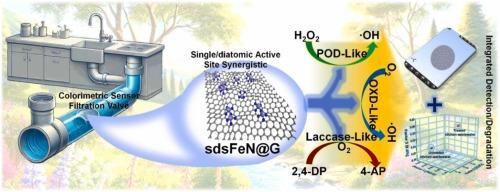
Conventional single-atom nanozyme materials often exhibit limited enzyme-like activities and substrate specificity, making it challenging to meet the integrated demands for simultaneous detection and purification in environmental applications. In this study, we developed a novel nanozyme system featuring single/diatomic synergistic iron active sites (sdsFeN@G). sdsFeN@G exhibits superior multi-enzyme activities (POD, OXD, Laccase), outperforming natural enzymes in catalytic efficiency. Density functional theory (DFT) calculations revealed that the Fe-N four-coordination bonding shifted the d-band center of Fe closer to the Fermi level, enhancing the catalytic activity of the single/diatomic synergistic active sites. The colorimetric sensor platform integrating sdsFeN@G as the active component exhibited a detection limit as low as 0.992 μM and, leveraging its Laccase-like activity, achieved effective degradation of these antioxidants with a maximum degradation rate of 80 % for kitchen wastewater. To meet the real-time detection and purification needs in practical kitchen wastewater discharge processes, a convenient detection/purification integrated kitchen wastewater filtration valve was designed based on the sdsFeN@G nanozyme. This work advances the development of multi-enzyme active nanozyme materials, providing a promising strategy for addressing real-world environmental protection challenges.
期刊介绍:
The Journal of Hazardous Materials serves as a global platform for promoting cutting-edge research in the field of Environmental Science and Engineering. Our publication features a wide range of articles, including full-length research papers, review articles, and perspectives, with the aim of enhancing our understanding of the dangers and risks associated with various materials concerning public health and the environment. It is important to note that the term "environmental contaminants" refers specifically to substances that pose hazardous effects through contamination, while excluding those that do not have such impacts on the environment or human health. Moreover, we emphasize the distinction between wastes and hazardous materials in order to provide further clarity on the scope of the journal. We have a keen interest in exploring specific compounds and microbial agents that have adverse effects on the environment.



 京公网安备 11010802042870号
京ICP备2023020795号-1
京公网安备 11010802042870号
京ICP备2023020795号-1

 分享
分享
 求助内容:
求助内容: 应助结果提醒方式:
 扫码关注我们
