Qilong Li , Lin Zhu , Xiaoying Pu , Qi Sui , Xuemei Sun , Xinguo Zhao , Rongyuan Wang , Bin Xia
{"title":"Occurrence, trophic transfer and risk assessment of microplastics in fishery organisms from the Bohai Sea, China","authors":"Qilong Li , Lin Zhu , Xiaoying Pu , Qi Sui , Xuemei Sun , Xinguo Zhao , Rongyuan Wang , Bin Xia","doi":"10.1016/j.jhazmat.2025.138367","DOIUrl":null,"url":null,"abstract":"<div><div>Marine microplastic (MP) pollution has emerged as a critical environmental issue, posing significant risks to a wide range of marine organisms. However, the trophic transfer of MPs with different characteristics among marine species remain poorly understood. This study investigated the abundances and characteristics of MPs in various fishery organisms from the Bohai Sea, China, and evaluated the influencing factors, trophic transfer and associated risks. Results showed that MP abundances ranged from 0.50 ± 0.52–2.38 ± 1.41 items per individual. Most MPs were smaller than 1 mm (74.6 %), with fiber being the most common shape (80.8 %), and transparent being the dominant color (75.3 %). Among the 13 identified polymer types, cellophane was the most prevalent. MP ingestion by fishery organisms was significantly influenced by body size, biological taxa, and habitat, while showing no correlation with feeding habits. Notably, the trophic transfer and significant biomagnification of MPs occurred through the marine food chain. Specially, MPs within the size ranges from 30 to 500 µm, in fibrous shape, transparent color, and composed of cellophane, PET, PP, and PA polymers, demonstrated enhanced potential for trophic transfer. PHI-based quantitative risk assessment revealed a medium to danger risk of MPs to marine fishery organisms, with hazard indices spanning medium to danger risk levels. These findings provide new insights into the bioaccumulation and risk of MPs across different trophic levels in marine organisms.</div></div>","PeriodicalId":361,"journal":{"name":"Journal of Hazardous Materials","volume":"493 ","pages":"Article 138367"},"PeriodicalIF":11.3000,"publicationDate":"2025-08-05","publicationTypes":"Journal Article","fieldsOfStudy":null,"isOpenAccess":false,"openAccessPdf":"","citationCount":"0","resultStr":null,"platform":"Semanticscholar","paperid":null,"PeriodicalName":"Journal of Hazardous Materials","FirstCategoryId":"93","ListUrlMain":"https://www.sciencedirect.com/science/article/pii/S0304389425012828","RegionNum":1,"RegionCategory":"环境科学与生态学","ArticlePicture":[],"TitleCN":null,"AbstractTextCN":null,"PMCID":null,"EPubDate":"2025/4/21 0:00:00","PubModel":"Epub","JCR":"Q1","JCRName":"ENGINEERING, ENVIRONMENTAL","Score":null,"Total":0}
引用次数: 0
Abstract
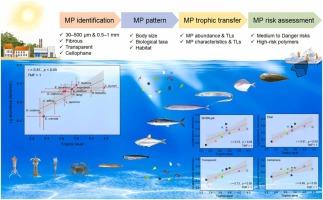
Marine microplastic (MP) pollution has emerged as a critical environmental issue, posing significant risks to a wide range of marine organisms. However, the trophic transfer of MPs with different characteristics among marine species remain poorly understood. This study investigated the abundances and characteristics of MPs in various fishery organisms from the Bohai Sea, China, and evaluated the influencing factors, trophic transfer and associated risks. Results showed that MP abundances ranged from 0.50 ± 0.52–2.38 ± 1.41 items per individual. Most MPs were smaller than 1 mm (74.6 %), with fiber being the most common shape (80.8 %), and transparent being the dominant color (75.3 %). Among the 13 identified polymer types, cellophane was the most prevalent. MP ingestion by fishery organisms was significantly influenced by body size, biological taxa, and habitat, while showing no correlation with feeding habits. Notably, the trophic transfer and significant biomagnification of MPs occurred through the marine food chain. Specially, MPs within the size ranges from 30 to 500 µm, in fibrous shape, transparent color, and composed of cellophane, PET, PP, and PA polymers, demonstrated enhanced potential for trophic transfer. PHI-based quantitative risk assessment revealed a medium to danger risk of MPs to marine fishery organisms, with hazard indices spanning medium to danger risk levels. These findings provide new insights into the bioaccumulation and risk of MPs across different trophic levels in marine organisms.
期刊介绍:
The Journal of Hazardous Materials serves as a global platform for promoting cutting-edge research in the field of Environmental Science and Engineering. Our publication features a wide range of articles, including full-length research papers, review articles, and perspectives, with the aim of enhancing our understanding of the dangers and risks associated with various materials concerning public health and the environment. It is important to note that the term "environmental contaminants" refers specifically to substances that pose hazardous effects through contamination, while excluding those that do not have such impacts on the environment or human health. Moreover, we emphasize the distinction between wastes and hazardous materials in order to provide further clarity on the scope of the journal. We have a keen interest in exploring specific compounds and microbial agents that have adverse effects on the environment.



 京公网安备 11010802042870号
京ICP备2023020795号-1
京公网安备 11010802042870号
京ICP备2023020795号-1

 分享
分享
 求助内容:
求助内容: 应助结果提醒方式:
 扫码关注我们
