Xiaowei Li , Xin Wu , Junzhe Zhang , Changjian Xie , Yingjun Song , Yunpeng Liu , Lingna Zheng , Shujing Zhang , Peng Zhang , Martina G. Vijver , Willie J.G.M. Peijnenburg , Iseult Lynch , Zhiling Guo
{"title":"Key events relating to homeostasis and regeneration of freshwater planarians (Dugesia Japonica) after exposure to various ZnO-forms","authors":"Xiaowei Li , Xin Wu , Junzhe Zhang , Changjian Xie , Yingjun Song , Yunpeng Liu , Lingna Zheng , Shujing Zhang , Peng Zhang , Martina G. Vijver , Willie J.G.M. Peijnenburg , Iseult Lynch , Zhiling Guo","doi":"10.1016/j.jhazmat.2025.138360","DOIUrl":null,"url":null,"abstract":"<div><div>This study aims to investigate the toxicity and underlying mechanisms of ZnO nanoparticles (ZnO NPs), bulk ZnO (ZnO MPs), and zinc ions (Zn<sup>2 +</sup>) on <em>Dugesia japonica</em> planarians, with a focus on their bioaccumulation, transformation, and associated biological effects. Using advanced techniques such as synchrotron X-ray fluorescence (XRF), X-ray Absorption Near Edge Structure (XANES) and single particle ICP-MS (sp-ICP-MS), we measured the accumulation, distribution, and transformation of these materials in planarians. All treatments caused significant Zn accumulation: ZnO NPs increased Zn by 120-fold, ZnO MPs by 100-fold, and Zn<sup>2+</sup> by 430-fold. XANES and sp-ICP-MS analysis confirmed that ZnO NPs remained largely in particulate form (40–60 %) following uptake by planarians. Toxicity tests revealed that all treatments impaired blastema growth, locomotion, stem cell proliferation, differentiation, and neural regeneration. ZnO MPs exhibited higher toxicity than ZnO NPs, while Zn<sup>2+</sup> resulted in elevated oxidative stress. ZnO NPs induced severe energy damage and triggered cell apoptosis, whereas ZnO MPs caused more pronounced necrosis cell death. Transcriptomic and proteomic analyses showed that all treatments disrupted pathways related to oxidative stress response, energy metabolism and cell apoptosis. ZnO NPs primarily affected the membrane integrity pathway, ZnO MPs altered cell homeostasis and membrane potential, while Zn<sup>2+</sup> exposure triggered metal ion-specific cellular reactions. These molecular and cellular changes collectively explain the observed phenotypic outcomes, which align with the Adverse Outcome Pathway framework. The findings provide insights into the environmental risks of different ZnO forms and highlight their distinct toxicity mechanisms.</div></div>","PeriodicalId":361,"journal":{"name":"Journal of Hazardous Materials","volume":"493 ","pages":"Article 138360"},"PeriodicalIF":11.3000,"publicationDate":"2025-08-05","publicationTypes":"Journal Article","fieldsOfStudy":null,"isOpenAccess":false,"openAccessPdf":"","citationCount":"0","resultStr":null,"platform":"Semanticscholar","paperid":null,"PeriodicalName":"Journal of Hazardous Materials","FirstCategoryId":"93","ListUrlMain":"https://www.sciencedirect.com/science/article/pii/S0304389425012750","RegionNum":1,"RegionCategory":"环境科学与生态学","ArticlePicture":[],"TitleCN":null,"AbstractTextCN":null,"PMCID":null,"EPubDate":"2025/4/21 0:00:00","PubModel":"Epub","JCR":"Q1","JCRName":"ENGINEERING, ENVIRONMENTAL","Score":null,"Total":0}
引用次数: 0
Abstract
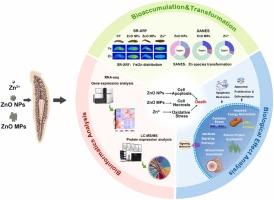
This study aims to investigate the toxicity and underlying mechanisms of ZnO nanoparticles (ZnO NPs), bulk ZnO (ZnO MPs), and zinc ions (Zn2 +) on Dugesia japonica planarians, with a focus on their bioaccumulation, transformation, and associated biological effects. Using advanced techniques such as synchrotron X-ray fluorescence (XRF), X-ray Absorption Near Edge Structure (XANES) and single particle ICP-MS (sp-ICP-MS), we measured the accumulation, distribution, and transformation of these materials in planarians. All treatments caused significant Zn accumulation: ZnO NPs increased Zn by 120-fold, ZnO MPs by 100-fold, and Zn2+ by 430-fold. XANES and sp-ICP-MS analysis confirmed that ZnO NPs remained largely in particulate form (40–60 %) following uptake by planarians. Toxicity tests revealed that all treatments impaired blastema growth, locomotion, stem cell proliferation, differentiation, and neural regeneration. ZnO MPs exhibited higher toxicity than ZnO NPs, while Zn2+ resulted in elevated oxidative stress. ZnO NPs induced severe energy damage and triggered cell apoptosis, whereas ZnO MPs caused more pronounced necrosis cell death. Transcriptomic and proteomic analyses showed that all treatments disrupted pathways related to oxidative stress response, energy metabolism and cell apoptosis. ZnO NPs primarily affected the membrane integrity pathway, ZnO MPs altered cell homeostasis and membrane potential, while Zn2+ exposure triggered metal ion-specific cellular reactions. These molecular and cellular changes collectively explain the observed phenotypic outcomes, which align with the Adverse Outcome Pathway framework. The findings provide insights into the environmental risks of different ZnO forms and highlight their distinct toxicity mechanisms.
期刊介绍:
The Journal of Hazardous Materials serves as a global platform for promoting cutting-edge research in the field of Environmental Science and Engineering. Our publication features a wide range of articles, including full-length research papers, review articles, and perspectives, with the aim of enhancing our understanding of the dangers and risks associated with various materials concerning public health and the environment. It is important to note that the term "environmental contaminants" refers specifically to substances that pose hazardous effects through contamination, while excluding those that do not have such impacts on the environment or human health. Moreover, we emphasize the distinction between wastes and hazardous materials in order to provide further clarity on the scope of the journal. We have a keen interest in exploring specific compounds and microbial agents that have adverse effects on the environment.



 京公网安备 11010802042870号
京ICP备2023020795号-1
京公网安备 11010802042870号
京ICP备2023020795号-1

 分享
分享
 求助内容:
求助内容: 应助结果提醒方式:
 扫码关注我们
