Yao Xie , Somia Yassin Hussain Abdalkarim , Hiba Adil Mahjoob , Chaopei Chen , Haicheng Huang , Hou-Yong Yu
{"title":"Unveiling the impact of soil depth on degradation of durable nanocomposite mulch-derived residue migration dynamics in plant ecosystems","authors":"Yao Xie , Somia Yassin Hussain Abdalkarim , Hiba Adil Mahjoob , Chaopei Chen , Haicheng Huang , Hou-Yong Yu","doi":"10.1016/j.jhazmat.2025.138364","DOIUrl":null,"url":null,"abstract":"<div><div>The increasing use of biodegradable mulches, such as polylactic acid (PLA), offers a promising approach to tackling plastic waste. However, if PLA is improperly disposed of and degraded uncontrollably, it can negatively impact soil health and plant growth, compromising environmental benefits. This study demonstrates an interaction between hydrophobically modified nanocellulose (CA-CNC(MgSt)), which serves as a plasticizer within a PLA matrix, to create a self-degradable mulch film (PC). Specifically, PC exhibits an impressive toughness of 3.55 MJ·m<sup>−3</sup>. The use of PC mulch increased soil moisture content, stem length, and leaf area by 31.6 % and 63.2 %, respectively, while maintaining high biosafety. The degradation behavior of PC mulch varied with soil depth (-2, −7, and −14 cm), enhancing soil porosity and lowering pH, which accelerated its degradation and promoted root growth. Additionally, PC degraded faster than pure PLA (<em>k</em><sub><em>p</em></sub> < <em>k</em><sub><em>pc</em></sub>), attributed to the preferential hydrolysis of ester bonds. Biodegradable microplastics (BMPs) generated from mulch degradation, including P-BMPs and PC-BMPs, were studied using cherry radish growth models to explore plant-soil-microplastic interactions. This study demonstrates the potential of PC mulch to reduce plastic pollution through effective biodegradation while enhancing the stability of the soil-plant ecosystem. However, comprehensive ecological risk assessments are essential before their large-scale application.</div></div>","PeriodicalId":361,"journal":{"name":"Journal of Hazardous Materials","volume":"493 ","pages":"Article 138364"},"PeriodicalIF":11.3000,"publicationDate":"2025-08-05","publicationTypes":"Journal Article","fieldsOfStudy":null,"isOpenAccess":false,"openAccessPdf":"","citationCount":"0","resultStr":null,"platform":"Semanticscholar","paperid":null,"PeriodicalName":"Journal of Hazardous Materials","FirstCategoryId":"93","ListUrlMain":"https://www.sciencedirect.com/science/article/pii/S0304389425012798","RegionNum":1,"RegionCategory":"环境科学与生态学","ArticlePicture":[],"TitleCN":null,"AbstractTextCN":null,"PMCID":null,"EPubDate":"2025/4/21 0:00:00","PubModel":"Epub","JCR":"Q1","JCRName":"ENGINEERING, ENVIRONMENTAL","Score":null,"Total":0}
引用次数: 0
Abstract
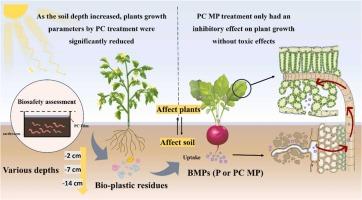
The increasing use of biodegradable mulches, such as polylactic acid (PLA), offers a promising approach to tackling plastic waste. However, if PLA is improperly disposed of and degraded uncontrollably, it can negatively impact soil health and plant growth, compromising environmental benefits. This study demonstrates an interaction between hydrophobically modified nanocellulose (CA-CNC(MgSt)), which serves as a plasticizer within a PLA matrix, to create a self-degradable mulch film (PC). Specifically, PC exhibits an impressive toughness of 3.55 MJ·m−3. The use of PC mulch increased soil moisture content, stem length, and leaf area by 31.6 % and 63.2 %, respectively, while maintaining high biosafety. The degradation behavior of PC mulch varied with soil depth (-2, −7, and −14 cm), enhancing soil porosity and lowering pH, which accelerated its degradation and promoted root growth. Additionally, PC degraded faster than pure PLA (kp < kpc), attributed to the preferential hydrolysis of ester bonds. Biodegradable microplastics (BMPs) generated from mulch degradation, including P-BMPs and PC-BMPs, were studied using cherry radish growth models to explore plant-soil-microplastic interactions. This study demonstrates the potential of PC mulch to reduce plastic pollution through effective biodegradation while enhancing the stability of the soil-plant ecosystem. However, comprehensive ecological risk assessments are essential before their large-scale application.
期刊介绍:
The Journal of Hazardous Materials serves as a global platform for promoting cutting-edge research in the field of Environmental Science and Engineering. Our publication features a wide range of articles, including full-length research papers, review articles, and perspectives, with the aim of enhancing our understanding of the dangers and risks associated with various materials concerning public health and the environment. It is important to note that the term "environmental contaminants" refers specifically to substances that pose hazardous effects through contamination, while excluding those that do not have such impacts on the environment or human health. Moreover, we emphasize the distinction between wastes and hazardous materials in order to provide further clarity on the scope of the journal. We have a keen interest in exploring specific compounds and microbial agents that have adverse effects on the environment.



 京公网安备 11010802042870号
京ICP备2023020795号-1
京公网安备 11010802042870号
京ICP备2023020795号-1

 分享
分享
 求助内容:
求助内容: 应助结果提醒方式:
 扫码关注我们
