Sustainable remediation of butyl xanthate-contaminated mine wastewater by combining emergent macrophyte Cyperus alternifolius with a versatile bacterial isolate
Qi Liu , Yao-Yao Ye , Sha Yang , Cheng-Yu Cui , Huan Du , Jin-Cheng Ye , Ji-Liang Cheng , Rui-Wen Hu , Lei Xiang , Bai-Lin Liu , Yan-Wen Li , Quan-Ying Cai , Miaoyue Zhang , Ce-Hui Mo , Hai-Ming Zhao
{"title":"Sustainable remediation of butyl xanthate-contaminated mine wastewater by combining emergent macrophyte Cyperus alternifolius with a versatile bacterial isolate","authors":"Qi Liu , Yao-Yao Ye , Sha Yang , Cheng-Yu Cui , Huan Du , Jin-Cheng Ye , Ji-Liang Cheng , Rui-Wen Hu , Lei Xiang , Bai-Lin Liu , Yan-Wen Li , Quan-Ying Cai , Miaoyue Zhang , Ce-Hui Mo , Hai-Ming Zhao","doi":"10.1016/j.jhazmat.2025.138345","DOIUrl":null,"url":null,"abstract":"<div><div>Butyl xanthate (BuX) is an emerging pollutant due to wide use as flotation collector, posing a serious threat to ecosystem health in mining areas. Here we develop a combinational plant-microbe remediation strategy for restoration of BuX-contaminated mining areas. A novel bacterial strain that completely degraded up to 1000 mg/L of BuX within 12 h was isolated and identified as <em>Pseudomonas monteilii</em> W50. It was found to harbor good tolerance to extreme environmental conditions and multiple plant growth-promoting traits such as phosphate and potassium solubilization, indole-3-acetic acid and gibberellin production, and cellulose degradation. This strain can colonize in the rhizosphere of an emergent macrophyte <em>Cyperus alternifolius</em>, improving removal of BuX and chemical oxygen demand (COD) from simulated wastewater. Compared to the phytoremediation alone, the removal of BuX and COD increased from 70 % to 98 % and from 21 % to 46 % respectively in the combined remediation The strain W50 protected the macrophyte from the phytotoxicity of BuX and the macrophyte provided it with a suitable habitat for return, benefiting each other. Compared to the individual treatment using <em>C. alternifolius</em> or strain W50, the combinational treatment significantly improved the plant growth and the residence of inoculated bacteria. Overall, <em>C. alternifolius</em> and strain W50 are the perfect combination for efficient and sustainable remediation of BuX-contaminated mine wastewater, overcoming the constraints of individual phytoremediation or bioaugmentation methods.</div></div>","PeriodicalId":361,"journal":{"name":"Journal of Hazardous Materials","volume":"493 ","pages":"Article 138345"},"PeriodicalIF":10.6000,"publicationDate":"2025-08-05","publicationTypes":"Journal Article","fieldsOfStudy":null,"isOpenAccess":false,"openAccessPdf":"","citationCount":"0","resultStr":null,"platform":"Semanticscholar","paperid":null,"PeriodicalName":"Journal of Hazardous Materials","FirstCategoryId":"93","ListUrlMain":"https://www.sciencedirect.com/science/article/pii/S0304389425012609","RegionNum":1,"RegionCategory":"环境科学与生态学","ArticlePicture":[],"TitleCN":null,"AbstractTextCN":null,"PMCID":null,"EPubDate":"2025/4/21 0:00:00","PubModel":"Epub","JCR":"Q1","JCRName":"ENGINEERING, ENVIRONMENTAL","Score":null,"Total":0}
引用次数: 0
Abstract
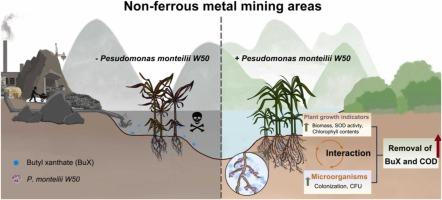
Butyl xanthate (BuX) is an emerging pollutant due to wide use as flotation collector, posing a serious threat to ecosystem health in mining areas. Here we develop a combinational plant-microbe remediation strategy for restoration of BuX-contaminated mining areas. A novel bacterial strain that completely degraded up to 1000 mg/L of BuX within 12 h was isolated and identified as Pseudomonas monteilii W50. It was found to harbor good tolerance to extreme environmental conditions and multiple plant growth-promoting traits such as phosphate and potassium solubilization, indole-3-acetic acid and gibberellin production, and cellulose degradation. This strain can colonize in the rhizosphere of an emergent macrophyte Cyperus alternifolius, improving removal of BuX and chemical oxygen demand (COD) from simulated wastewater. Compared to the phytoremediation alone, the removal of BuX and COD increased from 70 % to 98 % and from 21 % to 46 % respectively in the combined remediation The strain W50 protected the macrophyte from the phytotoxicity of BuX and the macrophyte provided it with a suitable habitat for return, benefiting each other. Compared to the individual treatment using C. alternifolius or strain W50, the combinational treatment significantly improved the plant growth and the residence of inoculated bacteria. Overall, C. alternifolius and strain W50 are the perfect combination for efficient and sustainable remediation of BuX-contaminated mine wastewater, overcoming the constraints of individual phytoremediation or bioaugmentation methods.
期刊介绍:
The Journal of Hazardous Materials serves as a global platform for promoting cutting-edge research in the field of Environmental Science and Engineering. Our publication features a wide range of articles, including full-length research papers, review articles, and perspectives, with the aim of enhancing our understanding of the dangers and risks associated with various materials concerning public health and the environment. It is important to note that the term "environmental contaminants" refers specifically to substances that pose hazardous effects through contamination, while excluding those that do not have such impacts on the environment or human health. Moreover, we emphasize the distinction between wastes and hazardous materials in order to provide further clarity on the scope of the journal. We have a keen interest in exploring specific compounds and microbial agents that have adverse effects on the environment.




 京公网安备 11010802042870号
京ICP备2023020795号-1
京公网安备 11010802042870号
京ICP备2023020795号-1

 分享
分享
 求助内容:
求助内容: 应助结果提醒方式:
 扫码关注我们
