The long-term in vitro co-exposure of polyethylene terephthalate (PET) nanoplastics and cigarette smoke condensate exacerbates the induction of carcinogenic traits
Michelle Morataya-Reyes , Aliro Villacorta , Javier Gutiérrez-García , Raquel Egea , Joan Martín-Pérez , Irene Barguilla , Ricard Marcos , Alba Hernández
{"title":"The long-term in vitro co-exposure of polyethylene terephthalate (PET) nanoplastics and cigarette smoke condensate exacerbates the induction of carcinogenic traits","authors":"Michelle Morataya-Reyes , Aliro Villacorta , Javier Gutiérrez-García , Raquel Egea , Joan Martín-Pérez , Irene Barguilla , Ricard Marcos , Alba Hernández","doi":"10.1016/j.jhazmat.2025.138359","DOIUrl":null,"url":null,"abstract":"<div><div>This study examines the long-term impact of polyethylene terephthalate nanoplastics (PET-NPLs) and cigarette smoke condensate (CSC) on human lung BEAS-2B cells, focusing on key biological hallmarks of carcinogenesis. True-to-life PET-NPLs were generated from plastic water bottles and characterized to simulate environmental exposure conditions; and a comprehensive battery of assays was employed to assess genotoxicity, cellular transformation, and invasiveness. It was observed that, compared to passage control and individual exposures, co-exposure to PET-NPLs and CSC exacerbates oxidative stress, genotoxicity, and tumorigenic transformation, as evidenced by increased DNA damage, colony formation in soft agar, and enhanced cell migration and invasion. Transcriptomic analysis revealed a shift in cellular stress regulation including the upregulation of stress-response genes, including <em>SLC7A11, NQO1</em>, and <em>HSPA1A</em>, which are linked to oxidative stress adaptation and tumor survival. At the same time, key tumor-suppressor genes, such as <em>LOX,</em> and <em>FN1</em>, were significantly downregulated, promoting cellular transformation and invasiveness. These results provide compelling evidence that the combination of PET-NPLs and CSC enhances carcinogenic traits through oxidative stress, genomic instability, and disruption of tumor-suppressive pathways. This study underscores the importance of evaluating the synergistic effects of combined environmental exposures and their implications for human health.</div></div>","PeriodicalId":361,"journal":{"name":"Journal of Hazardous Materials","volume":"493 ","pages":"Article 138359"},"PeriodicalIF":11.3000,"publicationDate":"2025-08-05","publicationTypes":"Journal Article","fieldsOfStudy":null,"isOpenAccess":false,"openAccessPdf":"","citationCount":"0","resultStr":null,"platform":"Semanticscholar","paperid":null,"PeriodicalName":"Journal of Hazardous Materials","FirstCategoryId":"93","ListUrlMain":"https://www.sciencedirect.com/science/article/pii/S0304389425012749","RegionNum":1,"RegionCategory":"环境科学与生态学","ArticlePicture":[],"TitleCN":null,"AbstractTextCN":null,"PMCID":null,"EPubDate":"2025/4/21 0:00:00","PubModel":"Epub","JCR":"Q1","JCRName":"ENGINEERING, ENVIRONMENTAL","Score":null,"Total":0}
引用次数: 0
Abstract
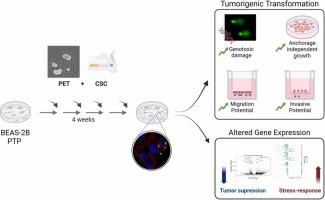
This study examines the long-term impact of polyethylene terephthalate nanoplastics (PET-NPLs) and cigarette smoke condensate (CSC) on human lung BEAS-2B cells, focusing on key biological hallmarks of carcinogenesis. True-to-life PET-NPLs were generated from plastic water bottles and characterized to simulate environmental exposure conditions; and a comprehensive battery of assays was employed to assess genotoxicity, cellular transformation, and invasiveness. It was observed that, compared to passage control and individual exposures, co-exposure to PET-NPLs and CSC exacerbates oxidative stress, genotoxicity, and tumorigenic transformation, as evidenced by increased DNA damage, colony formation in soft agar, and enhanced cell migration and invasion. Transcriptomic analysis revealed a shift in cellular stress regulation including the upregulation of stress-response genes, including SLC7A11, NQO1, and HSPA1A, which are linked to oxidative stress adaptation and tumor survival. At the same time, key tumor-suppressor genes, such as LOX, and FN1, were significantly downregulated, promoting cellular transformation and invasiveness. These results provide compelling evidence that the combination of PET-NPLs and CSC enhances carcinogenic traits through oxidative stress, genomic instability, and disruption of tumor-suppressive pathways. This study underscores the importance of evaluating the synergistic effects of combined environmental exposures and their implications for human health.
期刊介绍:
The Journal of Hazardous Materials serves as a global platform for promoting cutting-edge research in the field of Environmental Science and Engineering. Our publication features a wide range of articles, including full-length research papers, review articles, and perspectives, with the aim of enhancing our understanding of the dangers and risks associated with various materials concerning public health and the environment. It is important to note that the term "environmental contaminants" refers specifically to substances that pose hazardous effects through contamination, while excluding those that do not have such impacts on the environment or human health. Moreover, we emphasize the distinction between wastes and hazardous materials in order to provide further clarity on the scope of the journal. We have a keen interest in exploring specific compounds and microbial agents that have adverse effects on the environment.



 京公网安备 11010802042870号
京ICP备2023020795号-1
京公网安备 11010802042870号
京ICP备2023020795号-1

 分享
分享
 求助内容:
求助内容: 应助结果提醒方式:
 扫码关注我们
