Zhen Sun , Xueli Yang , Shaobin Yang , Kun Li , Xia Zhao , Lanxiang Yao , Wanru Xu , Haichao Wang , LanLan Guo , Guofeng Pan
{"title":"Ultrasensitive and ultra-selective room-temperature H2S gas sensor based on CuO-loaded In2O3 2D porous nanosheets","authors":"Zhen Sun , Xueli Yang , Shaobin Yang , Kun Li , Xia Zhao , Lanxiang Yao , Wanru Xu , Haichao Wang , LanLan Guo , Guofeng Pan","doi":"10.1016/j.jhazmat.2025.138355","DOIUrl":null,"url":null,"abstract":"<div><div>Developing a cost-effective sensing material capable of detecting H<sub>2</sub>S with ultra-sensitivity, ultra-selectivity, and low detection limits at room temperature remains highly anticipated. In this paper, two-dimensional (2D) porous In<sub>2</sub>O<sub>3</sub> nanosheets were prepared by a simple solvothermal method, and then CuO was modified on the In<sub>2</sub>O<sub>3</sub> surface by impregnation. The CuO/In<sub>2</sub>O<sub>3</sub> two-dimensional porous structure allows the fabricated sensor to be highly sensitive to H<sub>2</sub>S at room temperature. Modifying CuO on In<sub>2</sub>O<sub>3</sub> significantly improves the response (R<sub>a</sub>/R<sub>g</sub>) to 10 ppm H<sub>2</sub>S from 26 to 58000 at room temperature, while the response to other interfering gases (even 10 times the concentration of H<sub>2</sub>S) not exceeding 5. After loading CuO, the response time was shortened from 56 s to 2 s, and the detection limit was reduced from 500 ppb to 50 ppb. Meanwhile, CuO/In<sub>2</sub>O<sub>3</sub> also has good repeatability and long-term stability, and full recovery can be achieved by pulse heating. The gas sensing and characterization results demonstrate that the excellent sensing performance of CuO/In<sub>2</sub>O<sub>3</sub> for H<sub>2</sub>S at room temperature is due to the specific porous nanosheets morphology and structure of the material, the strong chemical affinity of alkaline CuO for H<sub>2</sub>S, as well as the formation of p-n heterojunctions.</div></div>","PeriodicalId":361,"journal":{"name":"Journal of Hazardous Materials","volume":"493 ","pages":"Article 138355"},"PeriodicalIF":11.3000,"publicationDate":"2025-08-05","publicationTypes":"Journal Article","fieldsOfStudy":null,"isOpenAccess":false,"openAccessPdf":"","citationCount":"0","resultStr":null,"platform":"Semanticscholar","paperid":null,"PeriodicalName":"Journal of Hazardous Materials","FirstCategoryId":"93","ListUrlMain":"https://www.sciencedirect.com/science/article/pii/S0304389425012701","RegionNum":1,"RegionCategory":"环境科学与生态学","ArticlePicture":[],"TitleCN":null,"AbstractTextCN":null,"PMCID":null,"EPubDate":"2025/4/21 0:00:00","PubModel":"Epub","JCR":"Q1","JCRName":"ENGINEERING, ENVIRONMENTAL","Score":null,"Total":0}
引用次数: 0
Abstract
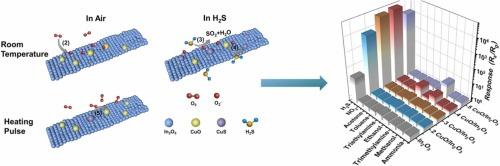
Developing a cost-effective sensing material capable of detecting H2S with ultra-sensitivity, ultra-selectivity, and low detection limits at room temperature remains highly anticipated. In this paper, two-dimensional (2D) porous In2O3 nanosheets were prepared by a simple solvothermal method, and then CuO was modified on the In2O3 surface by impregnation. The CuO/In2O3 two-dimensional porous structure allows the fabricated sensor to be highly sensitive to H2S at room temperature. Modifying CuO on In2O3 significantly improves the response (Ra/Rg) to 10 ppm H2S from 26 to 58000 at room temperature, while the response to other interfering gases (even 10 times the concentration of H2S) not exceeding 5. After loading CuO, the response time was shortened from 56 s to 2 s, and the detection limit was reduced from 500 ppb to 50 ppb. Meanwhile, CuO/In2O3 also has good repeatability and long-term stability, and full recovery can be achieved by pulse heating. The gas sensing and characterization results demonstrate that the excellent sensing performance of CuO/In2O3 for H2S at room temperature is due to the specific porous nanosheets morphology and structure of the material, the strong chemical affinity of alkaline CuO for H2S, as well as the formation of p-n heterojunctions.
期刊介绍:
The Journal of Hazardous Materials serves as a global platform for promoting cutting-edge research in the field of Environmental Science and Engineering. Our publication features a wide range of articles, including full-length research papers, review articles, and perspectives, with the aim of enhancing our understanding of the dangers and risks associated with various materials concerning public health and the environment. It is important to note that the term "environmental contaminants" refers specifically to substances that pose hazardous effects through contamination, while excluding those that do not have such impacts on the environment or human health. Moreover, we emphasize the distinction between wastes and hazardous materials in order to provide further clarity on the scope of the journal. We have a keen interest in exploring specific compounds and microbial agents that have adverse effects on the environment.



 京公网安备 11010802042870号
京ICP备2023020795号-1
京公网安备 11010802042870号
京ICP备2023020795号-1

 分享
分享
 求助内容:
求助内容: 应助结果提醒方式:
 扫码关注我们
