Islam M. Radwan , Chongyang Wang , Jae-Hong Kim , Haoran Wei , Dengjun Wang
{"title":"Sorptive removal of neonicotinoid pesticides by nanobiochars: Efficiency, kinetics, and reusability","authors":"Islam M. Radwan , Chongyang Wang , Jae-Hong Kim , Haoran Wei , Dengjun Wang","doi":"10.1016/j.jhazmat.2025.138354","DOIUrl":null,"url":null,"abstract":"<div><div>The widespread use of neonicotinoid (NEO) pesticides has raised significant environmental concerns due to their toxicity. We investigated the performance of 16 nanobiochars (NBCs), including NBC produced by Douglas fir at 900 °C (Doug 900 NBC), as sustainable sorbents for removing three common NEOs from aqueous solutions: imidacloprid, clothianidin, and thiamethoxam. The NBCs showed high sorption efficiency (∼ 100 %) and fast sorption kinetics (< 0.5 h) for three NEOs at environmentally relevant concentrations (100 ng/L). The sorption efficiency of NEOs was determined by the physicochemical properties of NBCs, including specific surface area (SSA), pore volume (PV), pore diameter (PD), and elemental composition (carbon, nitrogen, and hydrogen contents). The NBCs with higher SSA and larger PV offered more abundant sorption sites, facilitating fast NEO sorption. Particularly, the Doug 900 NBC achieved ∼ 100 % removal efficiency of NEOs within 0.5 h under simulated groundwater conditions (67.5 mg/L of total dissolved solids and 10 mg/L of humic acid). The Doug 900 NBC also maintained high removal efficiency over four continuous reuse cycles. The structural equation modeling revealed that pyrolysis temperature indirectly affects NEO sorption by modifying NBC’s properties of SSA, PV, and PD. Our findings highlight the high potential of NBCs for sustainable removal of NEO pesticides in aquatic environments at environmentally relevant concentrations.</div></div>","PeriodicalId":361,"journal":{"name":"Journal of Hazardous Materials","volume":"493 ","pages":"Article 138354"},"PeriodicalIF":11.3000,"publicationDate":"2025-08-05","publicationTypes":"Journal Article","fieldsOfStudy":null,"isOpenAccess":false,"openAccessPdf":"","citationCount":"0","resultStr":null,"platform":"Semanticscholar","paperid":null,"PeriodicalName":"Journal of Hazardous Materials","FirstCategoryId":"93","ListUrlMain":"https://www.sciencedirect.com/science/article/pii/S0304389425012695","RegionNum":1,"RegionCategory":"环境科学与生态学","ArticlePicture":[],"TitleCN":null,"AbstractTextCN":null,"PMCID":null,"EPubDate":"2025/4/21 0:00:00","PubModel":"Epub","JCR":"Q1","JCRName":"ENGINEERING, ENVIRONMENTAL","Score":null,"Total":0}
引用次数: 0
Abstract
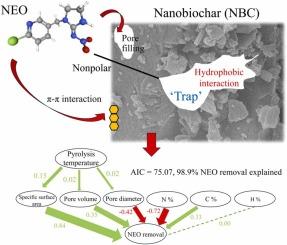
The widespread use of neonicotinoid (NEO) pesticides has raised significant environmental concerns due to their toxicity. We investigated the performance of 16 nanobiochars (NBCs), including NBC produced by Douglas fir at 900 °C (Doug 900 NBC), as sustainable sorbents for removing three common NEOs from aqueous solutions: imidacloprid, clothianidin, and thiamethoxam. The NBCs showed high sorption efficiency (∼ 100 %) and fast sorption kinetics (< 0.5 h) for three NEOs at environmentally relevant concentrations (100 ng/L). The sorption efficiency of NEOs was determined by the physicochemical properties of NBCs, including specific surface area (SSA), pore volume (PV), pore diameter (PD), and elemental composition (carbon, nitrogen, and hydrogen contents). The NBCs with higher SSA and larger PV offered more abundant sorption sites, facilitating fast NEO sorption. Particularly, the Doug 900 NBC achieved ∼ 100 % removal efficiency of NEOs within 0.5 h under simulated groundwater conditions (67.5 mg/L of total dissolved solids and 10 mg/L of humic acid). The Doug 900 NBC also maintained high removal efficiency over four continuous reuse cycles. The structural equation modeling revealed that pyrolysis temperature indirectly affects NEO sorption by modifying NBC’s properties of SSA, PV, and PD. Our findings highlight the high potential of NBCs for sustainable removal of NEO pesticides in aquatic environments at environmentally relevant concentrations.
期刊介绍:
The Journal of Hazardous Materials serves as a global platform for promoting cutting-edge research in the field of Environmental Science and Engineering. Our publication features a wide range of articles, including full-length research papers, review articles, and perspectives, with the aim of enhancing our understanding of the dangers and risks associated with various materials concerning public health and the environment. It is important to note that the term "environmental contaminants" refers specifically to substances that pose hazardous effects through contamination, while excluding those that do not have such impacts on the environment or human health. Moreover, we emphasize the distinction between wastes and hazardous materials in order to provide further clarity on the scope of the journal. We have a keen interest in exploring specific compounds and microbial agents that have adverse effects on the environment.



 京公网安备 11010802042870号
京ICP备2023020795号-1
京公网安备 11010802042870号
京ICP备2023020795号-1

 分享
分享
 求助内容:
求助内容: 应助结果提醒方式:
 扫码关注我们
