{"title":"Realizing Color-Tunable Photochromism in Apatite-Structured Compounds via Trapping Energy Management for Wide Gamut Encryption","authors":"Jingxuan Zhang, Hengwei Lin, Jiaren Du","doi":"10.1002/lpor.202500221","DOIUrl":null,"url":null,"abstract":"<p>Photochromic materials have shown significant potential in a plethora of possible applications. However, in practical applications, they remain limited by intricate multi-stage synthesis processes and a restricted range of photochromic colors. Modulating the chromatic properties involves an intricate manipulation of their chemical composition, crystal structure, and trapping energy levels, rendering it extremely challenging to achieve a desired color gamut. In this study, apatite-type materials are rapidly synthesized using a microwave-assisted approach. The photochromic behavior is systematically examined by substituting F⁻ ions with Cl⁻ ions, facilitating the transformation of color centers from pink to green and ultimately to blue. Notably, the prominent reflectance absorption peak ≈554 nm exhibited a gradual red shift to 625 nm. A thorough characterization reveals that this large shift in wavelength of F-center arises from the effective modulation in the trapping energy levels with differing trap distributions linked to photochromism observed across the various Sr₅(PO₄)₃F₁₋<sub>x</sub>Cl<sub>x</sub>:1%Eu. Finally, the potential applications of these multicolor compounds are demonstrated in routine chromatic decorations and sophisticated multi-hued cryptographic technologies. These findings highlight the efficacy of trapping energy management in optimizing photochromic behavior and the considerable capability of the photochromic materials for on-demand practical applications.</p>","PeriodicalId":204,"journal":{"name":"Laser & Photonics Reviews","volume":"19 16","pages":""},"PeriodicalIF":10.0000,"publicationDate":"2025-04-19","publicationTypes":"Journal Article","fieldsOfStudy":null,"isOpenAccess":false,"openAccessPdf":"","citationCount":"0","resultStr":null,"platform":"Semanticscholar","paperid":null,"PeriodicalName":"Laser & Photonics Reviews","FirstCategoryId":"101","ListUrlMain":"https://onlinelibrary.wiley.com/doi/10.1002/lpor.202500221","RegionNum":1,"RegionCategory":"物理与天体物理","ArticlePicture":[],"TitleCN":null,"AbstractTextCN":null,"PMCID":null,"EPubDate":"","PubModel":"","JCR":"Q1","JCRName":"OPTICS","Score":null,"Total":0}
引用次数: 0
Abstract
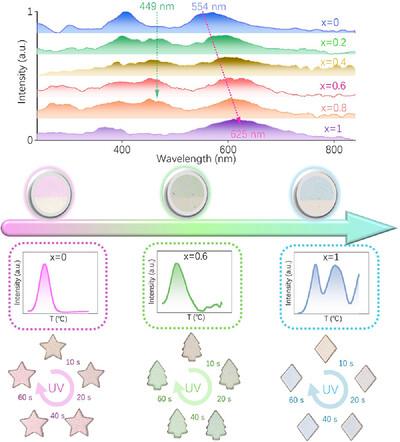
Photochromic materials have shown significant potential in a plethora of possible applications. However, in practical applications, they remain limited by intricate multi-stage synthesis processes and a restricted range of photochromic colors. Modulating the chromatic properties involves an intricate manipulation of their chemical composition, crystal structure, and trapping energy levels, rendering it extremely challenging to achieve a desired color gamut. In this study, apatite-type materials are rapidly synthesized using a microwave-assisted approach. The photochromic behavior is systematically examined by substituting F⁻ ions with Cl⁻ ions, facilitating the transformation of color centers from pink to green and ultimately to blue. Notably, the prominent reflectance absorption peak ≈554 nm exhibited a gradual red shift to 625 nm. A thorough characterization reveals that this large shift in wavelength of F-center arises from the effective modulation in the trapping energy levels with differing trap distributions linked to photochromism observed across the various Sr₅(PO₄)₃F₁₋xClx:1%Eu. Finally, the potential applications of these multicolor compounds are demonstrated in routine chromatic decorations and sophisticated multi-hued cryptographic technologies. These findings highlight the efficacy of trapping energy management in optimizing photochromic behavior and the considerable capability of the photochromic materials for on-demand practical applications.
期刊介绍:
Laser & Photonics Reviews is a reputable journal that publishes high-quality Reviews, original Research Articles, and Perspectives in the field of photonics and optics. It covers both theoretical and experimental aspects, including recent groundbreaking research, specific advancements, and innovative applications.
As evidence of its impact and recognition, Laser & Photonics Reviews boasts a remarkable 2022 Impact Factor of 11.0, according to the Journal Citation Reports from Clarivate Analytics (2023). Moreover, it holds impressive rankings in the InCites Journal Citation Reports: in 2021, it was ranked 6th out of 101 in the field of Optics, 15th out of 161 in Applied Physics, and 12th out of 69 in Condensed Matter Physics.
The journal uses the ISSN numbers 1863-8880 for print and 1863-8899 for online publications.




 京公网安备 11010802042870号
京ICP备2023020795号-1
京公网安备 11010802042870号
京ICP备2023020795号-1

 分享
分享
 求助内容:
求助内容: 应助结果提醒方式:
 扫码关注我们
