Xuelian Liu , Qian Li , Yuying Zheng , Weijie Zheng
{"title":"Polypropylene assisted phase separation nylon-6 antistatic composites: MWCNTs-NH2 and CB-NH2 as hybrid conductive nanofillers","authors":"Xuelian Liu , Qian Li , Yuying Zheng , Weijie Zheng","doi":"10.1016/j.polymer.2025.128433","DOIUrl":null,"url":null,"abstract":"<div><div>Antistatic nylon-6 (PA6) composites have attracted considerable attention due to their tailored properties for electronics, textiles, and automotive applications. In this paper, the antistatic PA6 composites comprising with polypropylene (PP), aminated multi-walled carbon nanotubes (MWCNTs-NH<sub>2</sub>) and aminated carbon black (CB–NH<sub>2</sub>) were prepared by melt blending and compression molding. In the composite system, PP was used as the co-matrix to assist the phase separation of PA6. MWCNTs-NH<sub>2</sub> and CB-NH<sub>2</sub> were introduced as conductive fillers. All composites showed good thermal stability with the T<sub>5 %</sub> higher than 376 °C and the composites containing fillers showed higher residues after thermal degradation due to the good thermal stability of MWCNTs-NH<sub>2</sub> and CB-NH<sub>2</sub>. The DSC and XRD results indicated that the crystallization properties of the composite materials were determined by PA6 and PP rather the conductive fillers. In general, the introduction of conductive fillers decreased the mechanical properties but effectively improved the conductivity of the composites and then the antistatic properties. Besides, the antistatic analysis and mechanical test denoted that MWCNTs-NH<sub>2</sub> and CB-NH<sub>2</sub> showed synergistic effect on improving the antistatic and mechanical properties of the composites, which was more evident at high MWCNTs-NH<sub>2</sub> quantity. The micromorphologies obtained by SEM first confirmed the ductile fracture of these composites, and then disclosed a two-phase structure of PA6 and PP polymer matrix, where the conductive fillers were found in the PA6 phase. Considering both mechanical and antistatic properties, the composite (PCNB-3) containing both 3 phr MWCNTs-NH<sub>2</sub> and CB-NH<sub>2</sub> was proposed for the antistatic PA6 composite.</div></div>","PeriodicalId":405,"journal":{"name":"Polymer","volume":"328 ","pages":"Article 128433"},"PeriodicalIF":4.5000,"publicationDate":"2025-04-21","publicationTypes":"Journal Article","fieldsOfStudy":null,"isOpenAccess":false,"openAccessPdf":"","citationCount":"0","resultStr":null,"platform":"Semanticscholar","paperid":null,"PeriodicalName":"Polymer","FirstCategoryId":"92","ListUrlMain":"https://www.sciencedirect.com/science/article/pii/S0032386125004197","RegionNum":2,"RegionCategory":"化学","ArticlePicture":[],"TitleCN":null,"AbstractTextCN":null,"PMCID":null,"EPubDate":"","PubModel":"","JCR":"Q2","JCRName":"POLYMER SCIENCE","Score":null,"Total":0}
引用次数: 0
Abstract
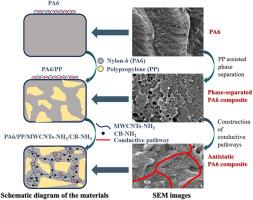
Antistatic nylon-6 (PA6) composites have attracted considerable attention due to their tailored properties for electronics, textiles, and automotive applications. In this paper, the antistatic PA6 composites comprising with polypropylene (PP), aminated multi-walled carbon nanotubes (MWCNTs-NH2) and aminated carbon black (CB–NH2) were prepared by melt blending and compression molding. In the composite system, PP was used as the co-matrix to assist the phase separation of PA6. MWCNTs-NH2 and CB-NH2 were introduced as conductive fillers. All composites showed good thermal stability with the T5 % higher than 376 °C and the composites containing fillers showed higher residues after thermal degradation due to the good thermal stability of MWCNTs-NH2 and CB-NH2. The DSC and XRD results indicated that the crystallization properties of the composite materials were determined by PA6 and PP rather the conductive fillers. In general, the introduction of conductive fillers decreased the mechanical properties but effectively improved the conductivity of the composites and then the antistatic properties. Besides, the antistatic analysis and mechanical test denoted that MWCNTs-NH2 and CB-NH2 showed synergistic effect on improving the antistatic and mechanical properties of the composites, which was more evident at high MWCNTs-NH2 quantity. The micromorphologies obtained by SEM first confirmed the ductile fracture of these composites, and then disclosed a two-phase structure of PA6 and PP polymer matrix, where the conductive fillers were found in the PA6 phase. Considering both mechanical and antistatic properties, the composite (PCNB-3) containing both 3 phr MWCNTs-NH2 and CB-NH2 was proposed for the antistatic PA6 composite.
期刊介绍:
Polymer is an interdisciplinary journal dedicated to publishing innovative and significant advances in Polymer Physics, Chemistry and Technology. We welcome submissions on polymer hybrids, nanocomposites, characterisation and self-assembly. Polymer also publishes work on the technological application of polymers in energy and optoelectronics.
The main scope is covered but not limited to the following core areas:
Polymer Materials
Nanocomposites and hybrid nanomaterials
Polymer blends, films, fibres, networks and porous materials
Physical Characterization
Characterisation, modelling and simulation* of molecular and materials properties in bulk, solution, and thin films
Polymer Engineering
Advanced multiscale processing methods
Polymer Synthesis, Modification and Self-assembly
Including designer polymer architectures, mechanisms and kinetics, and supramolecular polymerization
Technological Applications
Polymers for energy generation and storage
Polymer membranes for separation technology
Polymers for opto- and microelectronics.




 京公网安备 11010802042870号
京ICP备2023020795号-1
京公网安备 11010802042870号
京ICP备2023020795号-1

 分享
分享
 求助内容:
求助内容: 应助结果提醒方式:
 扫码关注我们
