Structural Engineering of Core–Shell Ni3B@Ni(BO2)2 on V2MoO8 (0D@2D/1D) Composites: Advanced Strategies for Enhancing High Energy Density in Asymmetric Supercapacitors
Ahamed Milton, Abdullah Al Mahmud, Ramaraj Sukanya, Raj Karthik, Eswaran Kamaraj, Carmel B. Breslin, P. Muhammed Shafi, Jae-Jin Shim
{"title":"Structural Engineering of Core–Shell Ni3B@Ni(BO2)2 on V2MoO8 (0D@2D/1D) Composites: Advanced Strategies for Enhancing High Energy Density in Asymmetric Supercapacitors","authors":"Ahamed Milton, Abdullah Al Mahmud, Ramaraj Sukanya, Raj Karthik, Eswaran Kamaraj, Carmel B. Breslin, P. Muhammed Shafi, Jae-Jin Shim","doi":"10.1021/acs.langmuir.5c00378","DOIUrl":null,"url":null,"abstract":"The development of hierarchical core–shell structures and multicomponent metal boride/metal oxide-based composites presents a promising strategy to enhance supercapacitor (SC) performance. In this study, we synthesized a Ni<sub>3</sub>B@Ni(BO<sub>2</sub>)<sub>2</sub> (0D@2D) core–shell structure and integrated it with V<sub>2</sub>MoO<sub>8</sub> (VMO) rods (1D) to form a Ni<sub>3</sub>B@Ni(BO<sub>2</sub>)<sub>2</sub>/VMO (NB@NBO/VMO (0D@2D/1D)) composite. This composite was then used as an electrode material on a flexible carbon cloth (CC) substrate for SC applications. The 1D-VMO rods were derived from V-doped MoSe<sub>2</sub> nanosheets via hydrothermal synthesis and calcination, while the NB@NBO/VMO composite was obtained by using a liquid-phase method. Structural, compositional, and morphological characterizations were conducted using XRD, XPS, FE-SEM, and TEM-EDS. In a three-electrode system, the NB@NBO/VMO-50 composite showed an impressive <i>C</i><sub>s</sub> of 698 F g<sup>–1</sup> at 1 A g<sup>–1</sup>, ascribed to its unique core–shell architecture, which enhances contact and faradaic properties, shortens ion diffusion paths, and provides abundant active sites. Notably, the NB@NBO/VMO-50 displayed excellent cyclic stability, retaining 75.1% of its capacitance after 10,000 cycles at 10 A g<sup>–1</sup>. This performance is better than those of other electrodes, including pristine VMO/CC, NB/CC, NB@NBO/VMO-25, and NB@NBO/VMO-75. When evaluated in a two-electrode asymmetric SC system, the NB@NBO/VMO-50/CC||rGO device operated at 1.6 V and delivered a high energy density (ED) of 40.5 Wh kg<sup>–1</sup> at a power density (PD) of 800 W kg<sup>–1</sup>. It also reached a PD of 16,000 W kg<sup>–1</sup> while maintaining an ED of 23.5 Wh kg<sup>–1</sup>. The device also showed remarkable long-term durability, maintaining 79.3% of its capacitance and 99.9% Coulombic efficiency after 8000 charge–discharge cycles at 8 A g<sup>–1</sup>, demonstrating its strong potential for next-generation energy storage applications.","PeriodicalId":50,"journal":{"name":"Langmuir","volume":"33 1","pages":""},"PeriodicalIF":3.9000,"publicationDate":"2025-04-21","publicationTypes":"Journal Article","fieldsOfStudy":null,"isOpenAccess":false,"openAccessPdf":"","citationCount":"0","resultStr":null,"platform":"Semanticscholar","paperid":null,"PeriodicalName":"Langmuir","FirstCategoryId":"92","ListUrlMain":"https://doi.org/10.1021/acs.langmuir.5c00378","RegionNum":2,"RegionCategory":"化学","ArticlePicture":[],"TitleCN":null,"AbstractTextCN":null,"PMCID":null,"EPubDate":"","PubModel":"","JCR":"Q2","JCRName":"CHEMISTRY, MULTIDISCIPLINARY","Score":null,"Total":0}
引用次数: 0
Abstract
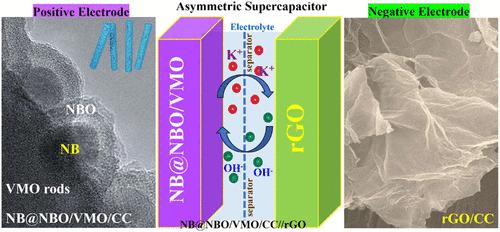
The development of hierarchical core–shell structures and multicomponent metal boride/metal oxide-based composites presents a promising strategy to enhance supercapacitor (SC) performance. In this study, we synthesized a Ni3B@Ni(BO2)2 (0D@2D) core–shell structure and integrated it with V2MoO8 (VMO) rods (1D) to form a Ni3B@Ni(BO2)2/VMO (NB@NBO/VMO (0D@2D/1D)) composite. This composite was then used as an electrode material on a flexible carbon cloth (CC) substrate for SC applications. The 1D-VMO rods were derived from V-doped MoSe2 nanosheets via hydrothermal synthesis and calcination, while the NB@NBO/VMO composite was obtained by using a liquid-phase method. Structural, compositional, and morphological characterizations were conducted using XRD, XPS, FE-SEM, and TEM-EDS. In a three-electrode system, the NB@NBO/VMO-50 composite showed an impressive Cs of 698 F g–1 at 1 A g–1, ascribed to its unique core–shell architecture, which enhances contact and faradaic properties, shortens ion diffusion paths, and provides abundant active sites. Notably, the NB@NBO/VMO-50 displayed excellent cyclic stability, retaining 75.1% of its capacitance after 10,000 cycles at 10 A g–1. This performance is better than those of other electrodes, including pristine VMO/CC, NB/CC, NB@NBO/VMO-25, and NB@NBO/VMO-75. When evaluated in a two-electrode asymmetric SC system, the NB@NBO/VMO-50/CC||rGO device operated at 1.6 V and delivered a high energy density (ED) of 40.5 Wh kg–1 at a power density (PD) of 800 W kg–1. It also reached a PD of 16,000 W kg–1 while maintaining an ED of 23.5 Wh kg–1. The device also showed remarkable long-term durability, maintaining 79.3% of its capacitance and 99.9% Coulombic efficiency after 8000 charge–discharge cycles at 8 A g–1, demonstrating its strong potential for next-generation energy storage applications.
层次化核壳结构和多组分金属硼化物/金属氧化物基复合材料的发展为提高超级电容器的性能提供了一条有前途的途径。在本研究中,我们合成了Ni3B@Ni(BO2)2 (0D@2D)核壳结构,并将其与V2MoO8 (VMO)棒材(1D)结合,形成Ni3B@Ni(BO2)2/VMO (NB@NBO/VMO (0D@2D/1D))复合材料。然后将该复合材料用作SC应用的柔性碳布(CC)衬底上的电极材料。通过水热法和煅烧法制备了v掺杂MoSe2纳米片的1D-VMO棒,通过液相法制备了NB@NBO/VMO复合材料。采用XRD、XPS、FE-SEM和TEM-EDS对其进行了结构、成分和形态表征。在三电极体系中,NB@NBO/VMO-50复合材料在1 a g-1时的Cs值为698 F - 1,这归功于其独特的核壳结构,增强了接触和法拉第性质,缩短了离子扩散路径,并提供了丰富的活性位点。值得注意的是,NB@NBO/VMO-50表现出优异的循环稳定性,在10 A g-1下循环10,000次后保持了75.1%的电容。该性能优于其他电极,包括原始VMO/CC, NB/CC, NB@NBO/VMO-25和NB@NBO/VMO-75。当在双电极不对称SC系统中进行评估时,NB@NBO/VMO-50/CC||rGO器件在1.6 V下工作,在800 W kg-1的功率密度下提供了40.5 Wh kg-1的高能量密度(ED)。它还达到了16000 W kg-1的PD,同时保持了23.5 Wh kg-1的ED。该器件还表现出了卓越的长期耐用性,在8 A g-1的条件下进行8000次充放电循环后,保持了79.3%的电容和99.9%的库仑效率,显示出其在下一代储能应用中的强大潜力。
期刊介绍:
Langmuir is an interdisciplinary journal publishing articles in the following subject categories:
Colloids: surfactants and self-assembly, dispersions, emulsions, foams
Interfaces: adsorption, reactions, films, forces
Biological Interfaces: biocolloids, biomolecular and biomimetic materials
Materials: nano- and mesostructured materials, polymers, gels, liquid crystals
Electrochemistry: interfacial charge transfer, charge transport, electrocatalysis, electrokinetic phenomena, bioelectrochemistry
Devices and Applications: sensors, fluidics, patterning, catalysis, photonic crystals
However, when high-impact, original work is submitted that does not fit within the above categories, decisions to accept or decline such papers will be based on one criteria: What Would Irving Do?
Langmuir ranks #2 in citations out of 136 journals in the category of Physical Chemistry with 113,157 total citations. The journal received an Impact Factor of 4.384*.
This journal is also indexed in the categories of Materials Science (ranked #1) and Multidisciplinary Chemistry (ranked #5).



 京公网安备 11010802042870号
京ICP备2023020795号-1
京公网安备 11010802042870号
京ICP备2023020795号-1

 分享
分享
 求助内容:
求助内容: 应助结果提醒方式:
 扫码关注我们
