Xiangyu Sheng, Zhijian Du, Zhiyi Gao, Jianxiong Xu, La Li, Guozhen Shen
{"title":"An Implantable In-Hydrogel Wireless Supercapacitor-Activated Neuron System Enables Bidirectional Modulation","authors":"Xiangyu Sheng, Zhijian Du, Zhiyi Gao, Jianxiong Xu, La Li, Guozhen Shen","doi":"10.1002/adma.202504558","DOIUrl":null,"url":null,"abstract":"<p>The bidirectional modulation of cerebral neurons in the brain possesses enhancement and inhibition of neural activity, which is of great interest in the treatment of motor nerve disorders and emotional disorders, and cognitive defects. However, existing approaches usually rely on electrical/electrochemical stimulations, which show low security by implanting metal probes and unidirectional currents with single modulation. Herein, an implantable in-hydrogel wireless supercapacitor-activated neuron system consisting of the coil, diode bridge circuit, in-hydrogel supercapacitor, and stimulation electrodes is fabricated, which provides a bidirectional and adjustable ion diffusion current to safely and effectively excite and inhibit brain neurons. The designed in-hydrogel supercapacitor exhibits a high storage charge ability of ≈90 times larger than the devices without hydrogel encapsulation, owing to the in situ radical addition mechanism. Moreover, the in-hydrogel electrodes are implanted into the thalamus, amygdala, and prefrontal lobes of the brain to evoke the corresponding changes in potential intensity and frequency through the external chargeable coil and diode bridge circuit, which verifies the potential of the multimodule supercapacitor in amelioration and treatment Parkinson's, severe depression, and Alzheimer's disease.</p>","PeriodicalId":114,"journal":{"name":"Advanced Materials","volume":"37 29","pages":""},"PeriodicalIF":26.8000,"publicationDate":"2025-04-21","publicationTypes":"Journal Article","fieldsOfStudy":null,"isOpenAccess":false,"openAccessPdf":"","citationCount":"0","resultStr":null,"platform":"Semanticscholar","paperid":null,"PeriodicalName":"Advanced Materials","FirstCategoryId":"88","ListUrlMain":"https://advanced.onlinelibrary.wiley.com/doi/10.1002/adma.202504558","RegionNum":1,"RegionCategory":"材料科学","ArticlePicture":[],"TitleCN":null,"AbstractTextCN":null,"PMCID":null,"EPubDate":"","PubModel":"","JCR":"Q1","JCRName":"CHEMISTRY, MULTIDISCIPLINARY","Score":null,"Total":0}
引用次数: 0
Abstract
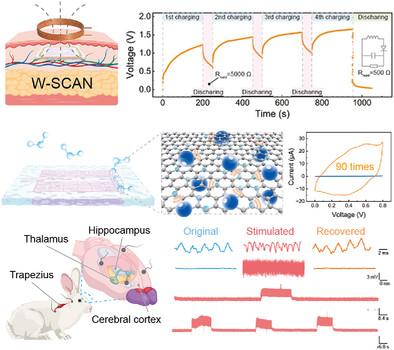
The bidirectional modulation of cerebral neurons in the brain possesses enhancement and inhibition of neural activity, which is of great interest in the treatment of motor nerve disorders and emotional disorders, and cognitive defects. However, existing approaches usually rely on electrical/electrochemical stimulations, which show low security by implanting metal probes and unidirectional currents with single modulation. Herein, an implantable in-hydrogel wireless supercapacitor-activated neuron system consisting of the coil, diode bridge circuit, in-hydrogel supercapacitor, and stimulation electrodes is fabricated, which provides a bidirectional and adjustable ion diffusion current to safely and effectively excite and inhibit brain neurons. The designed in-hydrogel supercapacitor exhibits a high storage charge ability of ≈90 times larger than the devices without hydrogel encapsulation, owing to the in situ radical addition mechanism. Moreover, the in-hydrogel electrodes are implanted into the thalamus, amygdala, and prefrontal lobes of the brain to evoke the corresponding changes in potential intensity and frequency through the external chargeable coil and diode bridge circuit, which verifies the potential of the multimodule supercapacitor in amelioration and treatment Parkinson's, severe depression, and Alzheimer's disease.
期刊介绍:
Advanced Materials, one of the world's most prestigious journals and the foundation of the Advanced portfolio, is the home of choice for best-in-class materials science for more than 30 years. Following this fast-growing and interdisciplinary field, we are considering and publishing the most important discoveries on any and all materials from materials scientists, chemists, physicists, engineers as well as health and life scientists and bringing you the latest results and trends in modern materials-related research every week.







 京公网安备 11010802042870号
京ICP备2023020795号-1
京公网安备 11010802042870号
京ICP备2023020795号-1

 分享
分享
 求助内容:
求助内容: 应助结果提醒方式:
 扫码关注我们
