Meiqi An , Conghui Tan , Hengshan Wang, Jing Li, Jijun Qiu, Jiao Xu, Yiming Yang
{"title":"Layered lead-free perovskite memristors with ultrahigh on/off ratio","authors":"Meiqi An , Conghui Tan , Hengshan Wang, Jing Li, Jijun Qiu, Jiao Xu, Yiming Yang","doi":"10.1016/j.apsusc.2025.163317","DOIUrl":null,"url":null,"abstract":"<div><div>Layered organic–inorganic hybrid halide perovskites hold promises for memristive and synaptic devices with ultralow power consumption. However, the lead-based layered perovskites often contain organic cations which are subject to thermal and optical instability. Here we report lead-free resistive switching devices incorporating nanostructured all-inorganic perovskite Cs<sub>3</sub>Bi<sub>2</sub>Br<sub>9</sub>. Monocrystalline hexagonal microplates of Cs<sub>3</sub>Bi<sub>2</sub>Br<sub>9</sub> were synthesized via a solution method featuring layered structure and smooth morphology. Upon sandwiched by sliver and conductive glass, the microplate devices exhibit resistive switching behavior under forming-free bias below 0.2 V. Ultrahigh on/off ratio up to 10<sup>9</sup> was recorded in these devices, favoring multi-level data storage capabilities within single memory units. The high switching ratio is attributed to the suppressed inter-layer electrical conductance of the microplates. In addition, the memristive devices demonstrate excellent stability over 20 months in ambient condition. This work offers insights into utilizing layered inorganic perovskite architectures for resistive switching devices with decoupled ionic and electronic transport.</div></div>","PeriodicalId":247,"journal":{"name":"Applied Surface Science","volume":"701 ","pages":"Article 163317"},"PeriodicalIF":6.9000,"publicationDate":"2025-08-30","publicationTypes":"Journal Article","fieldsOfStudy":null,"isOpenAccess":false,"openAccessPdf":"","citationCount":"0","resultStr":null,"platform":"Semanticscholar","paperid":null,"PeriodicalName":"Applied Surface Science","FirstCategoryId":"88","ListUrlMain":"https://www.sciencedirect.com/science/article/pii/S0169433225010311","RegionNum":2,"RegionCategory":"材料科学","ArticlePicture":[],"TitleCN":null,"AbstractTextCN":null,"PMCID":null,"EPubDate":"2025/4/20 0:00:00","PubModel":"Epub","JCR":"Q2","JCRName":"CHEMISTRY, PHYSICAL","Score":null,"Total":0}
引用次数: 0
Abstract
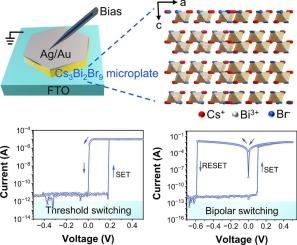
Layered organic–inorganic hybrid halide perovskites hold promises for memristive and synaptic devices with ultralow power consumption. However, the lead-based layered perovskites often contain organic cations which are subject to thermal and optical instability. Here we report lead-free resistive switching devices incorporating nanostructured all-inorganic perovskite Cs3Bi2Br9. Monocrystalline hexagonal microplates of Cs3Bi2Br9 were synthesized via a solution method featuring layered structure and smooth morphology. Upon sandwiched by sliver and conductive glass, the microplate devices exhibit resistive switching behavior under forming-free bias below 0.2 V. Ultrahigh on/off ratio up to 109 was recorded in these devices, favoring multi-level data storage capabilities within single memory units. The high switching ratio is attributed to the suppressed inter-layer electrical conductance of the microplates. In addition, the memristive devices demonstrate excellent stability over 20 months in ambient condition. This work offers insights into utilizing layered inorganic perovskite architectures for resistive switching devices with decoupled ionic and electronic transport.
期刊介绍:
Applied Surface Science covers topics contributing to a better understanding of surfaces, interfaces, nanostructures and their applications. The journal is concerned with scientific research on the atomic and molecular level of material properties determined with specific surface analytical techniques and/or computational methods, as well as the processing of such structures.




 京公网安备 11010802042870号
京ICP备2023020795号-1
京公网安备 11010802042870号
京ICP备2023020795号-1

 分享
分享
 求助内容:
求助内容: 应助结果提醒方式:
 扫码关注我们
