Dual-selectivity and high-sensitivity sensor for dibutylamine and diisopropylamine detection using ZnO nanoparticles with tetragonal dipyramidal morphology
Ming-Chao Zhu , Guo-Li Chen , Kun Song , Jian-Jiao Xin , Xiao-Ming Huang
{"title":"Dual-selectivity and high-sensitivity sensor for dibutylamine and diisopropylamine detection using ZnO nanoparticles with tetragonal dipyramidal morphology","authors":"Ming-Chao Zhu , Guo-Li Chen , Kun Song , Jian-Jiao Xin , Xiao-Ming Huang","doi":"10.1016/j.apsusc.2025.163322","DOIUrl":null,"url":null,"abstract":"<div><div>The simultaneous detection of the toxic gases Dibutylamine (DBA) and Diisopropylamine (DIPA) by ZnO has not been reported, making dual detection of these gases a challenge. In this paper, a tetragonal dipyramid-like ZnO precursor was prepared using a hydrothermal method, focusing on microstructural changes at different calcination temperatures and their effects on gas sensing performance. After calcination at 550 °C, tetragonal dipyramid-like ZnO (ZnO<sub>TD</sub>-550) was obtained, featuring two grooves that serve as “bridges” between the two tetragonal cones. The structure consists of uniform nanoparticles with a broad mesoporous distribution, high specific surface area, and abundant oxygen vacancies. These features collectively enable rapid gas reactions, enhancing sensor sensititity. The tetragonal dipyramid-like ZnO sensor exhibits an significant response to 100 ppm DBA at 133 °C (<em>S</em> = 300.6), and a comparable response to the same concentration of DIPA at 217 °C (<em>S</em> = 271.5). The ZnO<sub>TD</sub>-550 sensor also demonstrates a low detection limit, excellent long-term stability, reproducibility and humidity resistance for DBA/DIPA detection. This pioneering study reveals the capability of ZnO-based sensors for highly sensitivity and dual-selectivity detection of the toxic gases DBA and DIPA at distinct operating temperatures. In addition, the dual-sensitivity mechanisms have been thoroughly explored and analyzed.</div></div>","PeriodicalId":247,"journal":{"name":"Applied Surface Science","volume":"701 ","pages":"Article 163322"},"PeriodicalIF":6.9000,"publicationDate":"2025-08-30","publicationTypes":"Journal Article","fieldsOfStudy":null,"isOpenAccess":false,"openAccessPdf":"","citationCount":"0","resultStr":null,"platform":"Semanticscholar","paperid":null,"PeriodicalName":"Applied Surface Science","FirstCategoryId":"88","ListUrlMain":"https://www.sciencedirect.com/science/article/pii/S0169433225010360","RegionNum":2,"RegionCategory":"材料科学","ArticlePicture":[],"TitleCN":null,"AbstractTextCN":null,"PMCID":null,"EPubDate":"2025/4/20 0:00:00","PubModel":"Epub","JCR":"Q2","JCRName":"CHEMISTRY, PHYSICAL","Score":null,"Total":0}
引用次数: 0
Abstract
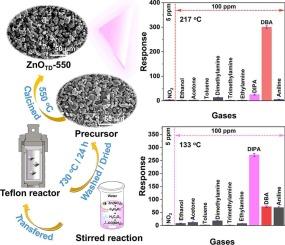
The simultaneous detection of the toxic gases Dibutylamine (DBA) and Diisopropylamine (DIPA) by ZnO has not been reported, making dual detection of these gases a challenge. In this paper, a tetragonal dipyramid-like ZnO precursor was prepared using a hydrothermal method, focusing on microstructural changes at different calcination temperatures and their effects on gas sensing performance. After calcination at 550 °C, tetragonal dipyramid-like ZnO (ZnOTD-550) was obtained, featuring two grooves that serve as “bridges” between the two tetragonal cones. The structure consists of uniform nanoparticles with a broad mesoporous distribution, high specific surface area, and abundant oxygen vacancies. These features collectively enable rapid gas reactions, enhancing sensor sensititity. The tetragonal dipyramid-like ZnO sensor exhibits an significant response to 100 ppm DBA at 133 °C (S = 300.6), and a comparable response to the same concentration of DIPA at 217 °C (S = 271.5). The ZnOTD-550 sensor also demonstrates a low detection limit, excellent long-term stability, reproducibility and humidity resistance for DBA/DIPA detection. This pioneering study reveals the capability of ZnO-based sensors for highly sensitivity and dual-selectivity detection of the toxic gases DBA and DIPA at distinct operating temperatures. In addition, the dual-sensitivity mechanisms have been thoroughly explored and analyzed.
期刊介绍:
Applied Surface Science covers topics contributing to a better understanding of surfaces, interfaces, nanostructures and their applications. The journal is concerned with scientific research on the atomic and molecular level of material properties determined with specific surface analytical techniques and/or computational methods, as well as the processing of such structures.




 京公网安备 11010802042870号
京ICP备2023020795号-1
京公网安备 11010802042870号
京ICP备2023020795号-1

 分享
分享
 求助内容:
求助内容: 应助结果提醒方式:
 扫码关注我们
