Hang Yang, Zhongge Luo, Boxue Wang, Ke Wang, Jianhong Zhao, Jin Zhang, Yuming Zhang, Qingju Liu
{"title":"Surface oxygen vacancy regulation via Li-doped in MOF-derived mesoporous TiO2 for printable mesoscopic perovskite solar cells","authors":"Hang Yang, Zhongge Luo, Boxue Wang, Ke Wang, Jianhong Zhao, Jin Zhang, Yuming Zhang, Qingju Liu","doi":"10.1016/j.apsusc.2025.163316","DOIUrl":null,"url":null,"abstract":"<div><div>The mesoporous TiO<sub>2</sub> displays low conductivity and abundant oxygen vacancies (OVs) defects, leading to reduced carrier extraction and affecting the power conversion efficiency (PCE) of perovskite solar cells (PSCs). In this study, we investigate the electron transport layer of mesoporous TiO<sub>2</sub> derived from Ti-MOFs with Li-doped, employing a strategy to regulate the OVs on the TiO<sub>2</sub> surface to enhance device performance. Experimental results demonstrate that Li doping increases the conductivity of TiO<sub>2</sub>, improves the energy level alignment between the TiO<sub>2</sub> and perovskite interfaces, and alleviates the residual stress in the perovskite. Theoretical calculations indicate that Li doping can inhibit the formation of OVs, reduce the band gap of TiO<sub>2</sub>, and decrease the surface energy of the interface, thereby enhancing carrier extraction. Ultimately, carbon-based printable mesoscopic PSC by Li-doped achieved a champion PCE of 18.07 % and improved long-term stability.</div></div>","PeriodicalId":247,"journal":{"name":"Applied Surface Science","volume":"702 ","pages":"Article 163316"},"PeriodicalIF":6.9000,"publicationDate":"2025-09-01","publicationTypes":"Journal Article","fieldsOfStudy":null,"isOpenAccess":false,"openAccessPdf":"","citationCount":"0","resultStr":null,"platform":"Semanticscholar","paperid":null,"PeriodicalName":"Applied Surface Science","FirstCategoryId":"88","ListUrlMain":"https://www.sciencedirect.com/science/article/pii/S016943322501030X","RegionNum":2,"RegionCategory":"材料科学","ArticlePicture":[],"TitleCN":null,"AbstractTextCN":null,"PMCID":null,"EPubDate":"2025/4/19 0:00:00","PubModel":"Epub","JCR":"Q2","JCRName":"CHEMISTRY, PHYSICAL","Score":null,"Total":0}
引用次数: 0
Abstract
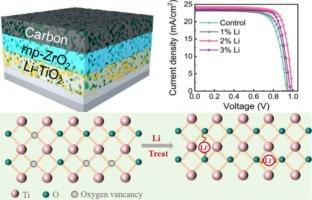
The mesoporous TiO2 displays low conductivity and abundant oxygen vacancies (OVs) defects, leading to reduced carrier extraction and affecting the power conversion efficiency (PCE) of perovskite solar cells (PSCs). In this study, we investigate the electron transport layer of mesoporous TiO2 derived from Ti-MOFs with Li-doped, employing a strategy to regulate the OVs on the TiO2 surface to enhance device performance. Experimental results demonstrate that Li doping increases the conductivity of TiO2, improves the energy level alignment between the TiO2 and perovskite interfaces, and alleviates the residual stress in the perovskite. Theoretical calculations indicate that Li doping can inhibit the formation of OVs, reduce the band gap of TiO2, and decrease the surface energy of the interface, thereby enhancing carrier extraction. Ultimately, carbon-based printable mesoscopic PSC by Li-doped achieved a champion PCE of 18.07 % and improved long-term stability.
期刊介绍:
Applied Surface Science covers topics contributing to a better understanding of surfaces, interfaces, nanostructures and their applications. The journal is concerned with scientific research on the atomic and molecular level of material properties determined with specific surface analytical techniques and/or computational methods, as well as the processing of such structures.




 京公网安备 11010802042870号
京ICP备2023020795号-1
京公网安备 11010802042870号
京ICP备2023020795号-1

 分享
分享
 求助内容:
求助内容: 应助结果提醒方式:
 扫码关注我们
