{"title":"Ultrabright Blue Lead-Halide Perovskite Light-Emitting Diodes Based on Phosphonic Acid Functionalized Hole Injection Layer","authors":"Xiyu Luo, Cong Tao, Yanru Lu, Zhijun Ren, Zengguang Zhang, Jiawei Chen, Qi Wang, Danlei Zhu, Haifeng Zhao, Zhongbin Wu, Xiaowang Liu, Yatao Zou, Dongdong Zhang, Shangshang Chen, Weidong Xu, Lian Duan","doi":"10.1021/acsnano.5c01879","DOIUrl":null,"url":null,"abstract":"Lead-halide perovskite light-emitting diodes (PeLEDs) are intrinsically capable of delivering high efficiency at high current densities compared to conventional solution-processed light-emitting diodes. While such performance and relevant high radiance have been well demonstrated in green and near-infrared ones, blue PeLEDs have lagged far behind due to extremely severe luminance-efficiency roll-off, especially in the pure-blue region (<480 nm, a CIEy coordinate below 0.15). Here, by tackling the critical limitations of phosphonic acid functional carbazoles (PACs) as hole injection layers and simultaneously leveraging their advantages on hole injection, we achieved ultrabright pure blue PeLEDs with minimized efficiency roll-off at high brightness with a CIEy coordinate below 0.15. We show that devices based on prevailing small-molecule PACs generally exhibit significant leakage currents. This is due to a synergistic effect of uneven surface coverage from reverse micelle formation and the nanoisland structure of thin-film lead-halide perovskite emitters. By using polymeric PACs instead, we demonstrate bright blue PeLEDs showing a peak luminance of ∼29 800 cd m<sup>–2</sup> (478 nm, at a CIEy coordinate below 0.15). We also achieve a high brightness reaching ∼140 000 cd m<sup>–2</sup> under pulsed driven. Our study not only provides a useful guidance for developing bright blue PeLEDs but also resolves a long-standing puzzle regarding the interfacial properties of PACs and their impact on hole transport, and it helps with the further design of these materials for lead-halide perovskite applications.","PeriodicalId":21,"journal":{"name":"ACS Nano","volume":"28 1","pages":""},"PeriodicalIF":16.0000,"publicationDate":"2025-04-21","publicationTypes":"Journal Article","fieldsOfStudy":null,"isOpenAccess":false,"openAccessPdf":"","citationCount":"0","resultStr":null,"platform":"Semanticscholar","paperid":null,"PeriodicalName":"ACS Nano","FirstCategoryId":"88","ListUrlMain":"https://doi.org/10.1021/acsnano.5c01879","RegionNum":1,"RegionCategory":"材料科学","ArticlePicture":[],"TitleCN":null,"AbstractTextCN":null,"PMCID":null,"EPubDate":"","PubModel":"","JCR":"Q1","JCRName":"CHEMISTRY, MULTIDISCIPLINARY","Score":null,"Total":0}
引用次数: 0
Abstract
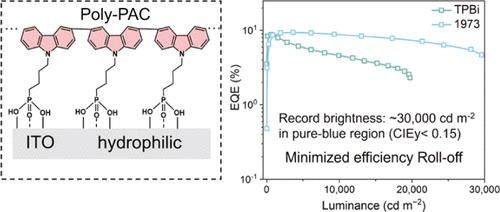
Lead-halide perovskite light-emitting diodes (PeLEDs) are intrinsically capable of delivering high efficiency at high current densities compared to conventional solution-processed light-emitting diodes. While such performance and relevant high radiance have been well demonstrated in green and near-infrared ones, blue PeLEDs have lagged far behind due to extremely severe luminance-efficiency roll-off, especially in the pure-blue region (<480 nm, a CIEy coordinate below 0.15). Here, by tackling the critical limitations of phosphonic acid functional carbazoles (PACs) as hole injection layers and simultaneously leveraging their advantages on hole injection, we achieved ultrabright pure blue PeLEDs with minimized efficiency roll-off at high brightness with a CIEy coordinate below 0.15. We show that devices based on prevailing small-molecule PACs generally exhibit significant leakage currents. This is due to a synergistic effect of uneven surface coverage from reverse micelle formation and the nanoisland structure of thin-film lead-halide perovskite emitters. By using polymeric PACs instead, we demonstrate bright blue PeLEDs showing a peak luminance of ∼29 800 cd m–2 (478 nm, at a CIEy coordinate below 0.15). We also achieve a high brightness reaching ∼140 000 cd m–2 under pulsed driven. Our study not only provides a useful guidance for developing bright blue PeLEDs but also resolves a long-standing puzzle regarding the interfacial properties of PACs and their impact on hole transport, and it helps with the further design of these materials for lead-halide perovskite applications.
期刊介绍:
ACS Nano, published monthly, serves as an international forum for comprehensive articles on nanoscience and nanotechnology research at the intersections of chemistry, biology, materials science, physics, and engineering. The journal fosters communication among scientists in these communities, facilitating collaboration, new research opportunities, and advancements through discoveries. ACS Nano covers synthesis, assembly, characterization, theory, and simulation of nanostructures, nanobiotechnology, nanofabrication, methods and tools for nanoscience and nanotechnology, and self- and directed-assembly. Alongside original research articles, it offers thorough reviews, perspectives on cutting-edge research, and discussions envisioning the future of nanoscience and nanotechnology.



 京公网安备 11010802042870号
京ICP备2023020795号-1
京公网安备 11010802042870号
京ICP备2023020795号-1

 分享
分享
 求助内容:
求助内容: 应助结果提醒方式:
 扫码关注我们
