{"title":"Structural evolution of polycrystalline diamond films under single-pulse femtosecond laser irradiation","authors":"Daqi Zhang, Tao Chen, Yun Zhong, Yingjie Li, Jinhai Si, Xun Hou","doi":"10.1016/j.apsusc.2025.163318","DOIUrl":null,"url":null,"abstract":"<div><div>Diamond thin films have important applications in a wide range of fields. Nevertheless, their ultra-hard and ultra-thin nature imposes limitations on their machinability. The utilization of ultrafast lasers in the surface modification of diamond thin films has led to numerous significant applications. The present study investigates the properties of single-pulse femtosecond laser radiation on microcrystalline diamond (MCD) films and finds that the diamond films show three types of modifications, namely, nonablative graphitization, ablation, and ionization with the increase of laser energy, with the thresholds of 0.52 J/cm<sup>2</sup> 1.03 J/cm<sup>2</sup> and 4.19 J/cm<sup>2</sup>, respectively. Furthermore, the irradiated area is characterized by an 'Arch-Crater-W like' feature. The high-pressure expanding plasma, which is generated during the ionization process, exerts a polishing effect on the diamond surface, resulting in a reduction of the surface roughness (Ra) to 5.6 nm and a decrease in the maximum profile peak height (Rp) by 61 %. Moreover, it has been established that femtosecond laser radiation of MCD films will shield the Raman signal of the silicon substrate, achieving an exponential reduction. The combination of these characteristics with the unique properties of femtosecond laser radiation diamond coatings suggests their potential for use in microelectronic packaging, surface modification of optical devices, biosensor manufacturing, and other fields, thereby demonstrating their unique value as a technological application.<ul><li><span></span><span><div>Diamond; Thin films; Femtosecond laser; materials processing.</div></span></li></ul></div></div>","PeriodicalId":247,"journal":{"name":"Applied Surface Science","volume":"702 ","pages":"Article 163318"},"PeriodicalIF":6.9000,"publicationDate":"2025-09-01","publicationTypes":"Journal Article","fieldsOfStudy":null,"isOpenAccess":false,"openAccessPdf":"","citationCount":"0","resultStr":null,"platform":"Semanticscholar","paperid":null,"PeriodicalName":"Applied Surface Science","FirstCategoryId":"88","ListUrlMain":"https://www.sciencedirect.com/science/article/pii/S0169433225010323","RegionNum":2,"RegionCategory":"材料科学","ArticlePicture":[],"TitleCN":null,"AbstractTextCN":null,"PMCID":null,"EPubDate":"2025/4/20 0:00:00","PubModel":"Epub","JCR":"Q2","JCRName":"CHEMISTRY, PHYSICAL","Score":null,"Total":0}
引用次数: 0
Abstract
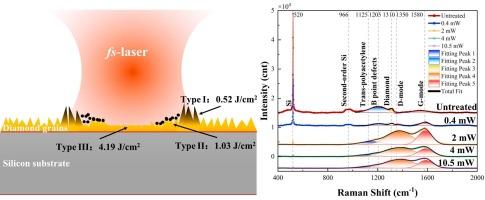
Diamond thin films have important applications in a wide range of fields. Nevertheless, their ultra-hard and ultra-thin nature imposes limitations on their machinability. The utilization of ultrafast lasers in the surface modification of diamond thin films has led to numerous significant applications. The present study investigates the properties of single-pulse femtosecond laser radiation on microcrystalline diamond (MCD) films and finds that the diamond films show three types of modifications, namely, nonablative graphitization, ablation, and ionization with the increase of laser energy, with the thresholds of 0.52 J/cm2 1.03 J/cm2 and 4.19 J/cm2, respectively. Furthermore, the irradiated area is characterized by an 'Arch-Crater-W like' feature. The high-pressure expanding plasma, which is generated during the ionization process, exerts a polishing effect on the diamond surface, resulting in a reduction of the surface roughness (Ra) to 5.6 nm and a decrease in the maximum profile peak height (Rp) by 61 %. Moreover, it has been established that femtosecond laser radiation of MCD films will shield the Raman signal of the silicon substrate, achieving an exponential reduction. The combination of these characteristics with the unique properties of femtosecond laser radiation diamond coatings suggests their potential for use in microelectronic packaging, surface modification of optical devices, biosensor manufacturing, and other fields, thereby demonstrating their unique value as a technological application.
期刊介绍:
Applied Surface Science covers topics contributing to a better understanding of surfaces, interfaces, nanostructures and their applications. The journal is concerned with scientific research on the atomic and molecular level of material properties determined with specific surface analytical techniques and/or computational methods, as well as the processing of such structures.




 京公网安备 11010802042870号
京ICP备2023020795号-1
京公网安备 11010802042870号
京ICP备2023020795号-1

 分享
分享
 求助内容:
求助内容: 应助结果提醒方式:
 扫码关注我们
