Lisa-Marie Kern, Vladyslav M. Kuchkin, Victor Deinhart, Christopher Klose, Themistoklis Sidiropoulos, Maike Auer, Simon Gaebel, Kathinka Gerlinger, Riccardo Battistelli, Steffen Wittrock, Tamer Karaman, Michael Schneider, Christian M. Günther, Dieter Engel, Ingo Will, Sebastian Wintz, Markus Weigand, Felix Büttner, Katja Höflich, Stefan Eisebitt, Bastian Pfau
{"title":"Controlled Formation of Skyrmion Bags","authors":"Lisa-Marie Kern, Vladyslav M. Kuchkin, Victor Deinhart, Christopher Klose, Themistoklis Sidiropoulos, Maike Auer, Simon Gaebel, Kathinka Gerlinger, Riccardo Battistelli, Steffen Wittrock, Tamer Karaman, Michael Schneider, Christian M. Günther, Dieter Engel, Ingo Will, Sebastian Wintz, Markus Weigand, Felix Büttner, Katja Höflich, Stefan Eisebitt, Bastian Pfau","doi":"10.1002/adma.202501250","DOIUrl":null,"url":null,"abstract":"<p>Topologically non-trivial magnetic solitons are complex spin textures with a distinct single-particle nature. Although magnetic skyrmions, especially those with unity topological charge, have attracted substantial interest due to their potential applications, more complex topological textures remain largely theoretical. In this work, the stabilization of isolated higher-order skyrmion bags beyond the prototypical π-skyrmion in ferromagnetic thin films is experimentally demonstrate, which has posed considerable challenges to date. Specifically, controlled generation of skyrmionium (2π-skyrmion), target skyrmion (3π-skyrmion), and skyrmion bags (with variable topological charge) are achieved through the introduction of artificially engineered anisotropy defects via local ion irradiation. They act as preferential sites for the field- or laser-induced nucleation of skyrmion bags. Remarkably, ultrafast laser pulses achieve a substantially higher conversion rate transforming skyrmions into higher-order skyrmion bags compared to their formation driven by magnetic fields. High-resolution x-ray imaging enables direct observation of the resulting skyrmion bags. Complementary micromagnetic simulations reveal the pivotal role of defect geometry–particularly diameter–in stabilizing closed-loop domain textures. The findings not only broaden the experimental horizon for skyrmion research, but also suggest strategies for exploiting complex topological spin textures within a unified material platform for practical applications.</p>","PeriodicalId":114,"journal":{"name":"Advanced Materials","volume":"37 29","pages":""},"PeriodicalIF":26.8000,"publicationDate":"2025-04-21","publicationTypes":"Journal Article","fieldsOfStudy":null,"isOpenAccess":false,"openAccessPdf":"https://onlinelibrary.wiley.com/doi/epdf/10.1002/adma.202501250","citationCount":"0","resultStr":null,"platform":"Semanticscholar","paperid":null,"PeriodicalName":"Advanced Materials","FirstCategoryId":"88","ListUrlMain":"https://advanced.onlinelibrary.wiley.com/doi/10.1002/adma.202501250","RegionNum":1,"RegionCategory":"材料科学","ArticlePicture":[],"TitleCN":null,"AbstractTextCN":null,"PMCID":null,"EPubDate":"","PubModel":"","JCR":"Q1","JCRName":"CHEMISTRY, MULTIDISCIPLINARY","Score":null,"Total":0}
引用次数: 0
Abstract
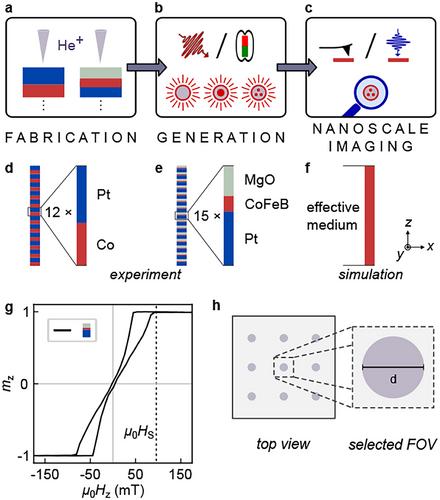
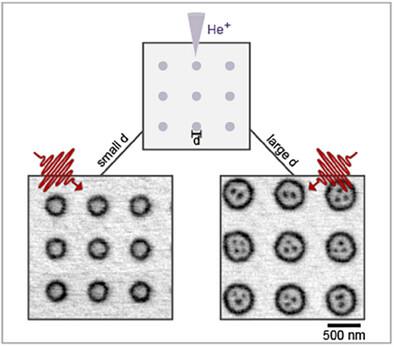
Topologically non-trivial magnetic solitons are complex spin textures with a distinct single-particle nature. Although magnetic skyrmions, especially those with unity topological charge, have attracted substantial interest due to their potential applications, more complex topological textures remain largely theoretical. In this work, the stabilization of isolated higher-order skyrmion bags beyond the prototypical π-skyrmion in ferromagnetic thin films is experimentally demonstrate, which has posed considerable challenges to date. Specifically, controlled generation of skyrmionium (2π-skyrmion), target skyrmion (3π-skyrmion), and skyrmion bags (with variable topological charge) are achieved through the introduction of artificially engineered anisotropy defects via local ion irradiation. They act as preferential sites for the field- or laser-induced nucleation of skyrmion bags. Remarkably, ultrafast laser pulses achieve a substantially higher conversion rate transforming skyrmions into higher-order skyrmion bags compared to their formation driven by magnetic fields. High-resolution x-ray imaging enables direct observation of the resulting skyrmion bags. Complementary micromagnetic simulations reveal the pivotal role of defect geometry–particularly diameter–in stabilizing closed-loop domain textures. The findings not only broaden the experimental horizon for skyrmion research, but also suggest strategies for exploiting complex topological spin textures within a unified material platform for practical applications.
期刊介绍:
Advanced Materials, one of the world's most prestigious journals and the foundation of the Advanced portfolio, is the home of choice for best-in-class materials science for more than 30 years. Following this fast-growing and interdisciplinary field, we are considering and publishing the most important discoveries on any and all materials from materials scientists, chemists, physicists, engineers as well as health and life scientists and bringing you the latest results and trends in modern materials-related research every week.






 京公网安备 11010802042870号
京ICP备2023020795号-1
京公网安备 11010802042870号
京ICP备2023020795号-1

 分享
分享
 求助内容:
求助内容: 应助结果提醒方式:
 扫码关注我们
