{"title":"Ultrahigh Piezoelectric Coefficients Achieved by Tailoring the Sequence and Nano-Domain Structure of P(VDF-TrFE)","authors":"Ba Qin, Guo-Tong Ding, Xiao-Yu Yang, Wen-Xuan Li, Yi-Jin He, An-Yi Ren, Wan-Li Xing, Shao-Bo Tan, Xiao-Yong Wei, Zhi-Cheng Zhang","doi":"10.1002/adma.202502708","DOIUrl":null,"url":null,"abstract":"<p>During past decades, the construction of morphotropic phase boundary (MPB) behavior in ceramic-based relaxor ferroelectrics has successfully led to a significant enhancement in the piezoelectric coefficient for actuators, transducers, and sensors application. However, MPB-like behavior is achieved only in the ferroelectric state in flexible ferroelectric polymers such as poly(vinylidene fluoride-trifluoroethylene) with the highest piezoelectric coefficients of ≈−63.5 pC/N, due to the lack of a rational design in polymer chain structure and composition. Here, the study reports the first MPB-like behavior observed in a relaxor ferroelectric polymer synthesized by fully hydrogenating poly(vinylidene fluoride-chlorotrifluoroethylene), which are primarily linked in a head-to-head/tail-to-tail manner, and trifluoroethylene units are randomly dispersed along the molecular chain. The unique polymer chain structure is found to be responsible for the formation of conformations disorder, thus strong relaxor behavior, and phase transition from an all<i>-trans</i> conformation to 3/1 helix, thus inducing phase boundary behavior. As a result, an outstanding longitudinal piezoelectric coefficient of −107 pC/N, more than five times higher than that of commercial poly(vinylidene fluoride) (−20 pC/N), is observed. This work opens up a new gate for next-generation high-performance flexible devices.</p>","PeriodicalId":114,"journal":{"name":"Advanced Materials","volume":"37 27","pages":""},"PeriodicalIF":26.8000,"publicationDate":"2025-04-21","publicationTypes":"Journal Article","fieldsOfStudy":null,"isOpenAccess":false,"openAccessPdf":"","citationCount":"0","resultStr":null,"platform":"Semanticscholar","paperid":null,"PeriodicalName":"Advanced Materials","FirstCategoryId":"88","ListUrlMain":"https://advanced.onlinelibrary.wiley.com/doi/10.1002/adma.202502708","RegionNum":1,"RegionCategory":"材料科学","ArticlePicture":[],"TitleCN":null,"AbstractTextCN":null,"PMCID":null,"EPubDate":"","PubModel":"","JCR":"Q1","JCRName":"CHEMISTRY, MULTIDISCIPLINARY","Score":null,"Total":0}
引用次数: 0
Abstract
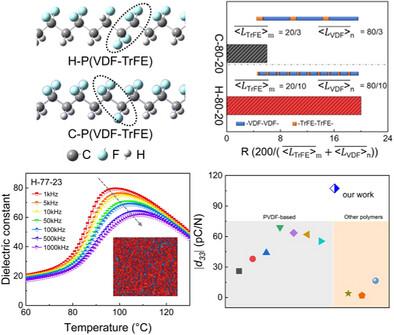
During past decades, the construction of morphotropic phase boundary (MPB) behavior in ceramic-based relaxor ferroelectrics has successfully led to a significant enhancement in the piezoelectric coefficient for actuators, transducers, and sensors application. However, MPB-like behavior is achieved only in the ferroelectric state in flexible ferroelectric polymers such as poly(vinylidene fluoride-trifluoroethylene) with the highest piezoelectric coefficients of ≈−63.5 pC/N, due to the lack of a rational design in polymer chain structure and composition. Here, the study reports the first MPB-like behavior observed in a relaxor ferroelectric polymer synthesized by fully hydrogenating poly(vinylidene fluoride-chlorotrifluoroethylene), which are primarily linked in a head-to-head/tail-to-tail manner, and trifluoroethylene units are randomly dispersed along the molecular chain. The unique polymer chain structure is found to be responsible for the formation of conformations disorder, thus strong relaxor behavior, and phase transition from an all-trans conformation to 3/1 helix, thus inducing phase boundary behavior. As a result, an outstanding longitudinal piezoelectric coefficient of −107 pC/N, more than five times higher than that of commercial poly(vinylidene fluoride) (−20 pC/N), is observed. This work opens up a new gate for next-generation high-performance flexible devices.
期刊介绍:
Advanced Materials, one of the world's most prestigious journals and the foundation of the Advanced portfolio, is the home of choice for best-in-class materials science for more than 30 years. Following this fast-growing and interdisciplinary field, we are considering and publishing the most important discoveries on any and all materials from materials scientists, chemists, physicists, engineers as well as health and life scientists and bringing you the latest results and trends in modern materials-related research every week.






 京公网安备 11010802042870号
京ICP备2023020795号-1
京公网安备 11010802042870号
京ICP备2023020795号-1

 分享
分享
 求助内容:
求助内容: 应助结果提醒方式:
 扫码关注我们
