Xuexia Gao , Binbin Li , Xiaohan Yuan , Yajing Yang , Min Lv , Zhishang Zhu , Jinfeng Song , Chengbo Gu
{"title":"Potential of pigeon pea [Cajanus cajan (L.) Millsp.] associated with endophytic bacterium Bacillus cereus PEB-9 to remediate cadmium-contaminated soil","authors":"Xuexia Gao , Binbin Li , Xiaohan Yuan , Yajing Yang , Min Lv , Zhishang Zhu , Jinfeng Song , Chengbo Gu","doi":"10.1016/j.jhazmat.2025.138344","DOIUrl":null,"url":null,"abstract":"<div><div>Phytoremediation associated with plant-beneficial bacteria has gained considerable attention for its efficiency in remediating cadmium (Cd)-contaminated soil. In this study, we isolated an endophytic bacterium, PEB-9, from pigeon pea, which was identified as <em>Bacillus cereus</em> and exhibited strong plant growth-promoting traits along with high Cd resistance <em>in vitro</em>. Pot experiments demonstrated that PEB-9 inoculation increased in pigeon pea biomass (11.45–19.29 %), Cd accumulation (43.89–69.90 %), and the Cd transfer factor (4.17–16.89 %) in Cd-stress soil (2–10 mg/kg), with soil remediation efficiency improving by 11.1–15.4 %. Under Cd stress, PEB-9-treated pigeon pea exhibited significant improvement in the activities of superoxide dismutase, peroxidase, and catalase, while a notable decrease in malondialdehyde content, indicating a reduction in Cd cytotoxicity. Additionally, the chlorophyll content in PEB-9-treated plants was significantly higher than that in the control group. Furthermore, PEB-9 inoculation enhanced bioavailable Cd, soil enzymes activity and nutrient content, including available nitrogen, phosphorus, and organic matter, while also boosting the relative abundance of stress-resistant bacterial groups, such as <em>Proteobacteria</em> and <em>Actinobacteria</em>. Correlation analysis indicated that soil nutrient changes induced by PEB-9 significantly influenced bacterial community structure, thereby regulating plant physiological responses, and improving Cd remediation efficacy of pigeon pea. These findings offer a valuable basis for the practical implementation of PEB-9 in remediating Cd-contaminated soils.</div></div>","PeriodicalId":361,"journal":{"name":"Journal of Hazardous Materials","volume":"493 ","pages":"Article 138344"},"PeriodicalIF":11.3000,"publicationDate":"2025-08-05","publicationTypes":"Journal Article","fieldsOfStudy":null,"isOpenAccess":false,"openAccessPdf":"","citationCount":"0","resultStr":null,"platform":"Semanticscholar","paperid":null,"PeriodicalName":"Journal of Hazardous Materials","FirstCategoryId":"93","ListUrlMain":"https://www.sciencedirect.com/science/article/pii/S0304389425012592","RegionNum":1,"RegionCategory":"环境科学与生态学","ArticlePicture":[],"TitleCN":null,"AbstractTextCN":null,"PMCID":null,"EPubDate":"2025/4/20 0:00:00","PubModel":"Epub","JCR":"Q1","JCRName":"ENGINEERING, ENVIRONMENTAL","Score":null,"Total":0}
引用次数: 0
Abstract
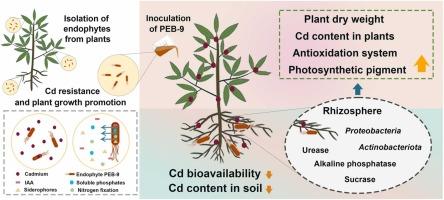
Phytoremediation associated with plant-beneficial bacteria has gained considerable attention for its efficiency in remediating cadmium (Cd)-contaminated soil. In this study, we isolated an endophytic bacterium, PEB-9, from pigeon pea, which was identified as Bacillus cereus and exhibited strong plant growth-promoting traits along with high Cd resistance in vitro. Pot experiments demonstrated that PEB-9 inoculation increased in pigeon pea biomass (11.45–19.29 %), Cd accumulation (43.89–69.90 %), and the Cd transfer factor (4.17–16.89 %) in Cd-stress soil (2–10 mg/kg), with soil remediation efficiency improving by 11.1–15.4 %. Under Cd stress, PEB-9-treated pigeon pea exhibited significant improvement in the activities of superoxide dismutase, peroxidase, and catalase, while a notable decrease in malondialdehyde content, indicating a reduction in Cd cytotoxicity. Additionally, the chlorophyll content in PEB-9-treated plants was significantly higher than that in the control group. Furthermore, PEB-9 inoculation enhanced bioavailable Cd, soil enzymes activity and nutrient content, including available nitrogen, phosphorus, and organic matter, while also boosting the relative abundance of stress-resistant bacterial groups, such as Proteobacteria and Actinobacteria. Correlation analysis indicated that soil nutrient changes induced by PEB-9 significantly influenced bacterial community structure, thereby regulating plant physiological responses, and improving Cd remediation efficacy of pigeon pea. These findings offer a valuable basis for the practical implementation of PEB-9 in remediating Cd-contaminated soils.
期刊介绍:
The Journal of Hazardous Materials serves as a global platform for promoting cutting-edge research in the field of Environmental Science and Engineering. Our publication features a wide range of articles, including full-length research papers, review articles, and perspectives, with the aim of enhancing our understanding of the dangers and risks associated with various materials concerning public health and the environment. It is important to note that the term "environmental contaminants" refers specifically to substances that pose hazardous effects through contamination, while excluding those that do not have such impacts on the environment or human health. Moreover, we emphasize the distinction between wastes and hazardous materials in order to provide further clarity on the scope of the journal. We have a keen interest in exploring specific compounds and microbial agents that have adverse effects on the environment.



 京公网安备 11010802042870号
京ICP备2023020795号-1
京公网安备 11010802042870号
京ICP备2023020795号-1

 分享
分享
 求助内容:
求助内容: 应助结果提醒方式:
 扫码关注我们
