Manganese-Doped Nanoparticles with Hypoxia-Inducible Factor 2α Inhibitor That Elicit Innate Immune Responses against von Hippel–Lindau Protein-Deficient Tumors
{"title":"Manganese-Doped Nanoparticles with Hypoxia-Inducible Factor 2α Inhibitor That Elicit Innate Immune Responses against von Hippel–Lindau Protein-Deficient Tumors","authors":"Yan Fang, Feiyang Shen, Rui Huang, Yao Lin, Yijia Wu, Qian Li, Zhu Xie, Xiaoyu Yang, Zhe Zhang, Xiaoliang Jin, Xianqun Fan, Jianfeng Shen","doi":"10.1021/acsnano.4c14277","DOIUrl":null,"url":null,"abstract":"The von Hippel–Lindau (VHL) tumor suppressor gene product, pVHL, is frequently deficient in a variety of human cancers. In addressing the treatment of pVHL-deficient tumors, hypoxia-inducible factor 2α (HIF-2α) has risen as a promising therapeutic target, culminating in the development of specific inhibitors like PT2385 and its analogues. Nonetheless, the absence of targeted delivery capabilities in these inhibitors heightens the risk of on-target toxicities. To mitigate these limitations, we have engineered a nanoparticle, termed PMMF (PT/MMSN@DSPE-PEG-FA), capable of delivering both a HIF-2α antagonist (PT2385) and manganese directly to tumor sites. PMMF has shown effective targeting of pVHL-deficient clear-cell renal cell carcinoma and melanoma, leading to significant therapeutic benefits and alleviating hypoxic and immunosuppressive traits of the tumor microenvironment. Functionally, PMMF boosts the cyclic GMP–AMP synthase–stimulator of interferon genes signaling pathway, which, in turn, stimulates a robust innate immune response. This response activates natural killer (NK) cells and CD8<sup>+</sup> T lymphocytes while curbing the infiltration of regulatory T cells. Notably, the therapeutic efficacy of PMMF is markedly reduced when NK cells are blocked but not affected by neutrophil blockade, highlighting the critical role of NK cells in PMMF-induced antitumor immunity. Additionally, the safety profile of PMMF showed minimal systemic post-treatment cytotoxicity. In summary, our findings position PMMF as a promising platform for treating tumors with pVHL deficiency and underscore the therapeutic potential of metalloimmunotherapy.","PeriodicalId":21,"journal":{"name":"ACS Nano","volume":"35 1","pages":""},"PeriodicalIF":16.0000,"publicationDate":"2025-04-21","publicationTypes":"Journal Article","fieldsOfStudy":null,"isOpenAccess":false,"openAccessPdf":"","citationCount":"0","resultStr":null,"platform":"Semanticscholar","paperid":null,"PeriodicalName":"ACS Nano","FirstCategoryId":"88","ListUrlMain":"https://doi.org/10.1021/acsnano.4c14277","RegionNum":1,"RegionCategory":"材料科学","ArticlePicture":[],"TitleCN":null,"AbstractTextCN":null,"PMCID":null,"EPubDate":"","PubModel":"","JCR":"Q1","JCRName":"CHEMISTRY, MULTIDISCIPLINARY","Score":null,"Total":0}
引用次数: 0
Abstract
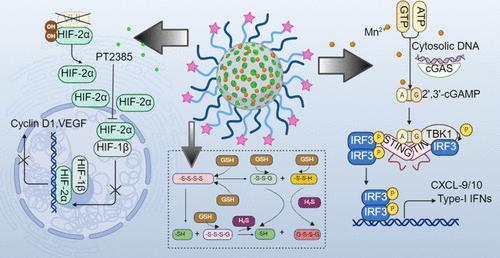
The von Hippel–Lindau (VHL) tumor suppressor gene product, pVHL, is frequently deficient in a variety of human cancers. In addressing the treatment of pVHL-deficient tumors, hypoxia-inducible factor 2α (HIF-2α) has risen as a promising therapeutic target, culminating in the development of specific inhibitors like PT2385 and its analogues. Nonetheless, the absence of targeted delivery capabilities in these inhibitors heightens the risk of on-target toxicities. To mitigate these limitations, we have engineered a nanoparticle, termed PMMF (PT/MMSN@DSPE-PEG-FA), capable of delivering both a HIF-2α antagonist (PT2385) and manganese directly to tumor sites. PMMF has shown effective targeting of pVHL-deficient clear-cell renal cell carcinoma and melanoma, leading to significant therapeutic benefits and alleviating hypoxic and immunosuppressive traits of the tumor microenvironment. Functionally, PMMF boosts the cyclic GMP–AMP synthase–stimulator of interferon genes signaling pathway, which, in turn, stimulates a robust innate immune response. This response activates natural killer (NK) cells and CD8+ T lymphocytes while curbing the infiltration of regulatory T cells. Notably, the therapeutic efficacy of PMMF is markedly reduced when NK cells are blocked but not affected by neutrophil blockade, highlighting the critical role of NK cells in PMMF-induced antitumor immunity. Additionally, the safety profile of PMMF showed minimal systemic post-treatment cytotoxicity. In summary, our findings position PMMF as a promising platform for treating tumors with pVHL deficiency and underscore the therapeutic potential of metalloimmunotherapy.
期刊介绍:
ACS Nano, published monthly, serves as an international forum for comprehensive articles on nanoscience and nanotechnology research at the intersections of chemistry, biology, materials science, physics, and engineering. The journal fosters communication among scientists in these communities, facilitating collaboration, new research opportunities, and advancements through discoveries. ACS Nano covers synthesis, assembly, characterization, theory, and simulation of nanostructures, nanobiotechnology, nanofabrication, methods and tools for nanoscience and nanotechnology, and self- and directed-assembly. Alongside original research articles, it offers thorough reviews, perspectives on cutting-edge research, and discussions envisioning the future of nanoscience and nanotechnology.



 京公网安备 11010802042870号
京ICP备2023020795号-1
京公网安备 11010802042870号
京ICP备2023020795号-1

 分享
分享
 求助内容:
求助内容: 应助结果提醒方式:
 扫码关注我们
