Junyeop Kim, Sumin Kim, Yerim Hwang, Saemin An, Jeonghyun Park, Yoo-Bin Kwon, Byounggook Cho, Daeyeol Kwon, Yunkyung Kim, Soi Kang, Young-Kwan Kim, Jongpil Kim
{"title":"Electromagnetized MXenes Enhance the Efficient Direct Reprogramming of Dopamine Neurons for Parkinson’s Disease Therapy","authors":"Junyeop Kim, Sumin Kim, Yerim Hwang, Saemin An, Jeonghyun Park, Yoo-Bin Kwon, Byounggook Cho, Daeyeol Kwon, Yunkyung Kim, Soi Kang, Young-Kwan Kim, Jongpil Kim","doi":"10.1021/acsnano.5c01457","DOIUrl":null,"url":null,"abstract":"MXenes, a two-dimensional transition metal carbide and nitride, have shown significant potential in various biological applications. In particular, the distinct properties of MXenes─including their functionalizable surface, biocompatibility, and conductive characteristics, make them highly promising materials for advancing biomedical technologies. Here, we report that MXene, under specific electromagnetic field (EMF) conditions, effectively promotes the direct lineage reprogramming of induced dopaminergic (iDA) neurons both <i>in vitro</i> and <i>in vivo</i>. Remarkably, we found that electromagnetized MXene leads to specific activation of histone acetylation during the induced dopaminergic neuronal reprogramming process and efficiently alleviates symptoms in a mouse model of Parkinson’s disease (PD). Moreover, MXene-mediated electromagnetic stimulation effectively promotes the direct reprogramming of human iDA neurons from skin fibroblasts. Therefore, our study highlights MXene’s application in cell reprogramming, offering promising advancements in regenerative medicine through improved efficiency and reliability.","PeriodicalId":21,"journal":{"name":"ACS Nano","volume":"126 1","pages":""},"PeriodicalIF":16.0000,"publicationDate":"2025-04-21","publicationTypes":"Journal Article","fieldsOfStudy":null,"isOpenAccess":false,"openAccessPdf":"","citationCount":"0","resultStr":null,"platform":"Semanticscholar","paperid":null,"PeriodicalName":"ACS Nano","FirstCategoryId":"88","ListUrlMain":"https://doi.org/10.1021/acsnano.5c01457","RegionNum":1,"RegionCategory":"材料科学","ArticlePicture":[],"TitleCN":null,"AbstractTextCN":null,"PMCID":null,"EPubDate":"","PubModel":"","JCR":"Q1","JCRName":"CHEMISTRY, MULTIDISCIPLINARY","Score":null,"Total":0}
引用次数: 0
Abstract
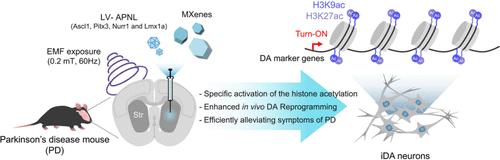
MXenes, a two-dimensional transition metal carbide and nitride, have shown significant potential in various biological applications. In particular, the distinct properties of MXenes─including their functionalizable surface, biocompatibility, and conductive characteristics, make them highly promising materials for advancing biomedical technologies. Here, we report that MXene, under specific electromagnetic field (EMF) conditions, effectively promotes the direct lineage reprogramming of induced dopaminergic (iDA) neurons both in vitro and in vivo. Remarkably, we found that electromagnetized MXene leads to specific activation of histone acetylation during the induced dopaminergic neuronal reprogramming process and efficiently alleviates symptoms in a mouse model of Parkinson’s disease (PD). Moreover, MXene-mediated electromagnetic stimulation effectively promotes the direct reprogramming of human iDA neurons from skin fibroblasts. Therefore, our study highlights MXene’s application in cell reprogramming, offering promising advancements in regenerative medicine through improved efficiency and reliability.
期刊介绍:
ACS Nano, published monthly, serves as an international forum for comprehensive articles on nanoscience and nanotechnology research at the intersections of chemistry, biology, materials science, physics, and engineering. The journal fosters communication among scientists in these communities, facilitating collaboration, new research opportunities, and advancements through discoveries. ACS Nano covers synthesis, assembly, characterization, theory, and simulation of nanostructures, nanobiotechnology, nanofabrication, methods and tools for nanoscience and nanotechnology, and self- and directed-assembly. Alongside original research articles, it offers thorough reviews, perspectives on cutting-edge research, and discussions envisioning the future of nanoscience and nanotechnology.



 京公网安备 11010802042870号
京ICP备2023020795号-1
京公网安备 11010802042870号
京ICP备2023020795号-1

 分享
分享
 求助内容:
求助内容: 应助结果提醒方式:
 扫码关注我们
