{"title":"High conductivity graphite paste for radio frequency identification tag with wireless hydrogen sensor based on CeO2–Fe2O3–graphene oxide†","authors":"Hossein Mojtabazadeh and Javad Safaei-Ghomi","doi":"10.1039/D5RA00587F","DOIUrl":null,"url":null,"abstract":"<p >Radio frequency identification (RFID) technology has made significant strides in recent years, opening up a world of possibilities for various industries. However, to achieve success, reliable and accurate real-time data is crucial. One exciting application of RFID technology is fast and wireless detection of gases. Hydrogen, in particular, is considered a clean fuel. However, it is highly flammable, and detecting it quickly and accurately is challenging in various industries. In this regard, our research focuses on developing a high-conductivity graphite paste for RFID tags integrated with a wireless hydrogen sensor based on nano-CeO<small><sub>2</sub></small>–Fe<small><sub>2</sub></small>O<small><sub>3</sub></small>–graphene oxide. In this work, we obtained a graphite paste using Ultra High Power (UHP) graphite electrodes with a high conductivity of 4.75 × 10<small><sup>5</sup></small> S cm<small><sup>−1</sup></small> for non-metallic substrates and 4 × 10<small><sup>6</sup></small> S cm<small><sup>−1</sup></small> with aluminum substrate. Furthermore, we incorporated a hydrogen gas detection sensor into the RFID tag utilizing graphene oxide and cerium oxide–iron oxide nanoparticles. The sensor demonstrated high sensitivity to low concentrations of H<small><sub>2</sub></small> gas (1 ppm), with stable and repeatable performance. The wireless sensing response was evaluated through reflection coefficient (<em>S</em><small><sub>11</sub></small>) measurements, confirming effective impedance matching between the RFID chip and antenna. Through this research, we aim to promote the advancement of RFID technology by introducing a low-cost, battery-free sensing platform using graphite and nano-engineered materials, suitable for diverse industrial applications.</p>","PeriodicalId":102,"journal":{"name":"RSC Advances","volume":" 16","pages":" 12773-12784"},"PeriodicalIF":4.6000,"publicationDate":"2025-04-22","publicationTypes":"Journal Article","fieldsOfStudy":null,"isOpenAccess":false,"openAccessPdf":"https://pubs.rsc.org/en/content/articlepdf/2025/ra/d5ra00587f?page=search","citationCount":"0","resultStr":null,"platform":"Semanticscholar","paperid":null,"PeriodicalName":"RSC Advances","FirstCategoryId":"92","ListUrlMain":"https://pubs.rsc.org/en/content/articlelanding/2025/ra/d5ra00587f","RegionNum":3,"RegionCategory":"化学","ArticlePicture":[],"TitleCN":null,"AbstractTextCN":null,"PMCID":null,"EPubDate":"","PubModel":"","JCR":"Q2","JCRName":"CHEMISTRY, MULTIDISCIPLINARY","Score":null,"Total":0}
引用次数: 0
Abstract
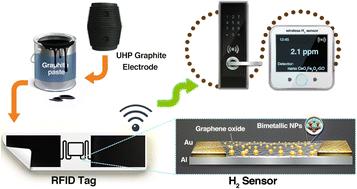
Radio frequency identification (RFID) technology has made significant strides in recent years, opening up a world of possibilities for various industries. However, to achieve success, reliable and accurate real-time data is crucial. One exciting application of RFID technology is fast and wireless detection of gases. Hydrogen, in particular, is considered a clean fuel. However, it is highly flammable, and detecting it quickly and accurately is challenging in various industries. In this regard, our research focuses on developing a high-conductivity graphite paste for RFID tags integrated with a wireless hydrogen sensor based on nano-CeO2–Fe2O3–graphene oxide. In this work, we obtained a graphite paste using Ultra High Power (UHP) graphite electrodes with a high conductivity of 4.75 × 10⁵ S cm−1 for non-metallic substrates and 4 × 10⁶ S cm−1 with aluminum substrate. Furthermore, we incorporated a hydrogen gas detection sensor into the RFID tag utilizing graphene oxide and cerium oxide–iron oxide nanoparticles. The sensor demonstrated high sensitivity to low concentrations of H2 gas (1 ppm), with stable and repeatable performance. The wireless sensing response was evaluated through reflection coefficient (S11) measurements, confirming effective impedance matching between the RFID chip and antenna. Through this research, we aim to promote the advancement of RFID technology by introducing a low-cost, battery-free sensing platform using graphite and nano-engineered materials, suitable for diverse industrial applications.
期刊介绍:
An international, peer-reviewed journal covering all of the chemical sciences, including multidisciplinary and emerging areas. RSC Advances is a gold open access journal allowing researchers free access to research articles, and offering an affordable open access publishing option for authors around the world.




 京公网安备 11010802042870号
京ICP备2023020795号-1
京公网安备 11010802042870号
京ICP备2023020795号-1

 分享
分享
 求助内容:
求助内容: 应助结果提醒方式:
 扫码关注我们
