In-source photocatalytic fragmentations of oligosaccharides in surface-assisted laser desorption/ionization mass spectrometry over titania nanoparticles
{"title":"In-source photocatalytic fragmentations of oligosaccharides in surface-assisted laser desorption/ionization mass spectrometry over titania nanoparticles","authors":"Takashi Fujita and Kohei Shibamoto","doi":"10.1039/D5RA00898K","DOIUrl":null,"url":null,"abstract":"<p >In this study, we investigated the fragmentation behavior of oligosaccharides, specifically α-cyclodextrin (α-CD) and maltohexaose, using TiO<small><sub>2</sub></small> nanoparticles as ionizing substrates in SALDI-MS. Both compounds exhibited selective fragmentation at glycosidic bonds, with characteristic fragment ions for α-CD observed at <em>m</em>/<em>z</em> = 835, 673, 511, and 349. Similar fragmentation patterns were obtained with other metal oxide semiconductors (ZnO, Fe<small><sub>2</sub></small>O<small><sub>3</sub></small>, WO<small><sub>3</sub></small>), while non-oxide semiconductors (CdS, CdSe) showed no fragmentation or molecular ion signals. The suppression of fragmentation upon glucose addition suggests the involvement of photoinduced holes, indicating that charge separation and oxide properties of the substrate contribute to the reaction. These findings demonstrate that SALDI-MS using oxide semiconductors enables controlled fragmentation of oligosaccharides and offers potential for structural analysis of glycans and photocatalytic surface reaction studies.</p>","PeriodicalId":102,"journal":{"name":"RSC Advances","volume":" 16","pages":" 12785-12790"},"PeriodicalIF":4.6000,"publicationDate":"2025-04-22","publicationTypes":"Journal Article","fieldsOfStudy":null,"isOpenAccess":false,"openAccessPdf":"https://pubs.rsc.org/en/content/articlepdf/2025/ra/d5ra00898k?page=search","citationCount":"0","resultStr":null,"platform":"Semanticscholar","paperid":null,"PeriodicalName":"RSC Advances","FirstCategoryId":"92","ListUrlMain":"https://pubs.rsc.org/en/content/articlelanding/2025/ra/d5ra00898k","RegionNum":3,"RegionCategory":"化学","ArticlePicture":[],"TitleCN":null,"AbstractTextCN":null,"PMCID":null,"EPubDate":"","PubModel":"","JCR":"Q2","JCRName":"CHEMISTRY, MULTIDISCIPLINARY","Score":null,"Total":0}
引用次数: 0
Abstract
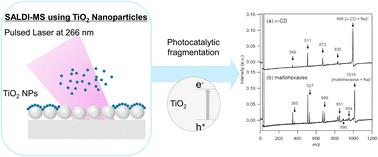
In this study, we investigated the fragmentation behavior of oligosaccharides, specifically α-cyclodextrin (α-CD) and maltohexaose, using TiO2 nanoparticles as ionizing substrates in SALDI-MS. Both compounds exhibited selective fragmentation at glycosidic bonds, with characteristic fragment ions for α-CD observed at m/z = 835, 673, 511, and 349. Similar fragmentation patterns were obtained with other metal oxide semiconductors (ZnO, Fe2O3, WO3), while non-oxide semiconductors (CdS, CdSe) showed no fragmentation or molecular ion signals. The suppression of fragmentation upon glucose addition suggests the involvement of photoinduced holes, indicating that charge separation and oxide properties of the substrate contribute to the reaction. These findings demonstrate that SALDI-MS using oxide semiconductors enables controlled fragmentation of oligosaccharides and offers potential for structural analysis of glycans and photocatalytic surface reaction studies.
期刊介绍:
An international, peer-reviewed journal covering all of the chemical sciences, including multidisciplinary and emerging areas. RSC Advances is a gold open access journal allowing researchers free access to research articles, and offering an affordable open access publishing option for authors around the world.



 京公网安备 11010802042870号
京ICP备2023020795号-1
京公网安备 11010802042870号
京ICP备2023020795号-1

 分享
分享
 求助内容:
求助内容: 应助结果提醒方式:
 扫码关注我们
