{"title":"In situ reduced gold nanoparticles in PDMS contact lenses for color blindness management†","authors":"M. Aravind, Haider Butt and Sajan Daniel George","doi":"10.1039/D4RA08879D","DOIUrl":null,"url":null,"abstract":"<p >Color vision deficiency, or color blindness, is an ocular condition in which individuals have difficulty distinguishing between certain colors. While there is currently no cure for this condition, various wearables can be used to improve the color perception of those affected. The most common wearables used are color-filtering glasses and lenses, which filter out the problematic wavelengths. The most prevalent form of color vision deficiency is red-green color blindness. In this study, gold nanoparticles were <em>in situ</em> reduced onto contact lens material, forming plasmonic contact lenses targeted for red-green color blindness management. The absorption of the plasmonic particles, which peaked at around 533 nm, filtered out specific wavelengths to significantly enhance the color perception of both deuteranopia and protanopia. The study also presented an approach of imaging through the plasmonic lenses, followed by color blindness vision simulation to replicate a colorblind individual's vision. When combined with the Ishihara test, this approach proved to effectively improve color perception with the use of plasmonic contact lenses. The study presents a facile method for creating stable, hydrophilic plasmonic contact lenses to manage color blindness. It also offers a unique way to simulate the impact of color filtering on the vision of individuals with color blindness.</p>","PeriodicalId":102,"journal":{"name":"RSC Advances","volume":" 16","pages":" 12765-12772"},"PeriodicalIF":4.6000,"publicationDate":"2025-04-22","publicationTypes":"Journal Article","fieldsOfStudy":null,"isOpenAccess":false,"openAccessPdf":"https://pubs.rsc.org/en/content/articlepdf/2025/ra/d4ra08879d?page=search","citationCount":"0","resultStr":null,"platform":"Semanticscholar","paperid":null,"PeriodicalName":"RSC Advances","FirstCategoryId":"92","ListUrlMain":"https://pubs.rsc.org/en/content/articlelanding/2025/ra/d4ra08879d","RegionNum":3,"RegionCategory":"化学","ArticlePicture":[],"TitleCN":null,"AbstractTextCN":null,"PMCID":null,"EPubDate":"","PubModel":"","JCR":"Q2","JCRName":"CHEMISTRY, MULTIDISCIPLINARY","Score":null,"Total":0}
引用次数: 0
Abstract
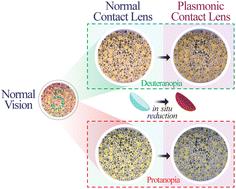
Color vision deficiency, or color blindness, is an ocular condition in which individuals have difficulty distinguishing between certain colors. While there is currently no cure for this condition, various wearables can be used to improve the color perception of those affected. The most common wearables used are color-filtering glasses and lenses, which filter out the problematic wavelengths. The most prevalent form of color vision deficiency is red-green color blindness. In this study, gold nanoparticles were in situ reduced onto contact lens material, forming plasmonic contact lenses targeted for red-green color blindness management. The absorption of the plasmonic particles, which peaked at around 533 nm, filtered out specific wavelengths to significantly enhance the color perception of both deuteranopia and protanopia. The study also presented an approach of imaging through the plasmonic lenses, followed by color blindness vision simulation to replicate a colorblind individual's vision. When combined with the Ishihara test, this approach proved to effectively improve color perception with the use of plasmonic contact lenses. The study presents a facile method for creating stable, hydrophilic plasmonic contact lenses to manage color blindness. It also offers a unique way to simulate the impact of color filtering on the vision of individuals with color blindness.
期刊介绍:
An international, peer-reviewed journal covering all of the chemical sciences, including multidisciplinary and emerging areas. RSC Advances is a gold open access journal allowing researchers free access to research articles, and offering an affordable open access publishing option for authors around the world.



 京公网安备 11010802042870号
京ICP备2023020795号-1
京公网安备 11010802042870号
京ICP备2023020795号-1

 分享
分享
 求助内容:
求助内容: 应助结果提醒方式:
 扫码关注我们
