Mohamed Mustafa, Emmanuel I. Epelle, Andrew Macfarlane, Michael Cusack, Anthony Burns and Mohammed Yaseen
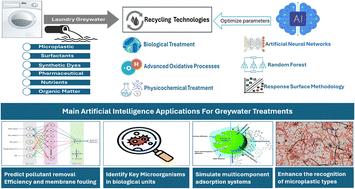
{"title":"Innovative approaches to greywater micropollutant removal: AI-driven solutions and future outlook","authors":"Mohamed Mustafa, Emmanuel I. Epelle, Andrew Macfarlane, Michael Cusack, Anthony Burns and Mohammed Yaseen","doi":"10.1039/D5RA00489F","DOIUrl":null,"url":null,"abstract":"<p >Greywater constitutes a significant portion of urban wastewater and is laden with numerous emerging contaminants that have the potential to adversely impact public health and the ecosystem. Understanding greywater's characteristics and measuring the contamination levels is crucial for designing an effective recycling system. However, wastewater treatment is an intricate process involving significant uncertainties, leading to variations in effluent quality, costs, and environmental risks. This review addresses the existing knowledge gap in utilising artificial intelligence (AI) to enhance the laundry greywater recycling process and elucidates the optimal treatment technologies for the most prevalent micropollutants, including microplastics, nutrients, surfactants, synthetic dyes, pharmaceuticals, and organic matter. The development of laundry greywater treatment technologies is also highlighted with a critical discussion of physicochemical, biological, and advanced oxidation processes (AOPs) based on their functions, methods, associated limitations, and future trends. Artificial neural networks (ANN) stand out as the most prevalent and extensively applied AI model in the domain of wastewater treatment. Utilising ANN models mitigates certain limitations inherent in traditional adsorption models, particularly by offering enhanced predictive accuracy under varied operating conditions and multicomponent adsorption systems. Moreover, tremendous success has been recorded with the random forest (RF) model, exhibiting 100% prediction accuracy for both sessile and effluent microbial communities within a bioreactor. The precise prediction or simulation of membrane fouling behaviours using AI techniques is also of paramount importance for understanding fouling mechanisms and formulating efficient strategies to mitigate membrane fouling.</p>","PeriodicalId":102,"journal":{"name":"RSC Advances","volume":" 16","pages":" 12125-12151"},"PeriodicalIF":4.6000,"publicationDate":"2025-04-22","publicationTypes":"Journal Article","fieldsOfStudy":null,"isOpenAccess":false,"openAccessPdf":"https://pubs.rsc.org/en/content/articlepdf/2025/ra/d5ra00489f?page=search","citationCount":"0","resultStr":null,"platform":"Semanticscholar","paperid":null,"PeriodicalName":"RSC Advances","FirstCategoryId":"92","ListUrlMain":"https://pubs.rsc.org/en/content/articlelanding/2025/ra/d5ra00489f","RegionNum":3,"RegionCategory":"化学","ArticlePicture":[],"TitleCN":null,"AbstractTextCN":null,"PMCID":null,"EPubDate":"","PubModel":"","JCR":"Q2","JCRName":"CHEMISTRY, MULTIDISCIPLINARY","Score":null,"Total":0}
引用次数: 0
Abstract
Greywater constitutes a significant portion of urban wastewater and is laden with numerous emerging contaminants that have the potential to adversely impact public health and the ecosystem. Understanding greywater's characteristics and measuring the contamination levels is crucial for designing an effective recycling system. However, wastewater treatment is an intricate process involving significant uncertainties, leading to variations in effluent quality, costs, and environmental risks. This review addresses the existing knowledge gap in utilising artificial intelligence (AI) to enhance the laundry greywater recycling process and elucidates the optimal treatment technologies for the most prevalent micropollutants, including microplastics, nutrients, surfactants, synthetic dyes, pharmaceuticals, and organic matter. The development of laundry greywater treatment technologies is also highlighted with a critical discussion of physicochemical, biological, and advanced oxidation processes (AOPs) based on their functions, methods, associated limitations, and future trends. Artificial neural networks (ANN) stand out as the most prevalent and extensively applied AI model in the domain of wastewater treatment. Utilising ANN models mitigates certain limitations inherent in traditional adsorption models, particularly by offering enhanced predictive accuracy under varied operating conditions and multicomponent adsorption systems. Moreover, tremendous success has been recorded with the random forest (RF) model, exhibiting 100% prediction accuracy for both sessile and effluent microbial communities within a bioreactor. The precise prediction or simulation of membrane fouling behaviours using AI techniques is also of paramount importance for understanding fouling mechanisms and formulating efficient strategies to mitigate membrane fouling.
期刊介绍:
An international, peer-reviewed journal covering all of the chemical sciences, including multidisciplinary and emerging areas. RSC Advances is a gold open access journal allowing researchers free access to research articles, and offering an affordable open access publishing option for authors around the world.




 京公网安备 11010802042870号
京ICP备2023020795号-1
京公网安备 11010802042870号
京ICP备2023020795号-1

 分享
分享
 求助内容:
求助内容: 应助结果提醒方式:
 扫码关注我们
