William Meza-Morales, Sahimy Ayus-Martinez, Jesus Jimenez-Osorio, Maria Buendia-Otero, Luis López, David Suleiman, Edu Suarez, Donald O. Freytes, Lisandro Cunci and Camilo Mora
{"title":"Functionalized screen-printed electrodes for non-invasive detection of vascular-endothelial cadherin in extracellular vesicles†","authors":"William Meza-Morales, Sahimy Ayus-Martinez, Jesus Jimenez-Osorio, Maria Buendia-Otero, Luis López, David Suleiman, Edu Suarez, Donald O. Freytes, Lisandro Cunci and Camilo Mora","doi":"10.1039/D4RA08926J","DOIUrl":null,"url":null,"abstract":"<p >In this study, we developed a biosensor using a gold screen-printed electrode (Au-SPE) functionalized with mercaptoundecanoic acid (MUA) and an antibody for detecting the vascular-endothelial cadherin (CD144) as a endothelial biomarker protein on extracellular vesicles (EVs) isolated from saliva. The MUA functionalization provides a stable platform for immobilizing the CD144 antibody, ensuring the detection of the target protein. This biosensor combines Au-SPE technology with an immunoassay, offering a rapid, sensitive, and non-invasive method for detection of CD144 carried by EVs. Characterization of saliva-derived EVs using transmission electron microscopy (TEM) and nanoparticle tracking analysis (NTA) confirmed their morphology and size, which fell within the expected range of 80–180 nm. NTA indicated a lower concentration of particles in saliva-EVs than in serum-EVs (controls), highlighting the need for sensitive detection of EV cargos in this type of EV. Immunodetection confirmed the presence of CD144 in both saliva and serum-derived EVs, with higher concentrations in serum. Functionalization of Au-SPEs with MUA and CD144 antibodies was confirmed by significant resistance changes, and atomic force microscopy (AFM) was used to verify the preservation of EV morphology and their capturing post-immune adsorption. A calibration curve demonstrated the high sensitivity of the biosensor prototype for detecting CD144-positive EVs, with a limit of detection (LOD) of 0.111 ng mL<small><sup>−1</sup></small> and a limit of quantification (LOQ) of 0.37 ng mL<small><sup>−1</sup></small>, requiring only 3 μL of EV-sample. This biosensor shows potential as a novel method for detecting and studying endothelial biomarkers associated with cardiovascular disease in EVs isolated from saliva, a capability not currently available with existing tools. Furthermore, it provides a key platform for expanding research to other biomarkers and diseases by monitoring protein cargos in the EVs, enhancing its utility across diverse clinical applications.</p>","PeriodicalId":102,"journal":{"name":"RSC Advances","volume":" 16","pages":" 12609-12621"},"PeriodicalIF":4.6000,"publicationDate":"2025-04-22","publicationTypes":"Journal Article","fieldsOfStudy":null,"isOpenAccess":false,"openAccessPdf":"https://pubs.rsc.org/en/content/articlepdf/2025/ra/d4ra08926j?page=search","citationCount":"0","resultStr":null,"platform":"Semanticscholar","paperid":null,"PeriodicalName":"RSC Advances","FirstCategoryId":"92","ListUrlMain":"https://pubs.rsc.org/en/content/articlelanding/2025/ra/d4ra08926j","RegionNum":3,"RegionCategory":"化学","ArticlePicture":[],"TitleCN":null,"AbstractTextCN":null,"PMCID":null,"EPubDate":"","PubModel":"","JCR":"Q2","JCRName":"CHEMISTRY, MULTIDISCIPLINARY","Score":null,"Total":0}
引用次数: 0
Abstract
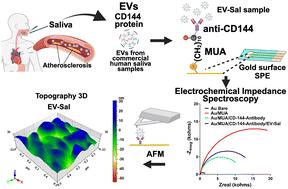
In this study, we developed a biosensor using a gold screen-printed electrode (Au-SPE) functionalized with mercaptoundecanoic acid (MUA) and an antibody for detecting the vascular-endothelial cadherin (CD144) as a endothelial biomarker protein on extracellular vesicles (EVs) isolated from saliva. The MUA functionalization provides a stable platform for immobilizing the CD144 antibody, ensuring the detection of the target protein. This biosensor combines Au-SPE technology with an immunoassay, offering a rapid, sensitive, and non-invasive method for detection of CD144 carried by EVs. Characterization of saliva-derived EVs using transmission electron microscopy (TEM) and nanoparticle tracking analysis (NTA) confirmed their morphology and size, which fell within the expected range of 80–180 nm. NTA indicated a lower concentration of particles in saliva-EVs than in serum-EVs (controls), highlighting the need for sensitive detection of EV cargos in this type of EV. Immunodetection confirmed the presence of CD144 in both saliva and serum-derived EVs, with higher concentrations in serum. Functionalization of Au-SPEs with MUA and CD144 antibodies was confirmed by significant resistance changes, and atomic force microscopy (AFM) was used to verify the preservation of EV morphology and their capturing post-immune adsorption. A calibration curve demonstrated the high sensitivity of the biosensor prototype for detecting CD144-positive EVs, with a limit of detection (LOD) of 0.111 ng mL−1 and a limit of quantification (LOQ) of 0.37 ng mL−1, requiring only 3 μL of EV-sample. This biosensor shows potential as a novel method for detecting and studying endothelial biomarkers associated with cardiovascular disease in EVs isolated from saliva, a capability not currently available with existing tools. Furthermore, it provides a key platform for expanding research to other biomarkers and diseases by monitoring protein cargos in the EVs, enhancing its utility across diverse clinical applications.
在这项研究中,我们开发了一种生物传感器,使用巯基十四酸(MUA)功能化的金丝网印刷电极(Au-SPE)和一种抗体,用于检测从唾液中分离的细胞外囊泡(ev)上作为内皮生物标记蛋白的血管内皮钙粘蛋白(CD144)。MUA功能化为CD144抗体的固定化提供了稳定的平台,保证了靶蛋白的检测。这种生物传感器结合了Au-SPE技术和免疫分析法,为检测ev携带的CD144提供了一种快速、敏感和无创的方法。利用透射电子显微镜(TEM)和纳米颗粒跟踪分析(NTA)对唾液源性电动汽车进行了表征,证实了它们的形态和尺寸在80-180 nm的预期范围内。NTA显示唾液EV中的颗粒浓度低于血清EV(对照组),强调需要对这类EV的EV货物进行敏感检测。免疫检测证实,唾液和血清来源的EVs中均存在CD144,血清中浓度较高。通过明显的抗性变化证实了au - spe与MUA和CD144抗体的功能化,并使用原子力显微镜(AFM)验证了EV形态的保存及其捕获后的免疫吸附。标定曲线表明,该传感器样品检测cd144阳性ev具有较高的灵敏度,检测限(LOD)为0.111 ng mL−1,定量限(LOQ)为0.37 ng mL−1,仅需3 μL ev样品。这种生物传感器有望成为一种检测和研究唾液中分离的ev中与心血管疾病相关的内皮生物标志物的新方法,这是目前现有工具无法实现的。此外,它还提供了一个关键平台,通过监测电动汽车中的蛋白质货物,将研究扩展到其他生物标志物和疾病,增强其在各种临床应用中的效用。
期刊介绍:
An international, peer-reviewed journal covering all of the chemical sciences, including multidisciplinary and emerging areas. RSC Advances is a gold open access journal allowing researchers free access to research articles, and offering an affordable open access publishing option for authors around the world.



 京公网安备 11010802042870号
京ICP备2023020795号-1
京公网安备 11010802042870号
京ICP备2023020795号-1

 分享
分享
 求助内容:
求助内容: 应助结果提醒方式:
 扫码关注我们
