Multifunctionality of Cellulose Multiwall Carbon Nanotube Composites in Polar Aprotic and Polar Protic Solvents

IF 2.8 3区 化学 Q2 POLYMER SCIENCE Journal of Applied Polymer Science Pub Date : 2025-02-23 DOI:10.1002/app.56913
Fred Elhi, Quoc Bao Le, Rudolf Kiefer
{"title":"Multifunctionality of Cellulose Multiwall Carbon Nanotube Composites in Polar Aprotic and Polar Protic Solvents","authors":"Fred Elhi,&nbsp;Quoc Bao Le,&nbsp;Rudolf Kiefer","doi":"10.1002/app.56913","DOIUrl":null,"url":null,"abstract":"<div>\n \n <p>More and more focus nowadays is laid on renewable “green” and smart materials. In this work, we want to demonstrate the multifunctional properties of cellulose (<span>CE</span>) with multiwall carbon nanotubes (MWCNTs) fiber (50 wt.% multiwall carbon nanotubes). Linear actuation of <span>CE</span>-MWCNTs fiber at the potential range 0.7 to −0.2 V in different solvents with the same concentration of bis(trifluoromethane) sulfonimide lithium salt (LiTFSI) revealed that the polar aprotic solvents propylene carbonate (PC), acetonitrile (ACN), and dimethyl sulfoxide (DMSO) had the main expansion at discharging. The main expansion occurred at charging in polar protic solvents such as water (Aq) and ethylene glycol (EG). Chronopotentiometric measurements of <span>CE</span>-MWCNTs fiber were performed and showed the best specific capacitance in PC solvent of 102.7 mF cm<sup>−2</sup> (±0.082 mA cm<sup>−2</sup>) with specific capacity retention of 83% (±3.82 mA cm<sup>−2</sup>). The sensor calibration revealed that the four different solvents can be distinguished. Characterization of <span>CE</span>-MWCNTs fiber is performed in scanning electron microscopy (SEM). Energy dispersive X-ray (EDX) spectroscopy was performed to investigate the element content after actuation cycles. Raman and FTIR spectroscopy are conducted to evaluate the composition of fiber <span>CE</span>-MWCNTs.</p>\n </div>","PeriodicalId":183,"journal":{"name":"Journal of Applied Polymer Science","volume":"142 21","pages":""},"PeriodicalIF":2.8000,"publicationDate":"2025-02-23","publicationTypes":"Journal Article","fieldsOfStudy":null,"isOpenAccess":false,"openAccessPdf":"","citationCount":"0","resultStr":null,"platform":"Semanticscholar","paperid":null,"PeriodicalName":"Journal of Applied Polymer Science","FirstCategoryId":"92","ListUrlMain":"https://onlinelibrary.wiley.com/doi/10.1002/app.56913","RegionNum":3,"RegionCategory":"化学","ArticlePicture":[],"TitleCN":null,"AbstractTextCN":null,"PMCID":null,"EPubDate":"","PubModel":"","JCR":"Q2","JCRName":"POLYMER SCIENCE","Score":null,"Total":0}
引用次数: 0

Abstract

More and more focus nowadays is laid on renewable “green” and smart materials. In this work, we want to demonstrate the multifunctional properties of cellulose (CE) with multiwall carbon nanotubes (MWCNTs) fiber (50 wt.% multiwall carbon nanotubes). Linear actuation of CE-MWCNTs fiber at the potential range 0.7 to −0.2 V in different solvents with the same concentration of bis(trifluoromethane) sulfonimide lithium salt (LiTFSI) revealed that the polar aprotic solvents propylene carbonate (PC), acetonitrile (ACN), and dimethyl sulfoxide (DMSO) had the main expansion at discharging. The main expansion occurred at charging in polar protic solvents such as water (Aq) and ethylene glycol (EG). Chronopotentiometric measurements of CE-MWCNTs fiber were performed and showed the best specific capacitance in PC solvent of 102.7 mF cm−2 (±0.082 mA cm−2) with specific capacity retention of 83% (±3.82 mA cm−2). The sensor calibration revealed that the four different solvents can be distinguished. Characterization of CE-MWCNTs fiber is performed in scanning electron microscopy (SEM). Energy dispersive X-ray (EDX) spectroscopy was performed to investigate the element content after actuation cycles. Raman and FTIR spectroscopy are conducted to evaluate the composition of fiber CE-MWCNTs.

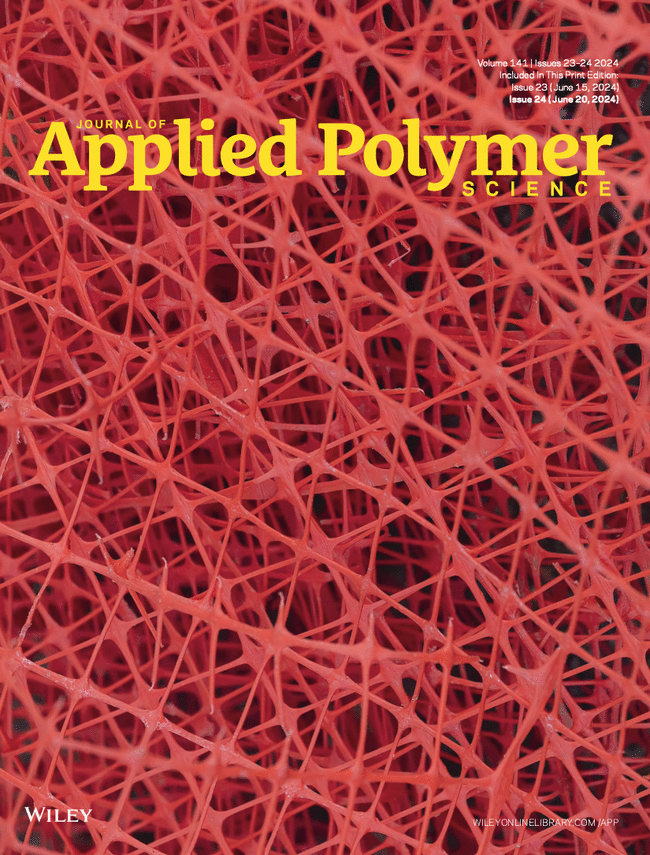
Abstract Image

查看原文
分享 分享
微信好友 朋友圈 QQ好友 复制链接
本刊更多论文
纤维素多壁碳纳米管复合材料在极性非质子和极性质子溶剂中的多功能性
如今,人们越来越关注可再生 "绿色 "智能材料。在这项工作中,我们希望展示纤维素(CE)与多壁碳纳米管(MWCNTs)纤维(50 wt.%多壁碳纳米管)的多功能特性。在相同浓度的双(三氟甲烷)磺酰亚胺锂盐(LiTFSI)的不同溶剂中,CE-MWCNTs 纤维在 0.7 至 -0.2 V 的电位范围内的线性驱动表明,极性非烷基溶剂碳酸丙烯酯(PC)、乙腈(ACN)和二甲基亚砜(DMSO)在放电时主要发生膨胀。在极性原生溶剂(如水(Aq)和乙二醇(EG))中充电时主要发生膨胀。对 CE-MWCNTs 纤维进行了慢电位测量,结果表明在 PC 溶剂中的比电容最好,为 102.7 mF cm-2(±0.082 mA cm-2),比容量保持率为 83%(±3.82 mA cm-2)。传感器校准结果表明,四种不同的溶剂均可区分。扫描电子显微镜(SEM)对 CE-MWCNTs 纤维进行了表征。能量色散 X 射线(EDX)光谱用于研究致动周期后的元素含量。拉曼光谱和傅立叶变换红外光谱用于评估 CE-MWCNTs 纤维的成分。
本文章由计算机程序翻译,如有差异,请以英文原文为准。
求助全文
约1分钟内获得全文 去求助
来源期刊
Journal of Applied Polymer Science
Journal of Applied Polymer Science 化学-高分子科学
CiteScore
5.70
自引率
10.00%
发文量
1280
审稿时长
2.7 months
期刊介绍: The Journal of Applied Polymer Science is the largest peer-reviewed publication in polymers, #3 by total citations, and features results with real-world impact on membranes, polysaccharides, and much more.
期刊最新文献
Editorial Board, Aims & Scope, Table of Contents Editorial Board, Aims & Scope, Table of Contents Editorial Board, Aims & Scope, Table of Contents Editorial Board, Aims & Scope, Table of Contents CO2, Fiber, and UV Direct Laser Writing of Graphene for Flexible EMI Shielding Applications: A Comparative Study
×
引用
GB/T 7714-2015
复制
MLA
复制
APA
复制
导出至
BibTeX EndNote RefMan NoteFirst NoteExpress
×
×
提示
您的信息不完整,为了账户安全,请先补充。
现在去补充
×
提示
您因"违规操作"
具体请查看互助需知
我知道了
×
提示
现在去查看 取消
×
提示
确定
0
微信
客服QQ
Book学术公众号 扫码关注我们
反馈
×
意见反馈
请填写您的意见或建议
请填写您的手机或邮箱
已复制链接
已复制链接
快去分享给好友吧!
我知道了
×
扫码分享
扫码分享
Book学术官方微信
Book学术文献互助
Book学术文献互助群
群 号:604180095
Book学术
文献互助 智能选刊 最新文献 互助须知 联系我们:info@booksci.cn
Book学术提供免费学术资源搜索服务,方便国内外学者检索中英文文献。致力于提供最便捷和优质的服务体验。
Copyright © 2023 Book学术 All rights reserved.
ghs 京公网安备 11010802042870号 京ICP备2023020795号-1





