{"title":"Influence of Sulfur Precursor Reactivity on Size-Controlled and Optical Properties of CdS Nanocrystals","authors":"Nguyen Minh Hoa","doi":"10.1002/slct.202500203","DOIUrl":null,"url":null,"abstract":"<p>This study investigates the synthesis of cadmium sulfide (CdS) nanocrystals (NCs) using a hot-injection method, focusing on how sulfur precursor reactivity, controlled by its preparation temperature, influences the final nanomaterial properties. The sulfur precursor was prepared at three temperatures (120, 140, and 180 °C) to modulate its reactivity. Transmission electron microscopy, UV–vis spectroscopy, and photoluminescence spectroscopy were employed to characterize the size, morphology, and optical properties of the resulting CdS NCs. We found a clear correlation between the sulfur precursor preparation temperature and the CdS nanocrystal properties. The precursor prepared at 140 °C resulted in the most homogeneous growth, leading to the smallest size distribution and highest quality NCs, as evidenced by the higher PL intensity. The precursor prepared at 180 °C resulted in a faster growth rate, ultimately leading to larger NCs with inhomogeneous morphologies, while the 120 °C precursor exhibited the slowest growth rate, producing larger particles with a wider size distribution. These findings underscore the significant role of sulfur precursor preparation temperature in controlling the final CdS nanocrystal material properties, offering valuable insights for the tailored synthesis of high-quality CdS nanomaterials for diverse applications.</p>","PeriodicalId":146,"journal":{"name":"ChemistrySelect","volume":"10 16","pages":""},"PeriodicalIF":2.0000,"publicationDate":"2025-04-22","publicationTypes":"Journal Article","fieldsOfStudy":null,"isOpenAccess":false,"openAccessPdf":"","citationCount":"0","resultStr":null,"platform":"Semanticscholar","paperid":null,"PeriodicalName":"ChemistrySelect","FirstCategoryId":"92","ListUrlMain":"https://chemistry-europe.onlinelibrary.wiley.com/doi/10.1002/slct.202500203","RegionNum":4,"RegionCategory":"化学","ArticlePicture":[],"TitleCN":null,"AbstractTextCN":null,"PMCID":null,"EPubDate":"","PubModel":"","JCR":"Q3","JCRName":"CHEMISTRY, MULTIDISCIPLINARY","Score":null,"Total":0}
引用次数: 0
Abstract
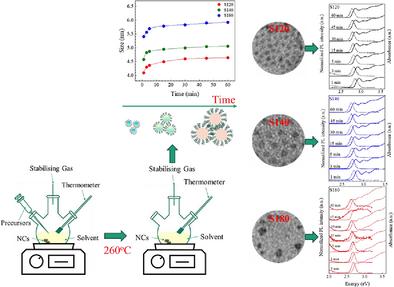
This study investigates the synthesis of cadmium sulfide (CdS) nanocrystals (NCs) using a hot-injection method, focusing on how sulfur precursor reactivity, controlled by its preparation temperature, influences the final nanomaterial properties. The sulfur precursor was prepared at three temperatures (120, 140, and 180 °C) to modulate its reactivity. Transmission electron microscopy, UV–vis spectroscopy, and photoluminescence spectroscopy were employed to characterize the size, morphology, and optical properties of the resulting CdS NCs. We found a clear correlation between the sulfur precursor preparation temperature and the CdS nanocrystal properties. The precursor prepared at 140 °C resulted in the most homogeneous growth, leading to the smallest size distribution and highest quality NCs, as evidenced by the higher PL intensity. The precursor prepared at 180 °C resulted in a faster growth rate, ultimately leading to larger NCs with inhomogeneous morphologies, while the 120 °C precursor exhibited the slowest growth rate, producing larger particles with a wider size distribution. These findings underscore the significant role of sulfur precursor preparation temperature in controlling the final CdS nanocrystal material properties, offering valuable insights for the tailored synthesis of high-quality CdS nanomaterials for diverse applications.
期刊介绍:
ChemistrySelect is the latest journal from ChemPubSoc Europe and Wiley-VCH. It offers researchers a quality society-owned journal in which to publish their work in all areas of chemistry. Manuscripts are evaluated by active researchers to ensure they add meaningfully to the scientific literature, and those accepted are processed quickly to ensure rapid online publication.





 京公网安备 11010802042870号
京ICP备2023020795号-1
京公网安备 11010802042870号
京ICP备2023020795号-1

 分享
分享
 求助内容:
求助内容: 应助结果提醒方式:
 扫码关注我们
