Xinzhe Xue, Zhen Liu, Swetha Chandrasekaran, Samuel Eisenberg, Curtis Althaus, Megan C. Freyman, Anica Pinongcos, Qiu Ren, Logan Valdovinos, Cathleen Hsieh, Bintao Hu, Bruce Dunn, Christine A. Orme, Xiao Wang, Marcus A. Worsley, Yat Li
{"title":"Interface-Controlled Redox Chemistry in Aqueous Mn2⁺/MnO₂ Batteries","authors":"Xinzhe Xue, Zhen Liu, Swetha Chandrasekaran, Samuel Eisenberg, Curtis Althaus, Megan C. Freyman, Anica Pinongcos, Qiu Ren, Logan Valdovinos, Cathleen Hsieh, Bintao Hu, Bruce Dunn, Christine A. Orme, Xiao Wang, Marcus A. Worsley, Yat Li","doi":"10.1002/adma.202419505","DOIUrl":null,"url":null,"abstract":"<p>Manganese dioxide (MnO<sub>2</sub>) deposition/dissolution (Mn<sup>2+</sup>/MnO<sub>2</sub>) chemistry, involving a two-electron-transfer process, holds promise for safe and eco-friendly large-scale energy storage. However, challenges like electrode/electrolyte interface environment fluctuations (H<sup>+</sup> and H<sub>2</sub>O activity), irreversible Mn degradation, and limited understanding of degradation mechanisms hinder the reversibility of the Mn<sup>2+</sup>/MnO<sub>2</sub> conversion. This study demonstrates a vanadyl/pervanadyl (VO<sup>2+</sup>/VO<sub>2</sub><sup>+</sup>) redox-mediated interface designed for high-energy Mn<sup>2+</sup>/MnO<sub>2</sub> batteries. Unlike flow systems, this work uncovers, for the first time, the mechanism of a static redox-mediated interface in regulating interfacial H<sup>+</sup> and H<sub>2</sub>O activities. Significantly, the VO<sup>2+</sup>/VO<sub>2</sub><sup>+</sup> chemical redox mediation targets Mn<sup>3+</sup> intermediates, suppressing their hydrolysis and enabling 100% Mn<sup>2+</sup>/MnO<sub>2</sub> conversion. The redox-mediated interface enhances the Mn redox electron transfer process, achieving a stable ≈95% coulombic efficiency and ultrahigh capacity of 100 mAh cm<sup>−</sup><sup>2</sup> with an areal energy density of 111 mWh cm<sup>−</sup><sup>2</sup>, outperforming flow systems. The electrode also exhibits an average specific capacity of 593 mAh g<sup>−1</sup>, approaching the theoretical limit of 616 mAh g<sup>−1</sup>, and a specific energy density of 721 Wh kg<sup>−1</sup> at high MnO<sub>2</sub> loadings (50–150 mg cm<sup>−2</sup>). The findings highlight the critical role of interfacial redox mediation in regulating H<sup>+</sup> and H<sub>2</sub>O activities and underscore the significance of interface dynamics.</p>","PeriodicalId":114,"journal":{"name":"Advanced Materials","volume":"37 28","pages":""},"PeriodicalIF":26.8000,"publicationDate":"2025-04-21","publicationTypes":"Journal Article","fieldsOfStudy":null,"isOpenAccess":false,"openAccessPdf":"","citationCount":"0","resultStr":null,"platform":"Semanticscholar","paperid":null,"PeriodicalName":"Advanced Materials","FirstCategoryId":"88","ListUrlMain":"https://advanced.onlinelibrary.wiley.com/doi/10.1002/adma.202419505","RegionNum":1,"RegionCategory":"材料科学","ArticlePicture":[],"TitleCN":null,"AbstractTextCN":null,"PMCID":null,"EPubDate":"","PubModel":"","JCR":"Q1","JCRName":"CHEMISTRY, MULTIDISCIPLINARY","Score":null,"Total":0}
引用次数: 0
Abstract
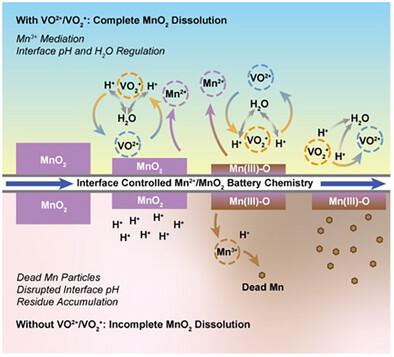
Manganese dioxide (MnO2) deposition/dissolution (Mn2+/MnO2) chemistry, involving a two-electron-transfer process, holds promise for safe and eco-friendly large-scale energy storage. However, challenges like electrode/electrolyte interface environment fluctuations (H+ and H2O activity), irreversible Mn degradation, and limited understanding of degradation mechanisms hinder the reversibility of the Mn2+/MnO2 conversion. This study demonstrates a vanadyl/pervanadyl (VO2+/VO2+) redox-mediated interface designed for high-energy Mn2+/MnO2 batteries. Unlike flow systems, this work uncovers, for the first time, the mechanism of a static redox-mediated interface in regulating interfacial H+ and H2O activities. Significantly, the VO2+/VO2+ chemical redox mediation targets Mn3+ intermediates, suppressing their hydrolysis and enabling 100% Mn2+/MnO2 conversion. The redox-mediated interface enhances the Mn redox electron transfer process, achieving a stable ≈95% coulombic efficiency and ultrahigh capacity of 100 mAh cm−2 with an areal energy density of 111 mWh cm−2, outperforming flow systems. The electrode also exhibits an average specific capacity of 593 mAh g−1, approaching the theoretical limit of 616 mAh g−1, and a specific energy density of 721 Wh kg−1 at high MnO2 loadings (50–150 mg cm−2). The findings highlight the critical role of interfacial redox mediation in regulating H+ and H2O activities and underscore the significance of interface dynamics.
二氧化锰(MnO2)沉积/溶解(Mn2+/MnO2)化学过程涉及双电子转移过程,有望实现安全和环保的大规模储能。然而,诸如电极/电解质界面环境波动(H+和H2O活性),不可逆的Mn降解以及对降解机制的有限理解等挑战阻碍了Mn2+/MnO2转化的可逆性。本研究展示了一种设计用于高能Mn2+/MnO2电池的钒基/过钒基(VO2+/VO2+)氧化还原介导界面。与流动系统不同,这项工作首次揭示了静态氧化还原介导的界面调节界面H+和H2O活性的机制。值得注意的是,VO2+/VO2+化学氧化还原介质以Mn3+中间体为目标,抑制它们的水解,实现100%的Mn2+/MnO2转化。氧化还原介导的界面增强了Mn氧化还原电子传递过程,实现了稳定的约95%的库仑效率和100 mAh cm - 2的超高容量,面能密度为111 mWh cm - 2,优于流动体系。该电极的平均比容量为593 mAh g−1,接近616 mAh g−1的理论极限,在高MnO2负载(50-150 mg cm−2)下的比能量密度为721 Wh kg−1。这些发现强调了界面氧化还原调解在调节H+和H2O活性中的关键作用,并强调了界面动力学的重要性。
期刊介绍:
Advanced Materials, one of the world's most prestigious journals and the foundation of the Advanced portfolio, is the home of choice for best-in-class materials science for more than 30 years. Following this fast-growing and interdisciplinary field, we are considering and publishing the most important discoveries on any and all materials from materials scientists, chemists, physicists, engineers as well as health and life scientists and bringing you the latest results and trends in modern materials-related research every week.







 京公网安备 11010802042870号
京ICP备2023020795号-1
京公网安备 11010802042870号
京ICP备2023020795号-1

 分享
分享
 求助内容:
求助内容: 应助结果提醒方式:
 扫码关注我们
