{"title":"Electrical Control of the Nuclear Spin States of Rare-Earth Adatoms","authors":"Homa Karimi, Aleksander L. Wysocki, Kyungwha Park","doi":"10.1021/acsnano.4c16416","DOIUrl":null,"url":null,"abstract":"Rare-earth adatoms on surfaces have been studied for potential atomic-scale magnetic storage, quantum sensing, and quantum computing applications. Despite accumulating experimental efforts, a comprehensive description of the electronic configurations of the adatoms remains elusive. Here, we investigate two charge states and several electronic configurations, including 5d and 6s valence shells, for a Sm adatom on a MgO substrate using multiconfigurational <i>ab initio</i> methods, for the possibility of using the Sm nuclear spin levels as qubits. For the configurations in a neutral charge state, we find that the electronic ground state is a singlet, and thus the hyperfine interaction associated with the <sup>147</sup>Sm nucleus is absent, which may greatly enhance nuclear spin coherence time. The degeneracy of the nuclear levels is lifted by the nuclear quadrupole interaction. We show that the splitting of the nuclear levels can be controlled by a static electric field, and that Rabi oscillations between the nuclear levels can be induced by a time-dependent electric field. For the configurations in a singly charged state, electronic Kramers doublets are formed. The electronic configurations including an unpaired 6s orbital exhibit a strong hyperfine Stark effect due to a large Fermi contact contribution to the hyperfine interaction. In these configurations, electric-field-induced Rabi oscillations between the electronic-nuclear levels can occur at frequencies up to 3 orders of magnitude higher than those for the neutral charge state. The proposed system may be experimentally observed within scanning tunneling microscopy.","PeriodicalId":21,"journal":{"name":"ACS Nano","volume":"17 1","pages":""},"PeriodicalIF":16.0000,"publicationDate":"2025-04-21","publicationTypes":"Journal Article","fieldsOfStudy":null,"isOpenAccess":false,"openAccessPdf":"","citationCount":"0","resultStr":null,"platform":"Semanticscholar","paperid":null,"PeriodicalName":"ACS Nano","FirstCategoryId":"88","ListUrlMain":"https://doi.org/10.1021/acsnano.4c16416","RegionNum":1,"RegionCategory":"材料科学","ArticlePicture":[],"TitleCN":null,"AbstractTextCN":null,"PMCID":null,"EPubDate":"","PubModel":"","JCR":"Q1","JCRName":"CHEMISTRY, MULTIDISCIPLINARY","Score":null,"Total":0}
引用次数: 0
Abstract
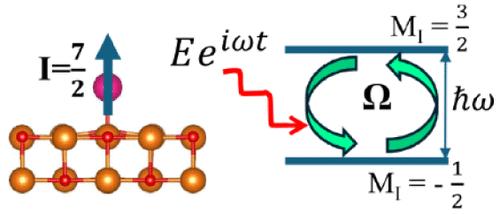
Rare-earth adatoms on surfaces have been studied for potential atomic-scale magnetic storage, quantum sensing, and quantum computing applications. Despite accumulating experimental efforts, a comprehensive description of the electronic configurations of the adatoms remains elusive. Here, we investigate two charge states and several electronic configurations, including 5d and 6s valence shells, for a Sm adatom on a MgO substrate using multiconfigurational ab initio methods, for the possibility of using the Sm nuclear spin levels as qubits. For the configurations in a neutral charge state, we find that the electronic ground state is a singlet, and thus the hyperfine interaction associated with the 147Sm nucleus is absent, which may greatly enhance nuclear spin coherence time. The degeneracy of the nuclear levels is lifted by the nuclear quadrupole interaction. We show that the splitting of the nuclear levels can be controlled by a static electric field, and that Rabi oscillations between the nuclear levels can be induced by a time-dependent electric field. For the configurations in a singly charged state, electronic Kramers doublets are formed. The electronic configurations including an unpaired 6s orbital exhibit a strong hyperfine Stark effect due to a large Fermi contact contribution to the hyperfine interaction. In these configurations, electric-field-induced Rabi oscillations between the electronic-nuclear levels can occur at frequencies up to 3 orders of magnitude higher than those for the neutral charge state. The proposed system may be experimentally observed within scanning tunneling microscopy.
人们一直在研究表面上的稀土金刚石,以便将其用于潜在的原子尺度磁存储、量子传感和量子计算应用。尽管实验方面的努力不断积累,但对金刚原子电子构型的全面描述仍然遥遥无期。在这里,我们使用多构型 ab initio 方法研究了氧化镁基底上 Sm 金刚原子的两种电荷态和几种电子构型,包括 5d 和 6s 价层,以探讨将 Sm 核自旋水平用作量子比特的可能性。对于中性电荷态的构型,我们发现电子基态是单线态,因此不存在与 147Sm 核相关的超细相互作用,这可能会大大提高核自旋相干时间。核四极相互作用解除了核级的退变性。我们的研究表明,核级的分裂可以由静态电场控制,而核级之间的拉比振荡可以由随时间变化的电场诱导。对于单电荷态的构型,会形成电子克拉默二重态。由于费米接触对超细相互作用的贡献很大,包括一个未成对的 6s 轨道在内的电子构型表现出很强的超细斯塔克效应。在这些构型中,电场诱导的电子核级之间的拉比振荡频率可比中性电荷态的频率高出 3 个数量级。所提出的系统可以通过扫描隧道显微镜进行实验观察。
期刊介绍:
ACS Nano, published monthly, serves as an international forum for comprehensive articles on nanoscience and nanotechnology research at the intersections of chemistry, biology, materials science, physics, and engineering. The journal fosters communication among scientists in these communities, facilitating collaboration, new research opportunities, and advancements through discoveries. ACS Nano covers synthesis, assembly, characterization, theory, and simulation of nanostructures, nanobiotechnology, nanofabrication, methods and tools for nanoscience and nanotechnology, and self- and directed-assembly. Alongside original research articles, it offers thorough reviews, perspectives on cutting-edge research, and discussions envisioning the future of nanoscience and nanotechnology.



 京公网安备 11010802042870号
京ICP备2023020795号-1
京公网安备 11010802042870号
京ICP备2023020795号-1

 分享
分享
 求助内容:
求助内容: 应助结果提醒方式:
 扫码关注我们
