Huang Yu , Dandan Zhang , Rui Xiong , Shengwei Liu , Ruiwen Hu , Pubo Chen , Xiaoyan Wu , Hantong Zou , Nan Hu , Dexin Ding , Qingyun Yan , Zhili He
{"title":"Soil-dependent responses of bacterial communities, phosphorus and carbon turnover to uranium stress in different soil ecosystems","authors":"Huang Yu , Dandan Zhang , Rui Xiong , Shengwei Liu , Ruiwen Hu , Pubo Chen , Xiaoyan Wu , Hantong Zou , Nan Hu , Dexin Ding , Qingyun Yan , Zhili He","doi":"10.1016/j.jhazmat.2025.138383","DOIUrl":null,"url":null,"abstract":"<div><div>Uranium (U) can impact microbially driven soil phosphorus (P) and carbon (C) cycling. However, the response of microbial P and C turnover to U in different soils is not well understood. Through the quantitative assay of P pools and soil organic C (SOC) quantitative assay and sequencing of 16S rRNA gene amplicons and metagenomes, we investigated the effect of U on P and C biotransformation in grassland (GL), paddy soil (PY), forest soil (FT). U (60 mg kg<sup>−1</sup>) impacted the diversity, interaction and stability of soil bacterial communities, leading to a decrease in available P (AP). Under U stress, organophosphate mineralization substantially contributed to the AP in GL and FT, whereas intracellular P metabolism dominated the AP in PY. Also, the reductive citrate cycle (rTCA cycle) promoted the content of SOC in GL, while the rTCA cycle and complex organic C degradation pathways enhanced the SOC in PY and FT, respectively. Notably, functional bacteria carrying organic C degradation genes could decompose SOC to enhance soil AP. Bacteria developed various resistance strategies to cope with U stress. This study reveals soil-dependent response of microbial P and C cycling and its ecological functions under the influence of radioactive contaminants in different soil systems.</div></div>","PeriodicalId":361,"journal":{"name":"Journal of Hazardous Materials","volume":"493 ","pages":"Article 138383"},"PeriodicalIF":11.3000,"publicationDate":"2025-08-05","publicationTypes":"Journal Article","fieldsOfStudy":null,"isOpenAccess":false,"openAccessPdf":"","citationCount":"0","resultStr":null,"platform":"Semanticscholar","paperid":null,"PeriodicalName":"Journal of Hazardous Materials","FirstCategoryId":"93","ListUrlMain":"https://www.sciencedirect.com/science/article/pii/S0304389425012981","RegionNum":1,"RegionCategory":"环境科学与生态学","ArticlePicture":[],"TitleCN":null,"AbstractTextCN":null,"PMCID":null,"EPubDate":"2025/4/22 0:00:00","PubModel":"Epub","JCR":"Q1","JCRName":"ENGINEERING, ENVIRONMENTAL","Score":null,"Total":0}
引用次数: 0
Abstract
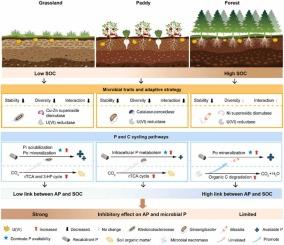
Uranium (U) can impact microbially driven soil phosphorus (P) and carbon (C) cycling. However, the response of microbial P and C turnover to U in different soils is not well understood. Through the quantitative assay of P pools and soil organic C (SOC) quantitative assay and sequencing of 16S rRNA gene amplicons and metagenomes, we investigated the effect of U on P and C biotransformation in grassland (GL), paddy soil (PY), forest soil (FT). U (60 mg kg−1) impacted the diversity, interaction and stability of soil bacterial communities, leading to a decrease in available P (AP). Under U stress, organophosphate mineralization substantially contributed to the AP in GL and FT, whereas intracellular P metabolism dominated the AP in PY. Also, the reductive citrate cycle (rTCA cycle) promoted the content of SOC in GL, while the rTCA cycle and complex organic C degradation pathways enhanced the SOC in PY and FT, respectively. Notably, functional bacteria carrying organic C degradation genes could decompose SOC to enhance soil AP. Bacteria developed various resistance strategies to cope with U stress. This study reveals soil-dependent response of microbial P and C cycling and its ecological functions under the influence of radioactive contaminants in different soil systems.
期刊介绍:
The Journal of Hazardous Materials serves as a global platform for promoting cutting-edge research in the field of Environmental Science and Engineering. Our publication features a wide range of articles, including full-length research papers, review articles, and perspectives, with the aim of enhancing our understanding of the dangers and risks associated with various materials concerning public health and the environment. It is important to note that the term "environmental contaminants" refers specifically to substances that pose hazardous effects through contamination, while excluding those that do not have such impacts on the environment or human health. Moreover, we emphasize the distinction between wastes and hazardous materials in order to provide further clarity on the scope of the journal. We have a keen interest in exploring specific compounds and microbial agents that have adverse effects on the environment.



 京公网安备 11010802042870号
京ICP备2023020795号-1
京公网安备 11010802042870号
京ICP备2023020795号-1

 分享
分享
 求助内容:
求助内容: 应助结果提醒方式:
 扫码关注我们
